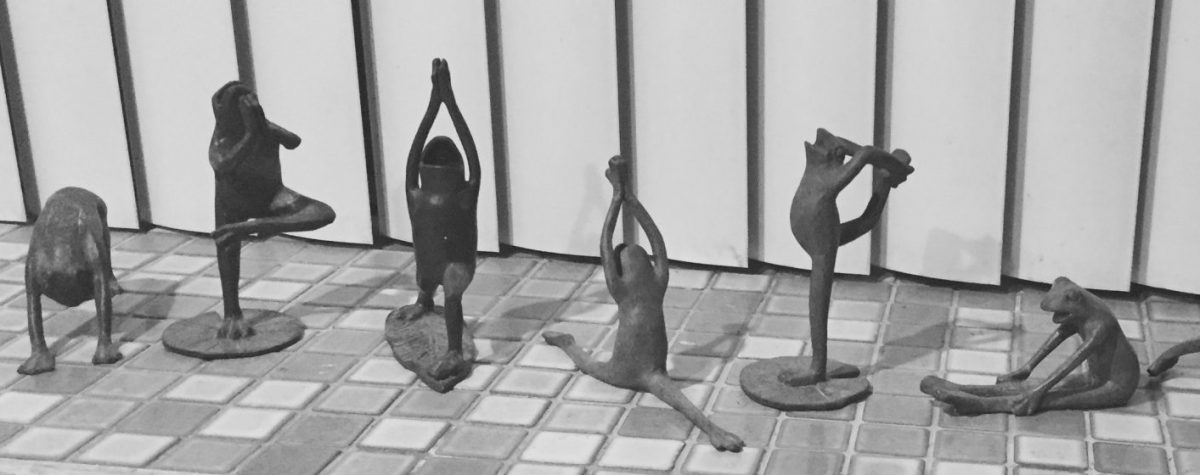
Disciplined and dedicated practice or learning
“Just performing the āsanas is one aspect of sādhana, but to understand one’s own body, mind and breath through the practice is another aspect; this has to be clearly understood by each practitioner. Often, one thinks of either limiting the freedom of the body movements because of fear and/or pain, or one attempts to break the limits using willpower in a wrong way, thus resulting in injury. When the body is unprepared, both these approaches are wrong. In fact, asana is a process to look into oneself.”
“Often, one thinks of the inner journey for the sake of self-realization. However, as the inner journey begins, one has to look at the first object, the first instrument – the body – which otherwise is neglected totally. We know the body as we have read and studied about it in school. However, this study of our anatomy and physiology gives us an objective knowledge of the body. Many hidden depths and sensitivities like the precise and judicious stretching of the arms ad legs remain unknown to the practitioner. The opening of the palms and the bottom of the feet of the sole-skin is not understood at all as there is no awareness.”
“Moreover, the thoracic tilts or extending the abdominal band remains unknown. The inverted position of the body remains absolutely beyond one’s imagination. Normally, one lacks the courage to move, stretch, twist, bend or balance and go topsy-turvy. Faith and courage are required to do so. Every action has its effect somewhere, which has to be searched and noticed.”
Yoga in Action: Intermediate Course, Dr. Geeta Iyengar
 Rafael Durán