by Michelle Goldberg (The New Yorker, Aug. 23, 2014)
In contemporary yoga classes, teachers often speak of Patañjali’s Yoga Sūtras, a philosophical text compiled around two thousand years ago, as the wellspring of the practice. This requires an imaginative leap, because the yoga sutras say next to nothing about physical poses; their overriding concern is the workings of the mind. Yoga, the sutras say, “is the restriction of the fluctuations of consciousness.” The total of their guidance about posture is that it should be “steady and comfortable.”
Instructions for postures, or āsana, appeared much later, in medieval tantra-inflected texts, such as the Haṭha Yoga Pradīpikā. Even in those works, however, you won’t find many of the positions taught today as yoga. Fifteen poses appear in the Haṭha Yoga Pradīpikā, most of them seated or supine. There are no sun salutations, no downward-facing dogs, or warriors. There are instructions for drawing discharged semen back into the penis, so as to overcome death, and for severing the tendon connecting the tongue to the bottom of the mouth, and lengthening it so that it can touch the forehead.
Until the twentieth century, educated Indians and Westerners alike tended to disdain the occult practices denoted by the term haṭha yoga. “We have nothing to do with it here, because its practices are very difficult and cannot be learnt in a day, and, after all, do not lead to much spiritual growth,” wrote Swami Vivekananda, who did much to popularize yoga philosophy in the West with his 1896 book, Raja Yoga. Only in the modern era has haṭha yoga been transformed into a wholesome, accessible regimen for health and well-being. A central figure in this transformation was B.K.S. Iyengar, the author of the 1966 yoga bible Light on Yoga, who died this week at the age of ninety-five.
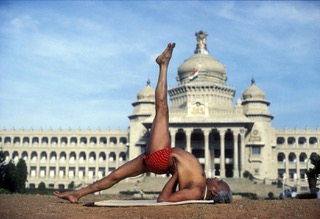
I met Iyengar in 2010, at his institute in Pune, a city about a hundred miles south of Mumbai, where students from all over the world travelled to study with the revered yoga master. I’d gone there to interview him for my book about Indra Devi, an actress born in Russia, who’d studied with Iyengar’s brother-in-law [and teacher], the guru Śri Tirumalai Krishnamacharya. Iyengar sat at the head of a table in a windowless basement library surrounded by Western students bent over research and translation projects. With his mane of white hair and intense, laughing eyes topped by bushy caterpillar brows, he seemed, in his nineties, impossibly vital, as if he had actually discovered a yogic method for cheating death.
Iyengar was the eleventh of thirteen children born into a poor South Indian family; after his father’s death, when he was eight years old, they neared destitution. Before Iyengar found yoga, he said many times, he was a sickly boy, enervated by tropical diseases. “My sisters and sisters-in-law used to say that my head would hang down on a repulsive body in such a way that they never touched me on account of my appearance,” he wrote in the essay My Yogic Journey. He left secondary school after failing an exam and losing his scholarship, and never received further education.
When Iyengar was sixteen, in 1934, he was sent to live with his sister and her husband, Krishnamacharya, in Mysore, a green, temperate city not far from Bangalore. He arrived at a time of enormous ferment in the development of modern yoga. Indian nationalists were particularly taken with the global vogue for ‘physical culture,’ in part because British domination was often justified in terms of physical superiority. As the nationalist movement gained steam and Indians turned away from foreign imports— replacing Western clothing with homespun khadi cloth, for example—nationalists found in the old haṭha yoga the basis for a physical culture that was distinctly Indian. Krishnamacharya, a brilliant scholar who had sacrificed respectability to pursue the outré path of haṭha yoga, was at the forefront of this renaissance. At the invitation of the progressive Maharaja of Mysore, a patron of traditional Indian arts and an avid sportsman, he ran a yoga shala at the palace, where he taught yogic physical culture to royal boys.
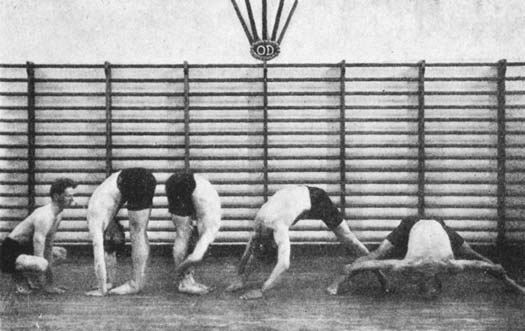
The system that Krishnamacharya created there drew on haṭha yoga, as well as traditional Indian wrestling and gymnastics, British Army calisthenics and, according to the scholar Mark Singleton, the Danish educator Niels Bukh’s ‘primitive gymnastics.’ It included sun salutations and standing postures, such as the triangle pose, that don’t appear in any ancient yogic text. In his 2010 book, Yoga Body: The Origins of Modern Posture Practice, Singleton concludes that Krishnamacharya’s method was “a synthesis of several extant methods of physical training that [prior to this period] would have fallen well outside any definition of yoga.”
Krishnamacharya could be fierce and demanding. “Guruji had a frightful personality,” Iyengar wrote. “He would hit us hard on our backs as if with iron rods. We were unable to forget the severity of his actions for a long time. My sister also was not spared from such blows.” Soon after Iyengar arrived, Krishnamacharya’s top pupil ran away, just days before a Y.M.C.A. conference at the palace that was to include an āsana recital. Needing someone to demonstrate, Krishnamacharya recruited his young relative, demanding that he learn a series of difficult poses [in a short period of time]. Though weak and stiff, Iyengar did his best to comply, injuring himself badly but impressing the audience. After that, he often demonstrated for his brother-in-law.
Krishnamacharya, eager to proselytize, eventually sent Iyengar to teach [at] colleges and gymnasiums in Pune. Iyengar worked hard as an instructor, afraid that, if he failed, he’d have to return to his brother-in-law. He knew from experience the dangers of forcing oneself into poses prematurely, and he set about developing a slower, more anatomically precise type of yoga, using props like blocks and blankets to help students find correct alignment. At once challenging and therapeutic, his [method of] yoga would become hugely popular in the West, thanks in large part to the assistance of the violinist Yehudi Menuhin.

Menuhin, who’d developed an interest in yoga after finding a book about it in an osteopath’s waiting room, met Iyengar while on tour in India in 1952. Iyengar’s teachings had a profound effect on him; in a 1953 Life magazine story called Yehudi’s Yoga, he said that yoga had led to a breakthrough in his art, and was even more important to him than violin practice. Menuhin introduced Iyengar to the Standard Oil heiress Rebekah Harkness, who brought him to Rhode Island for six weeks in 1956. Life photographed Iyengar instructing her family in seated forward bends and shoulder stands, and showed him performing a difficult forearm balance while perched on a low wall overlooking the sea. The article was headlined “A New Twist for Society.”
Iyengar doesn’t get all the credit for making yoga safe for society ladies; two of Krishnamacharya’s other students helped to disseminate yoga as we know it. Devi, the actress, who taught Hollywood stars like Greta Garbo and Gloria Swanson, was for a time known as the First Lady of Yoga. K. Pattabhi Jois, who began studying with Krishnamacharya as a boy and remained devoted to him all his life, created the vigorous ashṭaṅga [vinyāsa] system, the prototype for power yoga.
No other yoga teacher, however, was as influential as Iyengar. His Light on Yoga, with a foreword by Menuhin, remains unparallelled as a guide to āsana practice. As a Yoga Journal tribute put it, when “teachers refer to the correct way to do a posture, they’re usually alluding to the alignment Mr. Iyengar instructs and expertly models in his book.” In Light on Yoga, Iyengar describes yoga as a “timeless pragmatic science evolved over thousands of years dealing with the physical, moral, mental and spiritual well-being of man as a whole,” and calls Patañjali’s Yoga Sūtras the “first book to systematize this practice.” The desire to imbue his methods with ancient authority is understandable, but Iyengar was too modest. It was he, not any ancient sage, who figured out how to show people the world over the safest way to stand on their heads.
https://www.newyorker.com/business/currency/iyengar-invention-yoga
 Rafael Durán