Iyengar on Backward Extensions:

“Backbends are are like a third eye.”

Backbends [backward extensions] are not taught at the early stages in the practice of the this art, but only when the body is trained, tuned and toned to such an extent that it accepts these poses.

Backbends are to be felt more than expressed. The other postures can be expressed and then felt. Like in meditation each person has to feel backbends. Backbends are not poses meant for expressionism. Backbends are meant to understand the back parts of our bodies. The front body can be seen with the eyes, but the back body can only be felt. That’s why I say these are the most advanced postures, where the mind begins to look at the back. Otherwise it is felt on the peripheral level.

For a yogi, the backbending āsanas are meant to invert the mind, to look in and back, to feel the actual back portion of the body. It is my feeling that one who knows, and looks into the back can look into God. Without the accurate spine movement, one can’t exist dynamically. Backbends demand a certain standard both in the body and the mind. Backbends are like a third eye. The third eye means strength and power within to face the unseen light when it falls on you or me.
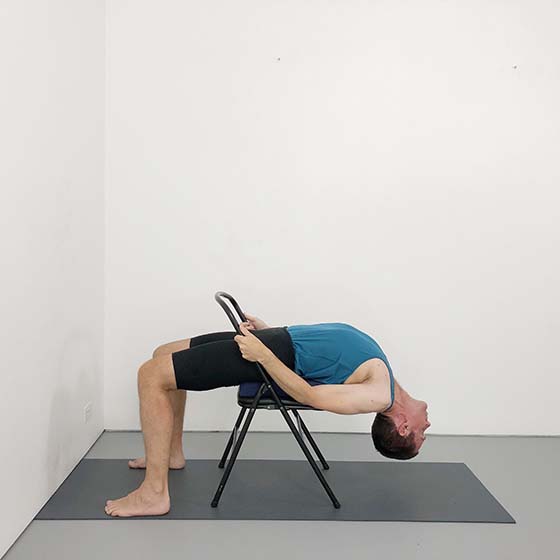
Inversions work on certain parts of the body; standing poses work on certain parts of the body, and so the twists and balances. But the understanding of penetration of the mind on the spinal nerves and spinal muscles are not touched by the above poses except in backbends.

Practitioners should try these only after they’ve mastered the standing poses, twists and inversions. The question of balancings are unimportant for backbends, but the others have to come. They are the base for backbends.

Tadāsana is the base for standing poses. Jānu śīrṣāsana is the base for forward bends. In inverted poses, Sālamba sarvāṅgāsana I is the base. In balancings, Bakāsana is the base. In backbends, Ūrdhva dhanurāsana is the base. One creates tremendous depth and vastness in the chest through the backbends that the emotional centre accommodates [absorbs and withstands] all types of pressures and strains. There is no chance for a person who does backbends to get emotionally depressed or distressed.
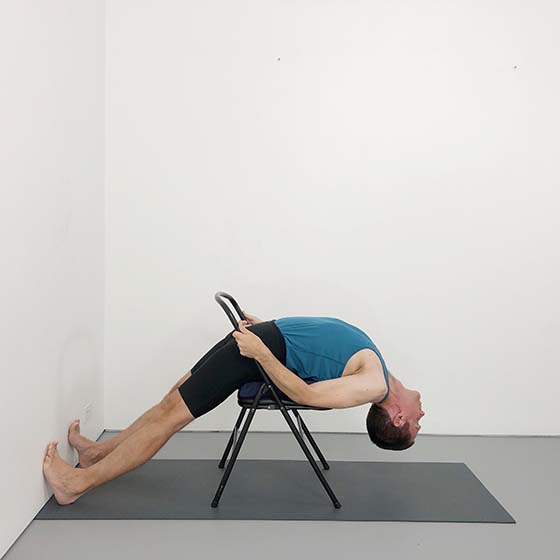
The beauty of backbends is that the person remains intellectually stable – not strong. Backbends give stability to the body and bring maturity in the intelligence in order to develop ripeness in the brain and ripeness in the emotions. When one does a lot of backbends, the blood is circulated with such speed and force that one feels hot in the body. As that body becomes warmer than normal, soothing or cooling poses have to be taught afterwards. Soothing and cooling poses like Adhomukha śvānāsana, Adhomukha vīrāsana, bending downwards, and lateral Uttānāsana, bring the body temperature back to normal.  This is the natural ‘pill’ in yoga, to come back to a natural state.

I also say with backbends, you have to be cautiously bold. Not carelessly bold. You have to descend to the dictation of the spine. You cannot command from the brain to do the poses. As you play with a child, guarding the child from injuries, similarly you have to play in backbends, guarding your spine. Keep the mind, the intelligence and will power in such a state that they may not trespass and disturb the body. When one does backbends, one has to think and rethink. One has to start from the beginning.
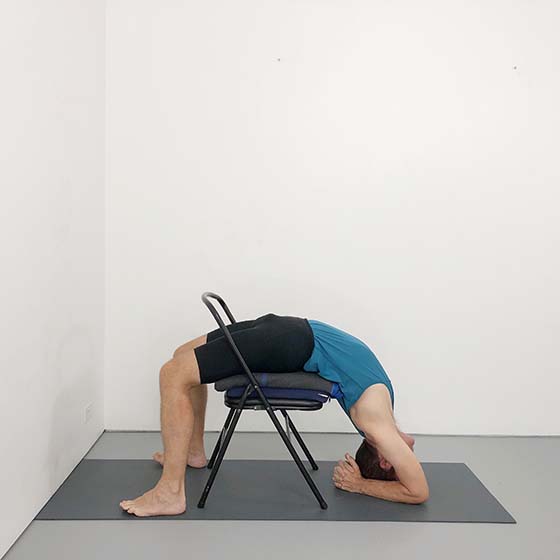
Healthy adjustments are very essential and important: Positioning of the cells, positioning of the spinal vertebrae, positioning of the joints, how to squeeze, how to stretch, are all to be digested. In other poses the sternum is touched from the outside, while in backbends one touches from inside. This helps us to educate the mind both ways. In Śīrṣāsana, or forward bends or balancings, the mind acts as extrovert. In backbendings, mind goes within. With both, one hits the inner mind within and without using the body as a means.

In forward bends, one uses the outer mind while in backbends the outer mind is silenced and the inner mind is made to work. In backbends, one touches the body physically, mentally, intellectually, consciously and spiritually everywhere. That’s the beauty of backbends. Emotionally we can never be disturbed, for the emotional centre becomes an extrovert. When you do Viparīta daṇḍāsana, your head looks backwards, but your conscious mind stretches everywhere. Study by observing how the mind gets regulated. You not only know the freedom in the spine, but also the freedom in the spirit.
B.K.S. Iyengar

Build Resilience

by Adding Variety to Your Yogāsana Practice

Carrie Owerko shows us how repetition and novelty are both important in daily practice – Sep. 27, 2017.

At 55 years young, I am realizing how important it is to cultivate resilience in my yoga practice and teaching. If we are too hard on ourselves, it becomes more and more difficult to do new, challenging, or unfamiliar things. But if we are able to watch our body, mind, and behavior during times of change (which is basically all the time, since we are always changing) and be compassionate with what we observe, we build the courage necessary to face change (and take risks) with friendliness, openness, and curiosity.

Over the last decade I witnessed my elderly parents become more and more isolated, with very limited exposure to new or novel experiences. This became a problem when life circumstances required a really big change. My Mom, whom I knew to be an adventurous and open-minded person, became more and more fearful. She disengaged from the things she loved. Her world shrank. There were many reasons for her fear and her resistance to change.

She became depressed, which was completely understandable, especially after the death of my Dad. Grief can be devastating. She had also lost her sight several years earlier, and this visual impairment made any type of change disorienting and difficult. She has also endured a few unfortunate falls (one that caused significant injury), and yet she is—in her own way—one of the most resilient people I know.

Her story is one of the many reasons why I am more and more interested in what makes us capable of embracing change, even difficult change, with a sense of possibility and potential for growth. We still feel fear, fall down, and experience our own resistance. How we act in the face of fear, get up after falling down, and take part in the process of change is important. We work on this in yoga.

Practice helps us learn how to stay engaged, continue to grow, and even find joy in the challenges that change presents (in fact, a recent study finds that yoga and meditation may enhance stress resilience and well-being). Practice helps us see that we are not static, fixed, unchanging entities. We are actually dynamic, ever-changing processes. The repetition inherent in daily practice is extremely important, as is the addition of variation and novelty, which I focus on in my upcoming Iyengar 201 course.

It can be invigorating and empowering to get out of our comfort zone. It is exciting to learn new things. It can be awkward at times, but it’s so worthwhile, especially if we are compassionate with ourselves in the process. This compassion can be like a kind of grace, because we give ourselves permission to be, to change, and to grow. We grow into the type of person who can bounce back after setbacks, get up after falling down, and stay present in the often unpredictable flow of life. We grow into more resilient beings.

Build Resilience with Sālamba sarvāṅgāsana (and Family)

Sālamba sarvāṅgāsana (Supported All-limb balance), and related poses, including Viparīta karaṇi (Inverted Action), bolster both courage and contentment. They can be deeply nourishing for the nervous system. As you become more familiar with Sālamba sarvāṅgāsana, you will be able to explore some of its many variations. The variations are helpful because we are practicing staying calm and present to change as it presents itself in the pose. By letting go of the idea that the pose has to be done one way, we begin to understand the pose more deeply, and ourselves more deeply in the process.

Try this simple variation of Viparīta karaṇi. It is fairly accessible for almost all levels of practice, and helps us explore our capacity to balance and relax at the same time.

How to: Place two to three blankets on a sticky mat near a wall. Turn the blankets so they are long enough to support your entire torso from your shoulders to your buttocks. Fold the sticky mat over the blankets like a wrap for a sandwich filling (the blankets are the filling). Place your shoulders on this ‘wrap’ and the soles of your feet on the wall with your legs bent. Keep your head on the floor. As you exhale, lift your pelvis up. Then place a yoga block under your sacrum. Tilt the block so the end that is closer to the wall is a little higher. This way, your lower back will feel a sense of traction and elongation. Then straighten your legs and rest your heels on the wall. If you feel stable, bring your feet off the wall as you take your legs to a vertical position. And if that feels stable, try spreading your legs wide apart. Observe how you are floating or balancing up on this block. Relax as much as possible without becoming inattentive. If your attention starts to drift, you might lose your balance. After a few minutes, bring your legs together and rest your feet back on the wall for a few more minutes. Then remove the block, come down, and slide your back onto the floor.

https://www.yogajournal.com/yoga-101/iyengar-201-build-resilience-by-adding-variety-to-your-yoga-practice