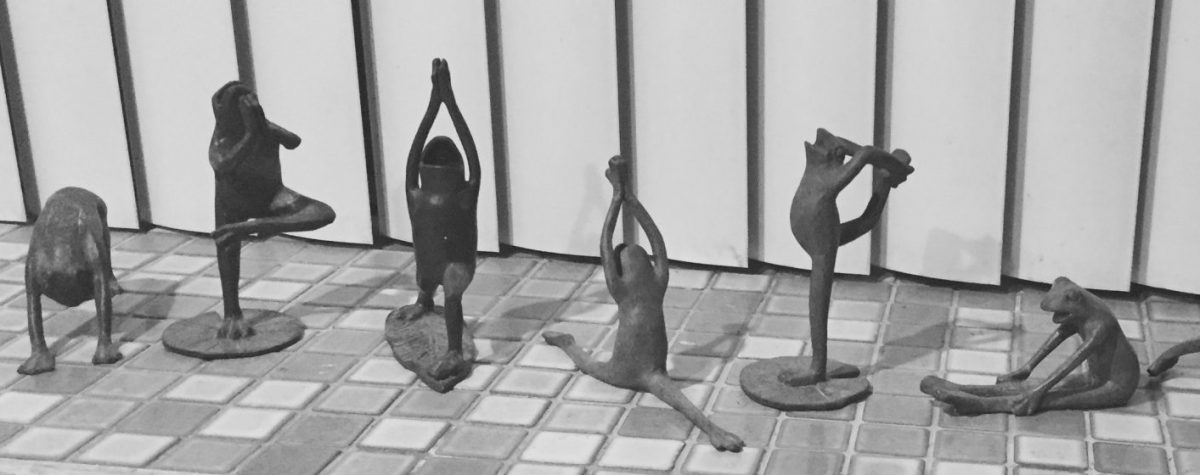
by mtkolar
MLive.com, November 1, 2007
 When Laurie Blakeney was 19, living in Ann Arbor, she attended her first Iyengar yoga class at the YMCA. “I fell in love with it,” Blakeney said. “It’s really an intelligent form of exercising. What drew me was how analytical, artistic, and disciplined it is.” Blakeney has continued to practice yoga since that day in 1971.
Iyengar yoga, she said, is a traditional form of yoga based on alignment not only of the body, but also the psyche. It focuses on developing strength, stamina, balance and flexibility. It strives to unite the body, mind, and spirit, for well-being. This form also utilizes several items such as blocks, ropes, and blankets.
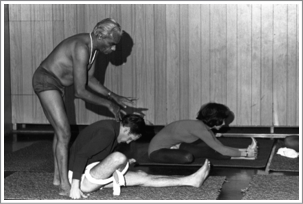
Iyengar is one of the most popular forms of yoga in Ann Arbor. In the 1970s, B.K.S. Iyengar, creator of Iyengar yoga, visited Ann Arbor’s YMCA and instructed teachers there. Blakeney said she believes it is popular in Ann Arbor because it came to the city before other forms of yoga were introduced. Blakeney, who each year travels to the Iyengar Institute in Pune, India, was recruited by one of her yoga instructors to become a teacher. She began teaching in 1977 and taught at institutions such as Wayne State University, University of Michigan, and from 1988 to 1998 she rented the Rudolf Steiner School Gym to run her own yoga program.
In 1998 she moved to a commercial building on 4th Avenue in downtown Ann Arbor, where she had a room of 1,400 square feet. She taught there until she decided the business had outgrown the space. Blakeney found a 4,500-square-foot vacant building at 420 W. Huron St., formerly the men’s homeless shelter.
Blakeney said she and the landlord, Ann Arbor developer Ed Shaffran, worked to transform the building into a school. A library, laundry room and restrooms were added, and the old oak floors and high ceilings were retained. The business opened in April 2006.
Although business had increased since the 1970s, Blakeney said, in the past couple of years it has stabilized. “There are many yoga studios opening, many more than five years ago, with not that many new people in the area.” She has a weekly enrollment of 270 people in the 18 classes offered this fall.
She said classes at the AASY differ from other exercise classes where the teacher is in front practicing along with the class. “Iyengar yoga classes teach people to understand the poses when in class,” Blakeney said. “They are taught the how and why… so that these can be practiced well outside of class.”
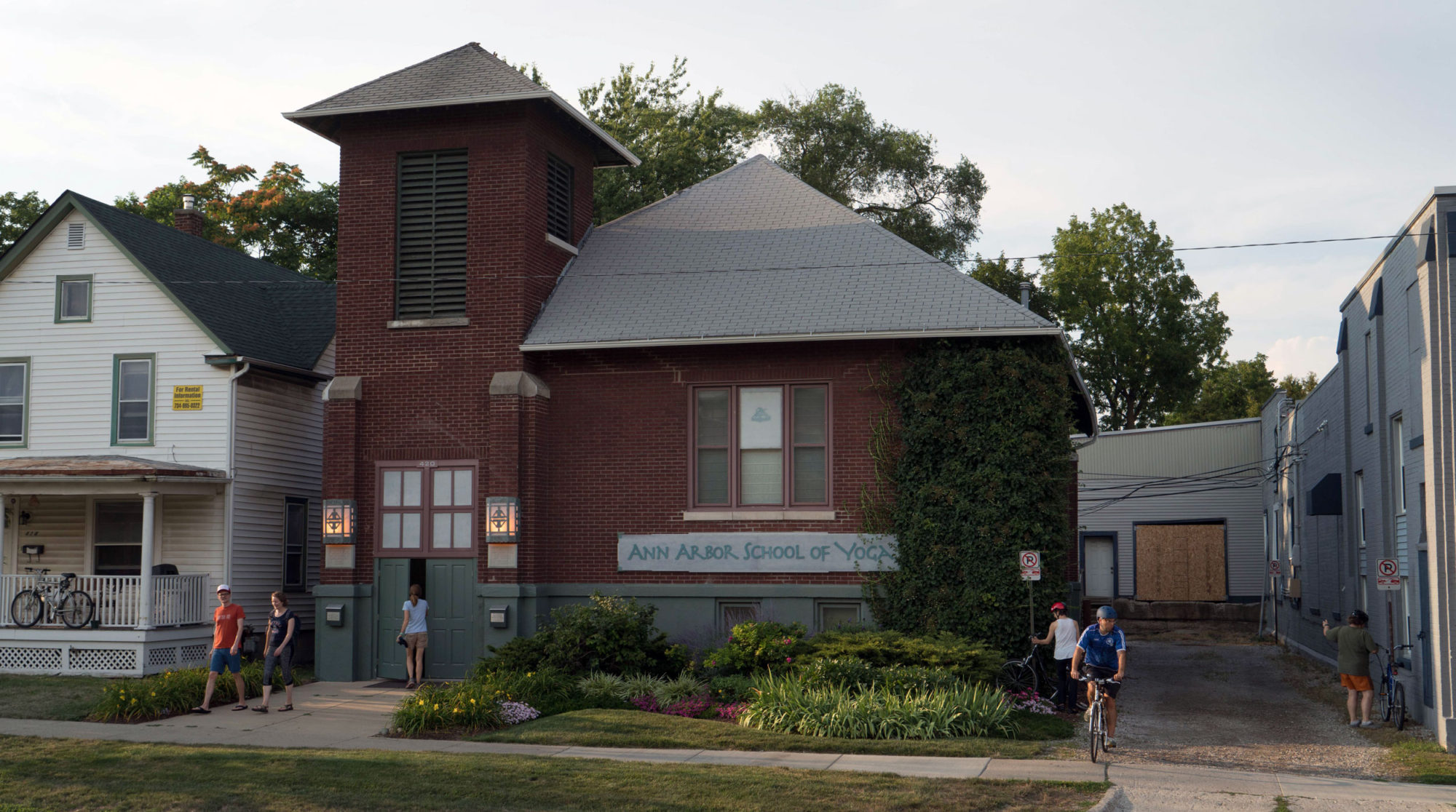 The center offers 10-week-long courses at $130 for Ann Arbor School of Yoga (AASY) members and $160 for nonmembers. The center also provides an occasional free trial class to the public. “It gives me a chance to explain to people what we do before they pay the $130 or $160 so they can make an educated choice if they want to take the class.”
Blakeney works with the nonprofit group AASY Action, which gives free classes to people staying at the Delounis Center Homeless Shelter. For AASY Action, a separate entity of AASY, she works with five other teachers. AASY Action, Blakeney said, is talking with some local agencies in hopes of serving other members of the community such as troubled youth, victims of domestic violence, and youths with learning disabilities.
She also offers special and out-of-town workshops, Teaching Training Intensive Weekends, and plans to take a group to Mexico in February for an annual workshop. She will return to Pune, India, in December to learn under the Iyengar family. “It is important for me to remain a student and learn,” Blakeney said.
BACKGROUND
Education: BA, Religious Studies, University of Michigan
Advanced Level Teaching Certificate granted by B.K.S. Iyengar, and studied annually in Pune, India, at the Iyengar Institute since 1983
Family: Son, 26
Residence: Ann Arbor
Experience: YNAUS Board, Chair of the Certification Committee
Curriculum Co-chair of 4 National Conventions, among other Committee service
Past the Board President of the IYAMW
Conference Chair for “From the Heartland Regional Conference”, in Chicago, Sept. 2011
INSIGHTS
Guiding principle: Best to work from personal experience, and try to learn, and then improve
Best way to keep competitive edge: Do the best that I can, based on my knowledge and experience
Mentor: B.K.S lyengar himself, his daughter and his son are my main teachers, and the institute in India is my mentorship
How do you motivate people: Share my enthusiasm
Goal yet to be achieved: Continue doing what I’m doing and have people benefit from it
Greatest passions: Continue to be intrigued with Iyengar yoga
TREASURES
Favorite cause: Art
Favorite book: The latest one was “The Time Traveler’s Wife”, I like fiction
Favorite movie: “My Brilliant Career”
Favorite restaurant: Zanzibar
Favorite vacation spot: Anywhere along the Great Lakes
Favorite way to spend free time: Reading
Vehicle: 1997 Audi A4
JUDGMENT CALLS
Best business decision: To start my own classes, rather than work at other programs in town
Worst business decision: Recently ordered way too many T-shirts, (for AASY)
Biggest missed opportunity: Don’t have one
Words that best describes you: Optimistic, but I’m also pragmatic
Advice you’d give yourself 10 years ago: Start saving more for retirement, since I’m self-employed
CONFESSIONS
What keeps you up at night: Nothing, really
Pet peeve: Don’t really have one
What did you eat for breakfast: A bagel with feta cheese and tomato, plus a cappuccino
Guilty pleasure: I can’t think of any, I don’t feel guilty about pleasure; maybe coffee
Person most interested in meeting: George Harrison
First choice for a new career: I won’t mind managing a nonprofit arts organization
 Rafael Durán