by Nina Mel, Elephant Journal, March 28, 2013
 Exploring the connection between our intention & our yoga practice. For a long time scientists believed that 98% of our DNA ‘text’ is not used in the coding of proteins and enzymes. Since it is not responsible for constructing our basic physical form, its purpose remained unknown for 15 years, and scientists called it ‘Junk DNA.’ But recent breakthrough revealed that this ‘junk’ is in fact crucial to the way our genome works.
This great result was achieved by researchers from the International project ENCODE (Encyclopedia of DNA Elements). 442 scientists, situated in 32 institutes around the world, including Britain, USA, Spain, Singapore, and Japan, began to work on this project in 2003. They used 300 years of computer time and five years in the lab to get their results.
Their main purpose was to deeply study the human genome, and they now declare that DNA is more active and multifunctional than was previously believed. As one of the participants of ENCODE, Bernie Evan from Cambridge says: “…the term ‘junk DNA’ can now be sent to the trash.”
But even in late 1990s, a team of Russian linguists led by Dr. Peter Gariaev discovered that the genetic code in ‘junk’ DNA follows uniform grammar and usage rules virtually identical to those of human language. It turns out that the ‘junk’ was laden with the intimations of intelligence, purpose, and meaning.
One of the basic assumptions made by Dr. Gariaev’s team is that “the genome has a capacity for quasi-consciousness so that DNA ‘words’ produce and help in recognition of semantically meaningful phrases.” Because the structures of DNA base pairs and that of language are so similar, we can alter our own genetics by simply using words and sentences, as has been experimentally proven.
 This finally explains why affirmations, hypnosis, conscious commands, and intention have such strong effects on humans, their bodies, and minds. Another scientist, cell biologist Dr. Glenn Rein, discovered experimentally that people with coherent electrocardiograms could wind or unwind DNA samples at will, while those with incoherent heart energy could not. In these experiments, simply feeling positive, love-based emotions was not enough to affect the DNA samples: “the intent to alter them had to be present.”
“Love-based emotions stimulate DNA to decompress so that messenger RNA can access codes for healing. Joy, gratitude and love accompanied with intention unwind or decompress DNA exposed to them.” Negative emotional states—anger, fear and similar emotions have the power to contract DNA molecules, compressing the DNA helix, “severely limiting access to genetic information necessary for healing, as well as evolution.”
The effects of focused intention have nonetheless been studied using both physical (Jahn and Dunne, 1986) and biological systems (Braud, 1989). A parallel investigation of conscious intention on biological systems falls under the auspices of healing research where investigators have demonstrated that various types of healers who use intention can produce biological effect (Benor, 1990).
The experiments conducted by Rein in 1992 were intended to study and compare the biological effects of different images, thoughts and intentions. The healer, Leonard Laskow, M.D., attained different states of consciousness working with intention. These various experiments showed that under the same experimental conditions some intentions were more biologically active than others.
These results indicate that focused human intention can influence the DNA synthesis. It was also demonstrated that intention was a critical component of the states of consciousness which produced biological effects.
 There are different ways we can consciously use the benefits of working with intention in our everyday lives. One of them is yogāsana practice. Encoding the DNA with intention has been used by yogis of ancient times in order to achieve higher states of consciousness, but this skill had been lost for centuries. When yoga was brought to the West, many versions lacked intention, therefore it changed a spiritual practice capable of truly transforming the mind and consciousness into a fitness-like physical practice without ‘spiritual core.’
As western medicine has divided the human body into separate parts, and as science has divided knowledge into physics, mathematics, philosophy, psychology, astronomy, and so forth, the yogic knowledge has also been divided into āsanas, prāṇāyāma, dhyāna, ayurveda, vastu… So Yoga became fragmented and could not reflect its very own nature, which is to connect. The link that connects this seemingly multi-faceted practice is intention, which will allow penetration into each of the fragmented parts and ‘connect’ them to the one.
N-Code Yoga, shows how to use intention in yogāsana practice and how to align it with āsana, śvasāyāma, and related movement in order to change DNA patterns, consciously releasing energy blockages, speed-up spiritual, physical, and psychological development, thereby distinguishing it from the conventional [modern] ways of practicing yoga.
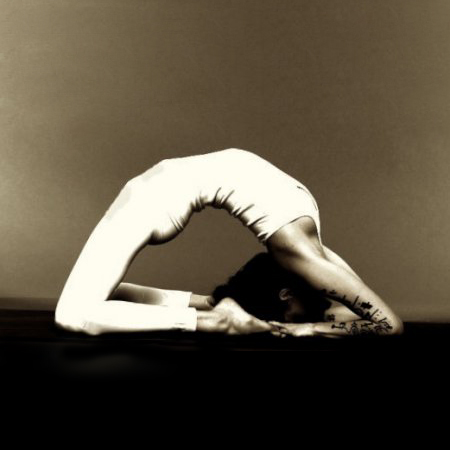 Using intention, especially when it is manifested in words and visualization during yoga practice, chakra get easily activated, energy meridians get cleansed, healing and detoxication processes are enhanced. Thus, intention deeply affects yoga practice and the practitioner on all levels: physical, mental and spiritual. A yoga practitioner can use intention to move her/his body, and mind, from one āsana to another, can breathe intention in and out, encoding it into every cell, so that this intention can be transmitted into the Universe, which begins to manifest itself in everyday life.
Practice for the sake of practice has no value, this can even be unsafe and dangerous because the new energy generated in the body during the practice without conscious direction can not be used in constructive ways. Since the undirected energy leaks out with daily emotional ups and downs, it is wasted and the practitioner’s energy level returns to its previous level or even less.
When energy is not directed consciously, it goes to its usual ‘neuro-pattern,’ strengthening the weak ‘points’ and negative patterns of the mind that have already been formed during past times. That is why the energy that is built during unconscious practice, a practice without intention becomes destructive.
Therefore intention encodes and dedicates one’s practice to a higher purpose, thus becoming a higher spiritual practice—a prayer, a gratitude, a vector of attention—all at the same time. Intention becomes a linking part of all aspects of yoga— yama, niyama, āsana, prāṇāyāma, pratyāhāra, dhāraṇā, and dhyāna. Intention reprograms the old ways of functioning, decompressing DNA, and awakening its dormant 98%, bringing the possibility of revealing and manifesting the full human potential ever closer [which makes the impossible, possible; the possible, attainable; and the attainable, graceful].
 Rafael Durán