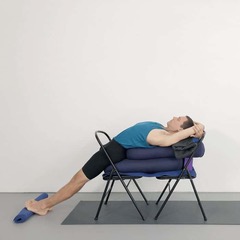
Salamba Purvottanāsana is a great example of an Iyengar method restorative pose that can help rejuvenate energy levels. Much of what is today known as restorative yoga has evolved from the teachings of the contemporary Indian yoga master B.K.S. Iyengar. His innovative usage of props allows the practitioner to remain in supported positions for longer periods of time, in yoga poses that might otherwise involve effort and fatigue.
The supported version of Purvottanāsana described in this post is well suited to times of tiredness or illness, and has many potential therapeutic applications. It is a great pose to include in a home yoga practice at times when energy needs to be preserved. Whilst in the pose the chest is held in an open but supported position. The degree of chest opening is similar to what might be achieved with more dynamic backbends, but can be sustained for a considerably longer duration of time. A practitioner would ideally stay in this pose and soak up it’s benefits for at least five or ten minutes. Remaining in the pose for an extended period of time has a calming effect on the nervous system. It can help to combat stress and counteract lethargy from mental and physical exertion.
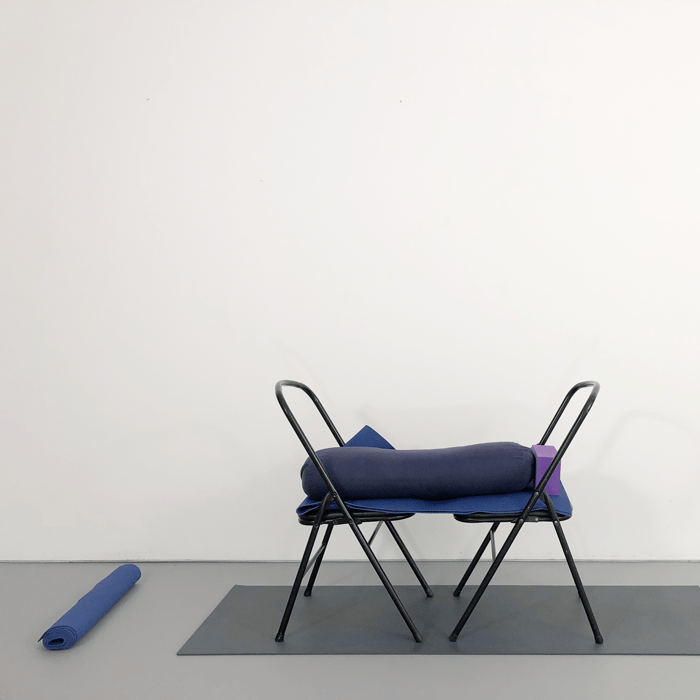
Set up your chairs and other props
- Position two chairs closely together so that the fronts are facing.
- Fold a yoga mat in half, and drape the mat over the seat of both chairs. This will help to link the chairs together and prevent them from sliding apart.
- Place a bolster on the seat of the chairs.
- Ensure that the end of the bolster is level to the edge of the first chair that you will be sitting on.
- The other end of the bolster will not quite reach the edge of the other seat. Place a block on its side edge in the section of the seat that overlaps the end of the bolster. This block will help to support the next bolster layer and will prevent your head and shoulders from sinking downwards.
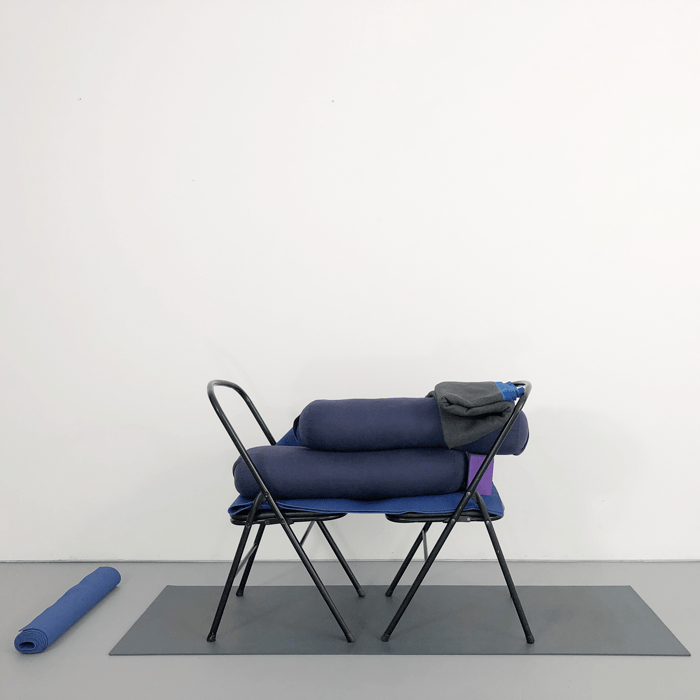
Build a bit more height
- Now place a second bolster on top of the first.
- Ensure that the top bolster overlaps the bottom bolster by around 20cm or 8 inches. The exposed section of the bottom bolster is where you will eventually sit.
- The other end of the top bolster will be supported by the block.
- Place a three-fold blanket at the end of the top bolster. Your head will eventually rest onto this blanket.
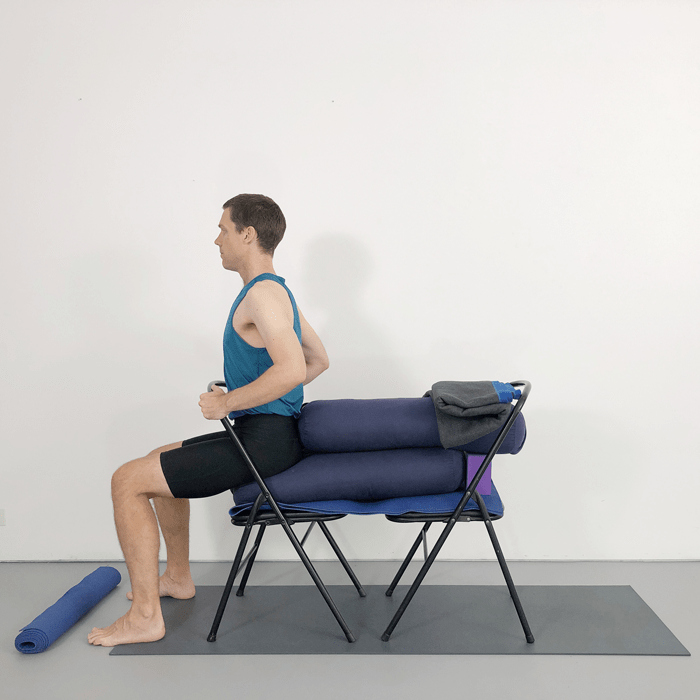
Position yourself
- Before lying back over the chairs, prepare a support for the balls of your feet. A rolled yoga mat is ideal for this purpose, but other nearby objects will do in a pinch. Anticipate how far this foot support will need to be away from the chair, and place it in position.
- To position yourself on the support, begin by sitting on the top bolster with your legs straddling either side of the support. Bring one leg through the inside of the chair frame and then slide forwards so that you are sitting on the bottom bolster.
- Keep your knees bent and have your feet flat to the floor, as you lie back over the top bolster.
- Position head on the three-fold blanket so that the tops of your shoulders are level to the edge of the blanket.
- Tuck buttocks towards your knees.
- Now straighten the legs.
- Turn inner thighs down, calves outwards, and press your big toe bases down and into the rolled mat.
- Allow arms to release down by your sides.
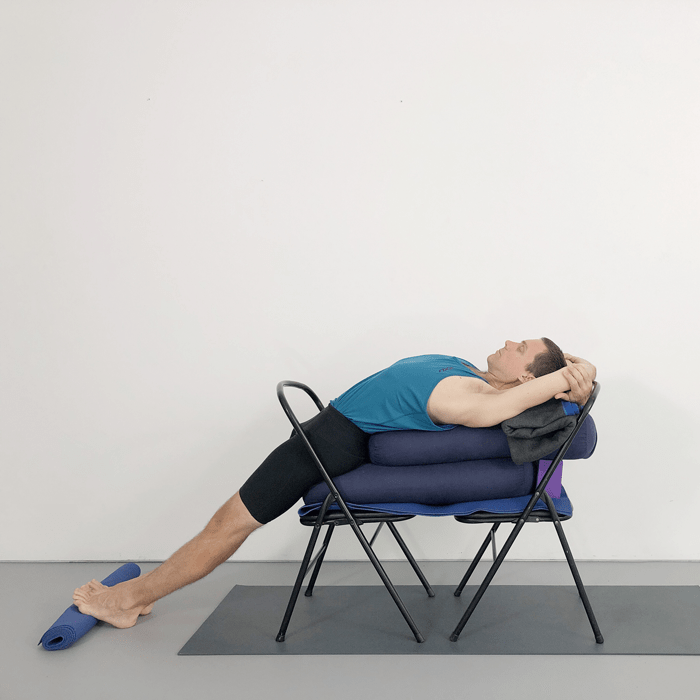
Relax…
- In addition to having arms hanging down by your sides, another option is to fold and bring them overhead to rest on the support.
- Fold your arms in such a way that, gently clasp each elbow with the fingers .
- This light grip is sufficient to stabilise your elbows at a shoulder width distance. You can then consciously allow shoulders to release in a downward and outward direction.
- As you remain in the pose observe how your breath starts to become soft and smooth.
- As chest is lifted up by the supports, allow your abdomen to relax and release in a downward direction.
- Ensure that your jaw muscles, tongue and eyes are free from tension.
Conclusion
Salamba Purvottanāsana is a rejuvenating pose that is commonly used in the Iyengar method. It can have specific therapeutic applications in a yogāsana class context, but is also a great pose to include in one’s home practice. It is an ideal pose to practice during times of fatigue or low energy. Remaining in this pose for around ten minutes will maximize its potential benefits.
Originally posted here
To view Lois Steinberg’s variations use the following link:
https://vimeo.com/601341143
 Rafael Durán