November 22, 2023
Written by Sarah Williams
B.K.S. Iyengar (1918-2014) is arguably one of the most well-known and influential yoga teachers within modern postural yoga. Named as one of the hundred most influential people in the world by Time magazine in 2004 Iyengar’s impact reached far beyond the yoga studio.
Spanning a life of almost 100 hundred years he went from sickly child to international Guru who wrote one of the best-selling yoga books of all time and pioneered a precise approach to yoga that used props to help the physical, mental, and intellectual body to align.
“Occasionally throughout history, there have been individuals whose achievements leave a positive mark across the entire world. B.K.S. Iyengar was such a person.” Iyengaryogalondon.co.uk
In this article we’ll look at:
- The life behind the teacher
- Philosophical influences on the Iyengar Method of Yoga
- Āsana approaches

B.K.S. Iyengar – The Child
“The approach of a young child to yoga is very different from that of an adult.” – B.K.S. Iyengar
Bellur Krishnamacarya Sunderaja Iyengar was one of 13 born into a poor brahmin family in Karnataka, India. His beginnings were rife with illness and during his childhood, he suffered from typhoid, malaria, and tuberculosis all of which impacted his education and well-being.
B.K.S. Iyengar – The Student
“Yoga works on each individual for his or her growth and betterment, physically, mentally, emotionally, and spiritually.” – B.K.S. Iyengar
Iyengar began yoga studies under the tutelage of his brother-in-law Śrī Tirumalai Krishnamacharya in Mysore at the age of 15. Krishnamacharya had little faith in Iyengar’s prospects as a yogi due to his physical health, but it was through yoga that Iyengar found a mode of healing and well-being.
As a teacher, Krishnamacharya was renowned for his fierce and uncompromising manner* towards his students, and it is said to have offered very little direct tutorage to Iyengar. Along with Krishnamacharya’s other students, K. Pattabhi Jois, Indra Devi, and T.K.V. Desikacha, Iyengar became one of the most influential yoga teachers of the 20th century.
B.K.S. Iyengar – The Teacher
“It is relatively easy to be a teacher of an academic subject, but to be a teacher in an art is very difficult, and to be a yoga teacher is the hardest of all, because yoga teachers have to be their own critics and correct their own practice.” – B.K.S. Iyengar
At just 18 Iyengar was sent to Pune to teach yoga. Resisting the traditional path of other yogis, Iyengar did not choose to become a sannyasi [a renunciate, or someone who has given up life as a householder] which subsequently allowed him to marry and become a father.
“In life, we have a lot of responsibilities. It is not meant for renunciation. We live in this society and it is our duty to give back to our society. Renunciation comes to me when I am 96. Renunciation means giving up the enjoyment of worldly happiness. But I am full of inner happiness.” – B.K.S. Iyengar
It was Iyengar’s relationship, both as a student and friend, with internationally renowned violinist Yehudi Menuhin in the 1950s that propelled him to success in the West. Menuhin said, “I consider B.K.S. Iyengar to be my first real violin teacher. He is the first to teach me how to use my body”.
Iyengar began teaching at the London Education Authority in the 1960s on the basis that the teachings be predominantly physical omitting the philosophical and spiritual aspects of yoga. This paved the way for the first Iyengar Institute in the West.
“Iyengar’s biomedical dialect made postural yoga appealing to a wide array of modern urban individuals.” Andrea Jain in Selling Yoga
Iyengar was a charismatic teacher and despite being notorious for his temper*, he was also known by his students for his sense of humor and compassion. Notably, his radical approach to teaching was founded on the notion that yoga was for everyone regardless of race, gender, or class.
After the death of his wife, Iyengar established the Ramamani Iyengar Memorial Yoga Institute in Pune in 1975 where he taught with his children Geeta and Prashant. Iyengar spent the rest of his life at the RIMYI and continued to teach well into his 90s.
Iyengar Method – The Training
“Yoga is my way of life.” – B.K.S. Iyengar
There are thousands of trained Iyengar Method teachers throughout the world, all of whom have undertaken the rigorous program of teacher training. At least eight years of study are required before entering the two-year introductory certificate program. Senior Iyengar Method teachers must undertake mandatory in-depth training to progress in their teaching.
Iyengar Method – The Philosophy
“Yoga does not just change the way we see things, it transforms the person who sees.” – B.K.S. Iyengar
B.K.S. Iyengar refers to the practice of yoga as “meditation in action”. His approach to the philosophical concepts of yoga was heavily underpinned by the classical yoga of Patañjali. In the Yoga Sūtras of Patañjali, we find the eight limbs of yoga which is a systematic approach to living a purposeful life and path to samādhi.
The eight limbs of yoga, also known as Aṣṭāṅga yoga (not to be confused with K. Pattabhi Jois’s Aṣṭāṅga vinyasa), provide a holistic guide to life with attention to ethical conduct, discipline, self-inquiry, and spirituality. The first four stages are concerned with refining aspects of daily life before diving deeper into the subtleties of meditation and consciousness.

Let’s take a look at the philosophical inquiry behind Iyengar’s method in more detail.
1 | Yamas – Often referred to as ethical standards, or restraints, the five Yamas set out a code of behaviors to live by. Consider these the do not’s:
- Ahiṃsā – non-violence (lit., non-harming)
- Satya – truthfulness (not lying)
- Asteya – non-stealing
- Brahmacharya – self-restraint, (not distracted)
- Aparigraha – non-avarice, non-hording, or non-possessiveness
2 | Niyamas– A compliment to the Yamas are five Niyamas considered the ‘inner observances’, and help us to act appropriately. [Regard] these as the do’s:
- Śauca – cleanliness, purity (external and internal)
- Saṇtoṣa – contentment
- Tapas – self-discipline, spiritual austerity, and persistent meditation
- Svādyāya – study of the sacred scriptures (for one’s liberation)
- Īśvarapraṇidhāna – dedication, or surrender (to a Supreme/God)
3 | Āsana – The physical postures, and the dominant form of yoga associated with modern practice.
4 | Prāṇāyāma – The practice of focusing on the breath. Eventually a means to activate prāṇa, or energy, prāṇāyāma is thus the control of the breath or breathing exercises. [It must first begin with studying one’s breath.]
5 | Pratyāhāra – Often referred to as detachment from the external (such as cravings or drama), pratyāhāra is the withdrawal of the senses and a tool for turning towards the internal.
6 | Dhāraṇā – Concentration, or focus on a single mental object, is the practice of dhāraṇā.
7 | Dhyāna – Meditation is the focus of this limb. Dhyāna differs from concentration as it is a wider state of awareness, and not reliant on a fixed mental point.
8 | Samādhi – A state of being that is at one with all that is around us, with the universe. A kind of enlightenment, or bliss, is used to describe the state of samādhi. [Another is a ‘settled’ of the mind.]
Iyengar Method – The practice
“Iyengar prescribed a thoroughly individualistic system of postural yoga that was a rigorous and disciplined form of body maintenance” Andrea Jain in Selling Yoga
The Iyengar Method is one of the first world-wide ‘brands’ of yoga and was initially successful because of its focus on physical methods with little focus on the wider teachings of yoga. This accessible approach to what was previously an esoteric practice used physical exercise to draw people in.
There are three important components of the Iyengar Method which provide a good insight into the style: alignment, sequencing, and the use of props.
ALIGNMENT
“The body cannot be separated from the mind, nor can the mind be separated from the soul” – B.K.S. Iyengar
The precise approach to the performance of postures in the Iyengar Method is detailed and specific. Postures are held for a longer duration than in many other styles allowing time to work with alignment, breath, corrections, and adjustments while in the shapes.
There is an emphasis on learning and progression through the alignment principles on account of the demanding attention and awareness required. ‘Good alignment’ means that the whole physiological and mental system is balanced.

SEQUENCING
“In India, āsana was never considered to be a merely physical practice as it is in the west.” – B.K.S. Iyengar
Iyengar’s is a methodical approach to sequencing postures and aims to prepare the body for opening in a safe way. Unlike many other styles, the Iyengar Method does not require warming sequences such as sun salutations (sūryanamaskāra). It often features poses being held for longer periods, sometimes up to 10 minutes, which are said to help to build strength, flexibility, as well as, focus. Classes generally end with a ‘re-invigorating’, or ‘re-energizing’ posture (śavāsana) to cultivate vitality.

PROPS
“But even in India, nowadays many people are beginning to think in this way because they have picked it up from the people in the West whose ideas are reflected back to the East.” – B.K.S. Iyengar
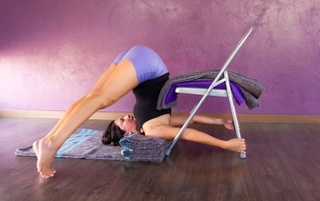
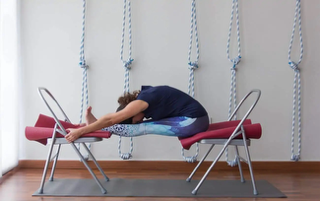
Considered a pioneer in the use of ‘props’, (Iyengar developed the use of belts, blocks, straps, walls, sandbags, chairs, stools, ropes, bolsters, sticky mats, and more), in order to provide support and help those with limitations, lack of experience, or injuries. The use of props compliments the alignment principles, and helps students to perform each pose safely.
Iyengar Method – Proposed Benefits
“Your body exists in the past and your mind exists in the future. In yoga, they come together in the present.” – B.K.S. Iyengar
Like other styles of yoga, the Iyengar Method is a good approach to improving health holistically. More specifically it claims to:
- Increase strength and flexibility
- Improve posture
- Boost energy
- Reduce chronic pain symptoms
- Lower blood pressure
- Improve concentration
B.K.S. Iyengar’s Writing
“My subject is yoga – the path which cultures the body and senses, refines the mind, civilizes the intelligence, and takes rest in the soul which is the core of our being.” – B.K.S. Iyengar
Light on Yoga is arguably one of the most widely known books on yoga, and includes over 600 photographs of 200 āsana accompanied by instructions on how to do the poses and gain their benefits. It has been translated into 23 languages since being published in 1966, and has been referred to as “the bible of modern yoga”. [Originally, this book was intended for those without a certified Iyengar Method instructor (CIYT).]
If you’re eager to find out more about the man and the practice of B.K.S. Iyengar then his Light on [series of books] is a good place to start:
Light on Yoga
Light on Life
Light on Prāṇāyāma
Light on the Yoga Sutras of Patañjali
Key Takeaways
Iyengar’s is a methodical approach to the practice of yoga and its success rides on the teachings of the man who pioneered a brand of yoga for householders that was both challenging and therapeutic.
“Yoga is a light, which once lit, will never dim. The better your practice, the brighter the flame.” – B.K.S Iyengar
[* A student originally teaches as s/he was taught]
 Rafael Durán
Excellent summary! Thank you.
Sent from AT&T Yahoo Mail for iPhone