Thus Spake BKS Iyengar, Part IV

The following are excerpts from Thus Spake BKS Iyengar by Noelle Perez-Christiaens,

©Institut de Yoga BKS Iyengar-Paris 1979

7. ĀTMAN
MERGING THE INDIVIDUAL SOUL (JIVĀTMAN)
WITH THE UNIVERSAL SOUL (PARAMĀTMAN)’
In many books dealing with Being one sees very knowledgeable distinctions between the Self and the self, the Self and myself, often rendered by the Latin ego. When someone speaks to you of ‘yourself,’ you know what s/he means. When someone speaks of the Self, you had so studied Einstein’s idea of Energy that it seemed to you there was nothing but It — all matter being, in the final analysis, energy — and that beyond the notion of person, of individual (of myself), there was a Source of Energy great and universal and neuter, as long as It was not manifested in some creation or other.

And as you realized that this energy Source is universal, that it underlies all creation, is the manifestation of everything, and precedes everything, at the same time you realized why Sanskrit — a language wherein the use of capital letters is unknown — doesn’t need to differentiate between the Self and the self. I remember being very perplexed when Iyengar said, “It’s the same;” those were the days before I discarded the notion of a personal God!

I was left with the problem of finding a translation for ātman, so often translated [as] ‘self.’ Mlle Esnoul came to my aid and suggested the translation ‘I’ or ‘me.’

We can say, then, that the fusion of the ātman in the Ātman is that of ‘me’ in the Being, an experience so dumbfounding, so inexpressible, of annihilation.

Doesn’t Iyengar say, over and over again that, “‘myself’ and ‘the self’ are one and the same?” In 1959 he wrote me, “When the mind is no longer a screen, the Soul (Ātman, the Being) is free and it shines as pure as crystal with no reflection on it. As the self is free from contact of things, that is the state of experiencing Samādhi.” (A45) I first used the French word ‘âme’ to translate ātman, which Iyengar expressed [as] ‘self’ or ‘soul.’ But after my experience of 1977, I see perfectly well that they might all be rendered by ‘BEING.’ Indeed, at the instant when thought is stopped by the energizing capture, an immense silence installs itself in one, and the BEING is revealed. No ’whys’ or ‘hows’ of a relative nature from the level of duality come to disturb the fact of being without qualification or modality: BEING is all.

In 1963 Iyengar added, “When the mind is controlled, what remains? The soul. That is the very purpose of yoga.” (F25) In 1968 another lexical difficulty was clarified: “…the consciousness of the heart, where the true Self reveals itself.” (J59) In Sanskrit, ‘heart’ is Hṛdaya (or Hridaya); not the organ, but what we mean when we say, ‘the heart of the matter,’ ‘the heartland of the continent,’ ‘the heart of the forest;’ that is, the deepest, central part of a being, the source of life. It is indeed in the depths of a being, well below all surface impressions, that the BEING reveals itself, annihilates all, dissolves all, absorbs all in Itself.

But for us this cannot come to pass outside of life, that is outside of āsanas, which are like rough maps. Iyengar specifies, “As long as you do not live totally in the body you do not live totally in the Self. Total awareness.” (X177) Here we could transcribe all his instructions on skin, on sensations; we might not betray him saying, ‘my body, my dear guru’ or ‘the body must silence the intellect and put its feet firmly back on the ground!’ If the attention on what is happening inside is not substantiated and continuous, the danger of fragmentation is ever-present, and the intellectual brain thrashes about, keeping the individual on the surface of her/himself. The sentient, animal brain can put wo/man back where s/he belongs and give her/his intelligence – and not her/his intellect – the chance to think calmly. Only the experience of reality can help a being to regain her/his balance and approach the consciousness of HER/HIMSELF: the BEING the s/he is.

An āsana is a slice of life slowed down, a rough map which allows for observation and correction; thus the Master specifies: “The āsana is an enquiry: who am I? Throwing out the parts until only the self is left. The final pose is ‘I am’.” (X181)

How many years must one work, in order to finally succeed in putting the profound truth of such a sentence to the test? Yet those who have really let themselves be caught up, who are beyond basics, and who are willing to give up everything in order to let yoga perform its work of merciless ‘peeling,’ can probably begin to render thanks to Iyengar for the profound wisdom which dictated to her/him such a sentence, uttered luminously out of uncommon experience of life!

* Cf. L’Aplomb, base de l’équilibre psychosomatique-N. Perz-Christiaens, Part V Ch 3

8. STHIRA AND SUKHA
“TATRA STHIRA-SUKHAM ĀSANAM”
A FIRM, STABLE SITTING POSTURE
(Patañjali II.45)
When the great Patañjali wrote [the] sūtras he collected, for the benefit of his followers, instructions from the great yogi of his time. We know that the sūtra designates a particular literary genre consisting of ‘stringing pearls on a thread’ (sūtra); it’s a rosary of mnemonic texts for teaching. Thus we won’t find plentiful explanations for beginners in the sūtras; rather a succinct resumé useful to the experienced pupil who can read ‘between’ the lines.

Now Patañjali says that the correct seat or foundation for meditation must be sthira and sukham. As we have seen for samasthithi*, sthira comes from the root STHA, which also gives the adjective ‘stable.’ Sukham is an adjective signifying the comfort of a wheel whose hub is well-centered. It’s a word right out of the experience of the nomadic peoples – Indians of today – who travel in ox-carts along bumpy country roads.

These two adjectives are thus extremely important for us, not only in the case of the posture for meditation, which does indeed require a very good seat, but also in that of any other posture, sitting or standing. In all postures the foundation is of prime importance. For the practice of yoga will lead us little by little towards samādhi along the bumpy roads of our lives.

How does Iyengar translate these basic requirements for a good seat, in order to bring them within our reach? “In mediation, the mind is still but razor-sharp, silent but vibrant with energy. This state cannot be achieved without a firm, stable, sitting posture, where the spine ascends and the mind descends, and dissolves in the consciousness of heart (Hṛdaya, the centre), where the true Self reveals itself.” (J59) When the foundation is comfortable enough for the spine to be effortlessly erect, then concentration can descend to be absorbed, dissolved, in the Being.

Several years later [BKS] returned to the same idea, “When you sit, first stability, then firmness.” (Q46) It’s of primary importance to note that the Master is addressing himself to Westerners, so often sprawled in seats they think are comfortable: for he has avoided the original notion of ‘comfort’ (sukham) which would be falsely interpreted by us and replaced it with ‘firm,’ an important word for the choice of a seat. Indeed, so that the spine may surrender absolutely to Gravity, comfort demands that the seat be firm and soft: firm at the base and soft under the skin. Then the foundation is perfect if the correct height has been found. From all the sit is evident that nothing can be done on a poor seat, maladapted to that which is being practiced (duke, uncomfortable).

Other sayings come to perfect this new enlightenment: “It is the job of the spine to keep the brain alert and in position” (J64); this is true of any posture. A spine out of plumb results in compensations in the vertebra, the incorrect positioning of the skull, and ultimately a brain out of plumb. Then the brain anesthetizes itself, shuts itself off from discomfort, and a Westerner can live without suffering too much, but also without evolving towards the goal s/he took on when s/he began to practice yoga! In a lesson Iyengar explicitly said, “I showed you the tension on my face in that concentration, remember? This is that tension known as rigid stillness. The rigid stillness is not a state of silence. The rigidity is a vibration.” (Q56) It is patently true, when a stable, comfortable seat has finally been experienced, that there could not be the slightest rigidity or the slightest tension. As soon as I hold up my back, or activate the muscles of the back, my spine will conform to the idea I am imposing upon it; but it will immediately lose all mobility, all adaptability, to the slightest prompting of the Breath which comes from a total surrender to gravity. As soon as one holds, one becomes rigid, and as Iyengar says elsewhere, “rigidity is a form of egotism,” a return to oneself, an expression of deeply felt infantile pleasure of the active ego!

Along this road to meditation, towards the complete dissolution of everything that makes me see myself as a person opposed to the Being, the comfortable foundation in gravity permitting absolute mobility is the basis for absolute immobility. This may seem incompressible to beginners. By ‘absolute immobility’ I mean not that which we think we are producing, which is rigidity, but that stability given by a complete non-resistance to gravity. It is in the perfect silence of all manifestations of my ego that finally the Being is manifested, the Being that I am without having realized it.

Patañjali frequently opposes sukha (su-kha, the good hub), comfort, ease, wellbeing; and dukha (du-kha, the uncomfortable hub), lack of ease, discomfort. Sukha alone is the true way. -(Patañjali II.7-8, and 46).

*Cf., L’Aplomb, base de l’equilibre psychosomatique, N.  Perez-Christiaens, Part V, Ch 3

Thus Spake BKS Iyengar, Part III

The following are excerpts from Thus Spake BKS Iyengar by Noelle Perez-Christiaens, ©Institut de Yoga BKS Iyengar-Paris 1979

5. KRAMAKĀLAYOGA
CHRONOLOGY’
As it was discussed in Yoga YUJ*, the word yoga expresses an idea of junction, of binding, of linking together several things to form a new entity. We have just seen that krama gives the idea of advancing, approaching, going towards. Kāla is time. Kramayoga was a rhythmical succession; kramakālayoga indicates the same succession in time. It’s a ‘chronological’ junction, the junction of successive moments in time, a series of moments or a series in time.

Iyengar is very attracted to this notion of time, which is a simple impression of the relative [one] in which we live until we experience samādhi, but he tries to prepare the pupil for the dissolution of time in infinity, to lead him slowly, towards the notion of a time beyond time, of a perpetual instant, a never-ending present. He therefore has to break the notion of time in our heads, especially the notion of time as a real entity which advances (KRAM). Thus he speaks of ‘chronological authority’, by which he means the authority of a clock which obliges us to stay in a posture the length of time we have decided to devote to it. He immediately breaks this notion: “Sit in this āsana and accept chronological authority. Chronological authority is no authority, as time is just movement in space.” (X33) And then returns to this idea in another way, “Do not do chronological timing without acting psychologically. The brain must work.” (X56)

We need a time of daily practice, until our whole lives are composed of daily yoga. But this time of work must not be a dead time, stupidly lent to obedience. The intelligence, the mind, must use this time and through it dip into eternity. A clue to this might be found in another reference to time: “Chronological time and psychological time are quite different.” (X280) We have all had the experience of seemingly endless moments, and days which fly by.

But we must admit that we would prefer to think of the word ‘chronometric’ rather than the word ‘chronological.’ The latter refers to an arrangement of dates and times of occurrence. Whith this in mind, the three sayings are much clearer and more comprehensible: “The authority of a time-piece is no authority, as time is just a movement in space.” (X33)

Only the perpetual present IS.

* Cf. Yoga YUJ, Noelle Perez-Christiaens, Paris

6. MANAS
PIT YUR BRAIN IN YOUR BUTTOCKS
At first glance, this sentence must leave you speechless; how to put an organ, the brain, down into a muscle, the buttocks? Why did he not say, for instance, ‘pay attention to your buttocks,’ or even ‘your buttocks must become intelligent?’ The Master used neither a word derived from ‘intelligence,’ nor one derived from ‘attention.’ Why not? For years I wondered why he named the organ and not its function.

And then, one day, having begun the translation of Pataňjali’s Yogasūtras with Mlle Anne Marie Esnoul, I came across the word manas several times, alone and in composition. Here are a few examples:
– (I.30): durmanasya, which she translated [as] ‘anxiety’ (dur expresses a discomfort)
– (I.34): manasaḥshiti,translated [as] ‘stability of mind’
– (II.40): saumansya, translated [as] ‘benevolence’ (sau, from SU, which means ‘beautiful’, ‘good’, ‘well’)

But each time Mlle Esnoul expressed a discomfort — the exact meaning of manas cannot be rendered in our languages by one word. She explained that it was ‘the attention which produces the perception of the bodily sensations.’
– Could we not translate it [as] ‘attention’?
– No, replied the Sanskrit scholar, attention is translated otherwise.
– Then perhaps [as] ‘perception?’
– No, there is another expression in Sanskrit for ‘perception.’
– Is it a faculty of the mind?
– Not for an Indian. Consider Iyengar: he translated it neither [as] ‘mind’ nor [as] ‘spirit’ in English. It’s a sensory faculty. It’s on the physical level with the senses, like a sixth sense. It’s the attention of the organ itself which allows it to perceive the vibrations it is responsible for collecting and transmitting to the brain.

Then I finally understood why Iyengar, wanting to use a physical word referring to the senses, chose ‘brain.’ In asking for the brain to be put down into the buttocks, he awakes in the pupil the idea of attention and perception, of efficacious concentration to make the buttocks become conscious of their responsibility within the entirety of the synthesis that is a posture.

Then other sayings became clear, ones to which I hadn’t paid enough attention [to] before: “What is the use of merely developing the muscles if the brain is not working?” Here again is the brain, tied to the physical world, to help the body become conscious, to perceive. This is the whole idea of manas. [Once more, referencing] the physical union: “The brain is the heaviest limb in our bodies.” (X194) Let us examine an even more recondite saying: “Move the ears deep inside, the brain resting on the mind. At the same time, the brain is looking at the mind so as not to allow the mind to create any vibration in you trunk, and the mind is watching the brain so that the brain is not cut off from the observation, from that humility.” (Q55) Here again, the brain is joined to the trunk, to the ear – a sensory organ – to the concrete sensory reality over which it watches so as not to allow it to err or to be disturbed by the mind, observing it in order to perceive all its subtlety.

It is difficult to understand right away what is hidden in the refined use of a word which may seem to be evoked in an unusual fashion!

Thus Spake BKS Iyengar, Part II

The following are excerpts from Thus Spake BKS Iyengar by Noelle Perez-Christiaens, ©Institut de Yoga BKS Iyengar-Paris 1979

3. SAMA
EVERYTHING SHOULD BE SYMMETRICAL
To understand this esoteric pronouncement, let us go back to the Sanskrit. The word sama means same, equal, similar, alike, identical to. We have encountered it in the second name of the posture tāḍāsana, samasthitiḥ. Saṃasthiti (with a point under the ‘‘) is an adjective signifying ease, comfort. In this word the notion of comfort and ease is inescapable. Samāna means homogenous, identical, of the same sort: samāyuj (YUJ being the root which gives us ‘yoga’) means to adjust, to join: samāyoga is a junction, a union. Here is the idea of two identical things joined or enrolled together in the same action.

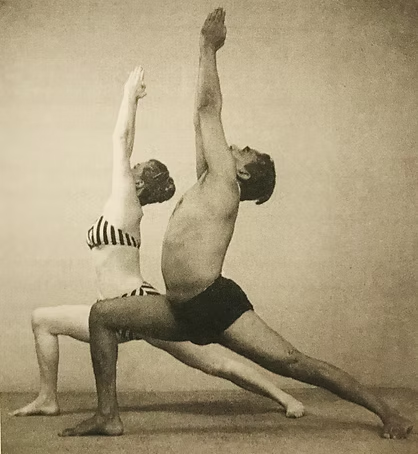
Now I [believe] we are ready to scale the prodigious heights of the Master’s thought: “Everything should be symmetrical: that is why yoga is a basic art.” This sentence helps to understand the following: “Take each pore of the skin for a conscious eye; adjust and balance gently your body from inside with the help of these conscious eyes as it is difficult for normal eyes (the outside ones) to observe and correct the body position (adjusting it from both sides).” Here indeed is the notion of sama, a balance, a parallelism creating harmony. He continues with more precision of thought: “Geometrical adjustment – you must be balanced – use both sides of the mind.” Here we might use the Sanskrit samāyoga! He returns to the notion of parallelism in the body: “Challenge and counter-challenge should weigh evenly on both the left and right sides. Only then will lightness come.” Clearly an equal weight, that is to say, an equal absence of weight, must be felt on both sides for lightness to be tasted. In other words, tāḍāsana first passive, then active, should bring lightness to both right and left sides evenly, for the work of yoga to operate its wonders in us.

Here is another sentence on the observance of parallelism in life and therefore in its preparation, the work on the equality in one’s foundation in yoga: “When I ask you to stretch your spine, you stretch in the middle where Suṣumṇa* is, but you should relax in the middle and stretch both sides: śakti will be free only then.” How can one better express the work of ‘active’ tāḍāsana, of the unimpeded diaphragm? When I think of the years I had to labour in order finally to be able to relax in the middle, instead of concentrating, [by letting] my ‘wings’, as Iyengar calls floating ribs, work peacefully! Yet I [only] first ‘heard’ this admonition in 1965.

Once Śakti is free, Kuṇḍalinī awakens, floods the whole being with incredible warmth, and hurdles it into the cosmic dance of Energy which is It and is manifested in the relative.

[*Suṣumṇa is the main energy channel in the subtle body, running along the spine and connecting the chakras from the base to the crown of the head. It is considered essential for the flow of vital life force energy, or praņā, and is associated with spiritual awakening and meditation practices.]

4. KRAMAYOGA
RHYTHMICAL STRETCHING OF THE SPINE
We come now to an even more impenetrable notion, that of rhythmical stretching. “Rhythm has to be observed in yoga,” says Iyengar. Do you ‘see’ what he means? I didn’t. [Although] as early as 1959, he wrote me: “In āsana, too, maintain a detached attitude to the body and at the same time do not neglect to stretch fully. Rushing to things saps the strength. The mind should be calm and everything should be done in rhythm.”

Later, the phrase “rhythmical stretching of the spine” [finally] pierced my ear-drum. Could this [also] be contained in sama?

Rather, why not, in Krama? Krama comes from the root KRAM, which means to advance, to go towards, to approach. The dictionary reveals interesting meanings for Krama which enlighten for us one of the least known aspects of Iyengar’s thought and teaching. These are: order, succession, series, and even ‘way of acting.’ Kramayoga means suite, succession, ordering. Thanks to Mademoiselle Esnoul, we can add ‘rhythm’ to this list. Kramayoga means rhythm.

Fine, but how can one do a yoga posture with rhythm? How can one stretch one’s spine rhythmically? There is a notion of ‘stepping’ in KRAM; to take steps, to advance with regular even steps. But I still didn’t understand: to me, rhythm denoted a regular beat in time. Cardiac rhythm, or respiratory rhythm, or the rhythm of my metronome at the piano, were all familiar examples of rhythm to me – ones in which the beat became more or less frequent in time.

In the course of my research, I came across a book on Sufism which described a certain mosque (also serving as a university) consisting of a central courtyard around which a certain number of pavilions were rhythmically distributed. The accompanying diagram clearly showed that these pavilions were harmoniously placed equidistant one from another, creating a beautiful, harmonious whole.

Then light dawned, and I understood finally how to make my students do backbends: little by little, [all the while] creating an equal space between each vertebra. Rather than a disharmonious and dangerous angle in the lower back, the goal [instead must be] a smooth curve embodying the spine from sacrum to the last vertebra of the nape. In order to achieve this, we must apply the saying previously cited: [avoiding all] compression in the spine, no matter how small, in the spine, [ensuring] no posterior muscle work, [instead leaving] the job to the big operator, the diaphragm and its team (which Iyengar calls the work of the ‘anterior muscles of the spine’). Then Suṣumṇa is free. ‘The way of the Lord has been prepared.’ And Kuṇḍalinī or Śakti awakens and circulates. Then you could almost cook an egg on the pupil’s back, such is the heat generated! [In addition] the silence created by the intensity of the concentration needed to maintain a stable foundation is so intense that an infinite peace seeps in all over, and the minutes ago by unnoticed.

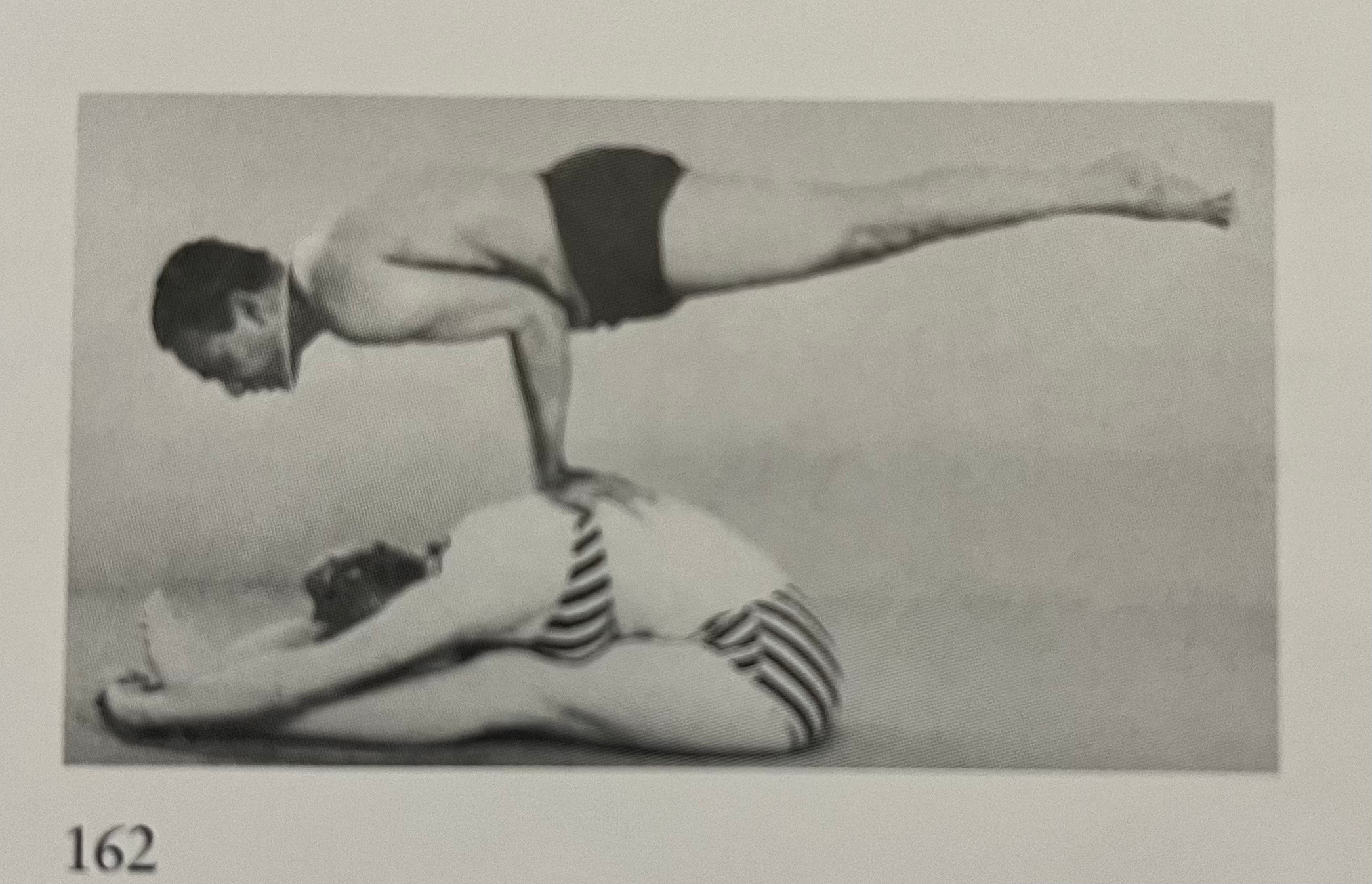
In Gstaad, Iyengar explained to A. that the nipples [must] spread out in backbends. Women don’t feel the same thing as men as they have more skin to stretch there. How can the nipples be spread out if the thorax isn’t, and how can it be stretched if all there was to do was bend at the waist, and force all the weight on the hands? This sensation can be felt only when a way to separate the thoracic vertebrae is found. Then the back establishes little by little a rhythmic and harmonious curve, and extension of the chest ensues, and only then do the nipples spread outwards. [However], never forget the master’s warning: “Don’t strain your back!

Noëlle Perez-Christiaens – a Posture Pioneer


by Dana K. Davis and Jenn Sherer

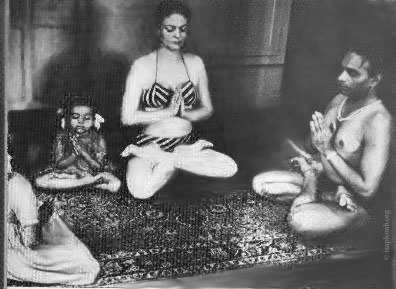
Once called a “Parisian Yoga Witch” in an online article, Noëlle Perez-Christiaens was a genius and a pioneer in the area of posture. She was born in 1925 and died August 8, 2019. This intense woman began by traveling alone to India in 1959 at age 33 to study with the famous haṭha yoga teacher, BKS Iyengar. She had studied spirituality and religion and was hoping to deepen her knowledge in India.

Noëlle was one of Iyengar’s first Western students, and spent 3 months, sometimes for 3 hours a day. Iyengar then was still teaching his pupils one-on-one at his home. During her stay in India, Noëlle was regarded virtually as one of the household, and this intimacy continued in their subsequent letters, where Iyengar wrote to her more as a colleague and friend than as a teacher.

He pushed her very hard. In her journal of her time in India (in the book Sparks of Divinity: the Teachings of BKS Iyengar from 1959 to 1975) she describes hurting everywhere, getting very sick and being exhausted. Yet she was devoted to Iyengar as her guru, and worked extremely hard to please him.

Struggling to Find the Missing Link
Back home in Paris, she worked with his teachings, and also later studied with him in Switzerland. Iyengar came to her yoga studio in Paris in 1971, 1972 and 1976 and during these visits, gave Noëlle insights that helped her realize that modern posture had become horribly misaligned.

She traveled to Africa and Portugal to study natural posture after Iyengar’s visits to Paris, where he had said that her students were not “on the axis”. She also felt heavy in the yoga poses, while Iyengar said one should feel light.

Her husband, Miguel, who she met in Portugal, was in natural alignment, or ‘Aplomb‘. Noëlle was able to study x-rays of the spines of people in natural ‘Aplomb’ and learned that people in less industrialized countries who carry weight on the head have a ‘natural arch‘ at the base of the spine, and their joints are aligned vertically. She changed the way she practiced and taught yoga as a result of these discoveries, and was able to find the lightness she had been searching for.

The Fruit of Her Work
Noëlle formed the Institut Superieur d’Aplomb in Paris in addition to her yoga studio (Institut de Yoga BKS Iyengar). In 1976 she self-published Sparks of Divinity: The Teachings of BKS Iyengar from 1959 to 1975 (in French & English). She would eventually write 27 books, only 2 of which have been translated into English (the other is Thus Spake BKS Iyengar). Always searching and learning, in 2008, in her 80s, she received her Doctorate in Ethnophysiology from the Ecole des Hautes Etudes en Sciences Sociales in Paris.

From there, Noëlle got the idea to study people who carry weight on their heads.  She traveled far and wide to find and study people who used their spines and skeletons sustainably in their every day life. Her research began in India but also led her to places like Burkina Faso, Africa; Morocco, and Portugal. She was forced to prove her work to her peers that spines were used sustainably by these people, no matter what their ethnic background. Her research and findings are recorded in her 29 books. Noëlle’s on-going work and teachings can be found at Institut Superieur D’Aplomb in Paris, www.isaplomb.org. Up to her passing in August 2019 at the age of 92, she continued to conduct empirical research and leading trips for her students to experience the physical and spiritual qualities of consciousness and connectedness that spinal awareness gives people.

Noëlle [was], as G. Lacombe says, a pupil of the first Iyengar, meaning the first period of B.K.S. Iyengar’s teaching, until 1975 – the period before he opened the Ramamani Iyengar Institute in Pune.  After the center opened, the classes became very large: 50, 60 or more pupils.”

To my knowledge, Noëlle is one [of the few] to have really followed what Iyengar was asking: “observe !”, “complete surrendering”, “you have to search”, “you must have millions of eyes”, etc. and above all, what he said to her, one day in Pune: “Go and walk behind Indian women, and observe them closely, copy them. When your shadow matches theirs, you will have made progress.”  When she really understood this, she realized that Iyengar was opening the way for an ethnographic research. The philosophical basis of Iyengar philosophy includes this ethnographic approach. That is the beginning of Noëlle’s research in ethnography. And after that the beginning of her research on people in natural Spinefulness.

Quotes from Sparks of Divinity
Here are a few quotes from Sparks of Divinity that I especially liked. You might find it interesting to apply these to your practice:

“Whether people are from the East or West, the tensions are there. Tensions are not stretches. If the stretching is good, relaxation is bound to be complete. A half-hearted stretch gives a half-hearted relaxation.” (from 1959)

“Sometimes the body says, ‘Yes,’ and the mind says, ‘Excuse me today.’ Sometimes the mind says, ‘Yes,’ and the body, ‘Excuse me.’ I always say, ‘Let us go ahead’.” (from 1959)

“Extension brings freedom” (from 1974)

“The whole body has to act. To extend a part, you must extend the whole.” (from 1974)

“As beginners, our intellect is only in the brain. You must have a million eyes, all over the body.” (not dated)

———-

Sparks of Divinity: The Teachings of BKS Iyengar from 1959 to 1975, Rodmell Press: Berkeley, 2012.

Photo of Miguel, Dana, and Noëlle from 2007, taken by Jean Couch.

Thus Spake BKS Iyengar, Part I

The following are excerpts from Thus Spake BKS Iyengar by Noelle Perez-Christiaens, ©Institut de Yoga BKS Iyengar-Paris 1979

1. RASA
YOU HAVE TO SAVOUR THE FRAGRANCE OF A POSTURE”
‘Fragrance’ is a sensory word—how can a posture have fragrance? This word expresses an agreeable sensation — how can an insufferably difficult posture produce an agreeable sensation? In this simple little word many have a chance to see that they are on the wrong track as they work to the breaking point with so much love and goodwill!

I discovered that the Sanskrit word Iyengar is translating is rasa (Patañjali, II.9). Rasa comes from the root RAS: to taste, to relish a taste; rasajña is one who savours, knows enjoyment; rasajñatva means poetic taste; rasayoga (in the plural) is a harmonious group of flavours.

Rasa is a sort of magnetic current flowing from the artist to her/his circle of auditors and back again, charged with the artistic emotion s/he created in them. It’s a tenuous, vibrating whole through which the spirit passes and transforms an ordinary Indian and makes her/ him thrill to eternal Vibration. It is el duende, which makes the matador sublime and enraptures the enthusiastic plaza, making the people rock in vibrations too powerful for simple mortals, unless they have been hoisted to that level. All this is rasa.

Is this what one experiences when toiling over ‘our’ postures or when one proudly performs fifty or a hundred backbends at a go? No. We are clearly on the wrong track: go seek elsewhere that which the Master would like to bring us to savour with him! Careful, though: Indians are excellent merchants, all Easterners are more cunning than we are, and if we are looking for something other than true fragrance, we will end by getting what we seek. Iyengar has said this clearly: “In ancient times, pupils went in search of gurus. Now gurus go in search of pupils. The is why spirituality has lost its fragrance.” (J81)

Here is a serious warning! From time to time, [we must] step back and ask ourselves sincerely what is it we are looking for, and if, we haven’t foundered in an easy, superficial, and highly physical yoga: whether we taste the rasa or not will give us our answer.

2. BRAHMĀSŪTRA
WATCH YOUR MEDIAN LINE”
Several ideas, which Iyengar describes differently, all express the same sensation, and seem all to be included in what treatises of Indian dance and sculpture call Brahmāsūtra, the thread of Brahmā. Among the sensations which Iyengar tries to make us feel are the axis, parallelism or symmetry, and the ‘median line’. Perhaps there are others: these three seem to me to be the essential ones.

As we will deal with the axis later, I will only allude to it here. However, I will try to define the sensation of the thread of Brahmā, of symmetry of the two sides of the body, or the parallel work of each side along the median line [an anatomical line created at the juncture of the medial or saggital, and frontal or coronal planes]. I believe that it does seem as though this is what Iyengar is saying several different ways.

In ancient India, no artist could begin work without having had a solid preparation in yoga, including āsana, prāṇāyāma, and [dhyāna] meditation. [S/]He therefore had to have practiced a balanced posture in a seated position, without which no cosmic reintegration is possible. It is evident, then, that the notion of ‘thread of Brahmā‘ or ‘plumb-line’ is well placed in the sūtras concerned with the dance and the proportions of statutes.

The different yoga postures are for us more and more subtle forms of balancing, or more and more refined foundations for concentration. As Iyengar says so well, they are application of an art in which the body is the material to model for the stone to chisel according to the idea the artist wishes to express. In sum, we are the stone, the sculptor is Brahmā, and the technique used is yoga. When we say ‘Brahmā‘ we might as well say: Harmony, Air, Silence, Peace, or Gravity. All of these are tangible manifestations of the non-manifested Energy, which remains quite esoteric a notion as long as It has not caught us up in Itself.

Among these tangible manifestations of Creative Energy, certain [ones] are fruits, like Harmony and Silence; others are rather agents like Air and Gravity. Without Gravity, the Air could not balance anything on the earth.

In the article The Dance and Sculpture in Classical Indian Art,* Kapila Malik Vātsyāyan writes, “Vertically, the human figure is conceived as composed of two halves, one on each side of the median line, the Brahmāsūtra, a fixed and invariable line representing the immutable force of gravity.” In a flash, we have here two notions Iyengar dwells upon: on the one hand, the axis of gravity every being must submit to, or live under pain of sprains and inflammations, in a state of constant aggression against the Cosmos – speaking of ahimsa (non-violence) but living in a state of himsa (aggression, injury); and on the other hand, the median line of the human body. Our task is always to bring the later to coincide with the former. How does the Master attempt to make us understand this median line? “The crown of the head, the centre of the forehead, the root of the nose, the tip of the nose, the middle of the sternum, all should be on the line.” (Q40) How could he be more explicit? We can well understand why he recommends to us, “always watch your median line.” (L2)

We find an echo of this in Vātsyāyan, “All movements are visualized in relation to the vertical median.” Several lines later, we read, “In Indian sculpture the study of flexion or bhañgā is essentially the study of the distribution of masses and the codification of the laws of balance.” We should not be surprised when Iyengar explains that our efforts of passivity and activity, “must test and ‘weigh’ the masses of the body on each side, as one estimates the weight of a piece of fruit in the hand.” He adds that this work of passivity and activity must balance weight evenly on each side of the body, “should weigh evenly on both the left and the right sides. Only then will lightness come.” (X322) Once all the weight has been brought gently back on to the median line and entrusted the thread of Brahmā, to Gravity, what could be left weighing heavily against it? Obviously, this work demands an enormous degree of attention. It’s a slow road but a sure one, towards great lightness — and freedom.

Iyengar explains this thought in other terms, “The right and left have to meet in the centre.”(Q40)  Consider the force conveyed by the word ‘meet’, as in the expression ‘to meet one’s death.’

Returning to Vātsyāyan, we find: “We call samabhañgā a position which is perfectly balanced: the two halves of the body, one on each side of the Brahmasūtra, are of equal weight and the distribution of the total weight is perfect. The physical balance produces a spiral and emotional balance. This is why gods and goddesses, and also humans in a state of peace (śanti), stillness, and collected thought are shown in samabhañga.” She adds that “all the sattvika pictures of Indian sculpture are shown in this attitude.

Iyengar continues: “that (meeting in the centre) means you are completely in contact; if there is looseness, there is no contact at all: the self and the body have lost the contact, so you learn nothing.” (Q40)

We could also quote many other sayings of the Master on the frantic search for balance, the gift of Brahmā the creator, which must not be held by the muscles but by the spirit, but we will content ourselves with one: “You have to work to obtain a perfect balance between both sides of the body” (K14) — here is the Brahmāsūtra again!

Echoing this union, Iyengar evokes, which arises out of the balance in Gravity, Vātsyāyan writes from a balanced creation in sculpture or dance (and we would add yoga) emanates “an aesthetic joy close to that supreme happiness that results from the union of the soul with God.” I believe his translator thought this was the best image to express the idea of the union of the ātman in the Ātman, or as Iyengar says, “the union of the Jivātman in the Parāmātman,” as we will see later on.

This work of constantly relinquishing one’s weight to gravity, to live on the thread of Brahmā and not to leave it, brings one gradually to taste rāsa. Rāsa will carry the true seeker on to ĀNANDA (Bliss).

*in Diogene, 1964, 45-48, pp 25-38

A last sentence from Vātsyāyan gives us a glimpse of the secrets of Indian mystical doctrine, which Iyengar does his utmost to transmit to us: “The position of samabhanga to which the dancer (of bharatanatyam) returns is of primary importance in Indian choreography, and , with rare exceptions, corresponds to a posture expressing the serenity of perfect balance.” She adds, “It is a position in which the weight is equally distributed between the two halves of the body.”

Bit by bit, we see the intricacy of the ideas: the centre and the two sides, the plumb-line, the thread of Brahmā, the perfect balance in the total surrender of one’s weight to Gravity. All these notions form a background against which one seems to see Iyengar as if in filagree. Two concise terms from Sanskrit appear to have produced this, Brahmāsūtra and Sama. We turn next to sama.

How to Use Yoga Props Effectively

Using yoga props can help you find balance and alignment. We break down basic poses to reeducate and still the mind by awakening the body’s intelligence.
by Leslie Peters

Yoga props reeducate and still the mind by awakening the body’s intelligence
Yoga is a complex subject with this very simple definition: yogah cittavrtti nirodhah (the Yoga Sūtra, I.2), which translated means, “Yoga is the cessation of movements in the consciousness,” according to B.K.S. Iyengar in his book Light on the Yoga Sūtras of Patañjali. Yogis divide consciousness (citta) into three parts: mind, ego, and intelligence. In his book, Light on Life, Iyengar compared these constituent parts to layers. The outermost layer is the mind. It is responsible for sifting through all of the information it receives through the five senses, as in “I’m hungry” or “I’m cold.” Because the mind constantly generates thoughts and images, Iyengar likened it to a computer that can’t stop itself from processing, or drawing distinctions, or making considered choices.

The ego is the innermost layer of consciousness. It is what gives us the sense of our separateness, or “I-ness,” and the feeling that we are at the center of everything. The ego is valuable because it is important to know that you are not the stranger sitting next to you on the bus or the tree in your front yard. But the ego has earned a negative reputation because it also holds on to all desires, achievements, prejudices, and opinions and identifies itself as being the sum total of any successes, worries, possessions, jobs, and whatever else that one has amassed. The ego clings to life and often lives in its glorious past or in the fearful future.

In between the mind and the ego lies the middle layer, intelligence. The distinguishing characteristics of intelligence are its capacity to perceive itself and its ability to choose to do something it hasn’t done before. In other words, intelligence is the part of our consciousness that enables us to objectively observe ourselves (including the mind and ego) and initiate change. Iyengar described intelligence as “the revolutionary of our consciousness.”

Iyengar wrote that when one layer of consciousness is active, it expands, causing the other layers to retract. So when we activate our intelligence, we force the overactive mind and clinging ego to recede, giving us the experience of stillness that is yoga.

The Importance of Yoga Props
Most of us think the physical brain is the only place where intelligence and perception occur. But Iyengar said that view devalues the innate intelligence of the body—the yogi’s vehicle on the path to stilling the consciousness. He insisted that intelligence can be cultivated in every cell of the body. One of the methods he developed for expanding intelligence is to use props while practicing yogāsana.

The skin is our first layer of intelligence, and the nerves in the skin feed information to the mind, Iyengar said. Since an average square inch of skin contains more than a thousand nerve endings, when a prop touches the skin, our consciousness is awakened and enlivened. Intelligence is developed not because we feel something but because we can observe where the prop touches us and where it doesn’t, and in what way the prop teaches us something new. “Every prop must make an imprint on the body,” Iyengar insisted, so that intelligence can be cultivated. There is no purpose to using a prop if we don’t learn something from it.

Stilling the fluctuations in our consciousness is a relentless, difficult, and demanding discipline. Therefore, fervor, or tapas, is essential if one wishes to progress along the path of yoga. Iyengar explained that tapas ignites the lamp of intelligence and that it is the duty of the guru to ignite the fire in each of his students and to shed the light of intelligence where there is darkness or ignorance. He likened props to gurus, meant to guide the student on the path. “Real gurus are rare and do not come often,” he often said. When the guru is not there in person, props can be used to guide the practitioner toward correct action and maximum intelligence. When used in this way, props can engage us in a process of observation, discernment, and reflection. This process will expand our intelligence and begin to teach us how to still the fluctuations of our consciousness.

Yogāsana Prop Sequence

1. Adho Mukha Śvānāsana (Downward-Facing Dog Pose)
Place a folded blanket on the floor and come onto your hands and knees. Place your hands on either side of the blanket as shown above, so they are shoulder-width apart and the middle fingers point straight ahead. Lift your knees off the floor and adjust your feet so that they are hip-width apart. Straighten your arms and legs. Rest your head on the blanket. If your head does not touch the blanket, either build up the height of support under your head or move your feet farther away from your hands. Stay for 1 to 3 minutes. Repeat the pose without the blanket and notice any differences. Compare the stretch of the legs and the extension in the spine when your head is supported and when it is not. Observe whether the arms and legs stretch better when the head rests on a support.

While you are in the pose, study yourself. It is easy to feel the places that are in contact with the floor or that are stretching. Use your intelligence to penetrate the places where you have no awareness. Iyengar says that while we are in the pose we must study the pose, not merely stay in it. Recharge the pose by pressing the hands into the floor. This will intensify the stretch of the legs. Be sure that both sides of the torso are in line and are the same length as the center of the torso. Observe where your intelligence recedes.

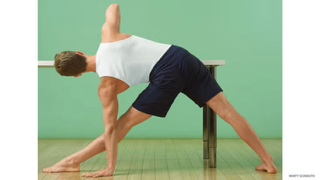
2. Utthita Trikoṇāsana (Extended Triangle Pose)
Stand facing a dining table or the back of a sofa. Separate your feet. Turn the right foot in slightly and turn the left leg out so that the left foot is parallel to your prop. Stretch your arms out to the side and, keeping the legs straight, move the left hand to the floor and stretch the right arm up. Observe the muscles in your upper back. Do you feel thickness in the trapezius muscles? (These are the large triangular muscles located where the neck and back meet.)

Observe the distance between the spine and your right and left shoulder blades. It is common for the bottom shoulder blade to move away from the spine while the top shoulder blade drops down toward the spine. Ideally, both shoulder blades should be equidistant from the spine. Most of us can’t feel what the top shoulder blade is doing in Trikonasana. We can feel the arm stretching, but that doesn’t necessarily mean the lift is there. In order to adjust and correct the pose, bend your right arm and press your right thumb into the top of your prop to move the top shoulder blade up and away from the spine and to move the trapezius muscle away from the head. The press of the thumb helps you access that shoulder blade in a way that is not possible without the resistance. Stay in the pose for 1 minute. Repeat the pose on the other side.

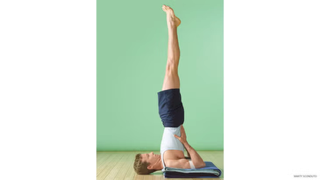
3. Sālamba Sarvāṅgāsana (Supported Shoulderstand)
Place a neatly folded stack of three blankets on the floor. Make a loop in a belt that is large enough so that when you slip it on your arms just above the elbows, the elbows are in line with your shoulders. Don’t make the loop too small or too large. Place the belt around the arms just above the elbows. Lie on your back with your shoulders on the blankets and head on the floor (your neck should not be on the blankets). As you lie there, notice where the belt touches the arms. Does the belt touch both arms in the same place and in the same way? Lift your legs up to come into Shoulderstand. Place your hands on your back. Keep your legs straight. Do not turn your head while in the pose.

According to Iyengar, the belt is used in this pose to educate the skin and muscles of the arm. It is not used as a support, nor does it stabilize the arms and keep them from moving apart. The feedback from the belt should give you answers to questions such as: Where does the belt touch each arm? Where do I feel the belt? Where don’t I feel the belt? Is one arm pulling toward the belt? If the belt feels different on each arm, which arm is doing the correct action?

Use the feeling of the belt against the arms to constantly adjust your pose. The biceps should rotate from the inside out. The more you turn the biceps out, the more the shoulder blades go up. When you come out of the pose, look to see whether the belt left a mark on your arms. It shouldn’t have. If a mark is there, it is an indication that your arm was pressing against the belt. The next time you practice the pose, see if you can correct the action in that arm.

[All yogāsana practice must be followed by śavāsana.] To set yourself up properly place one thin, folded blanket on the floor. Lie over it so that the blanket is perpendicular to the spine and below the base of the shoulder blades. Place another folded blanket under the head. Allow the shoulders to rest on the floor. This support creates a gentle lift for the sternum, which is soothing to the nerves. [Now, while focusing on your breath with closed lids, let go.]

Post

Leslie Peters was executive director of the B.K.S. Iyengar Yoga Institute of Los Angeles, and is now president and co-founder at Peters & Love.

How to Obtain Samādhi Through Your Prāṇāyāma Practice

Practicing prāṇāyāma is essential if you hope to experience samādhi, yoga‘s true purpose

by Leslie Peters

You’ve probably heard that the word yoga comes from the Sanskrit root yuj, which means to yoke or unite. And that the ultimate goal of yoga is liberation, also known as samādhi,through the union of the individual self with the universal soul. But just how do we unite what we perceive as a small individual self with something as vast, invisible, and ineffable as the universal soul?

An ancient yoga textbook, the Haṭha Yoga Pradīpikā, offers this simple answer: “Breath is the key to ultimate emancipation.” The Upaniṣads, the Hindu sacred scriptures, likewise equate pāṇa, in the form of breath, with the universal soul. When it is done properly and when a yoga practitioner is ready, prāṇāyāma, the yogic practice of regulating and channeling one’s breath, can provide a bridge between the individual self and the universal soul.

B.K.S. Iyengar explains how the three stages of the breath in prāṇāyāma—inhalation (pūraka), retention (antara kumbhaka), and exhalation (rechaka)—can connect us to the universal soul. During our inhalation, we are inviting prana to come in. According to Iyengar, the individual self must then move out of the way in order to make room for the soul. Iyengar believes that through this process, we are able to generate energy, expansion, and awareness within.

Iyengar tells us to think of the contact of the breath against the inner lung as the connection between universal soul and individual self. When we consciously stop the flow of breath (retention), we organize the mind’s thoughts and the body’s experience. The length of the retention varies. It should last just until the content (prāṇa) begins to move away from the container (the lung). We must keep the mind connected to the experience of the body to know when it’s time to exhale.

Practicing Prāṇāyāma to Relieve Stress
It is our goal to know at exactly what second the soul and the self begin to release away from each other. That is exactly when the exhalation should begin. Developing the ability to feel something as subtle as when the universal soul and the individual self begin to separate in the course of a breath takes regular practice and is what prāṇāyāma is all about.

Iyengar believes that in normal breathing, the brain initiates the action of inhalation and draws energy to itself. This keeps the brain in a state of tension. When the brain is tense, the breath is constricted. But in prāṇāyāma, the brain remains passive, and the lungs, bones, and muscles of the torso initiate the inhalation. Rather than suck in air, the lungs, diaphragm, ribs, and abdomen receive the breath. In describing the practice, Iyengar says that the breath must “be enticed or cajoled, like catching a horse in a field, not by chasing after it, but by standing still with an apple in one’s hand. Nothing can be forced; receptivity is everything.” We are to do prāṇāyāma with our intelligence, as opposed to our brains, Iyengar says.

By practicing prāṇāyāma and regulating the flow of prāṇa with measured observation and distribution of the breath, the mind becomes still. When this happens, we can allow the energy we normally spend engaging with and processing the world to bend inward.

According to Iyengar, āsana practice makes the body fit for prāṇāyāma, and prāṇāyāma practice makes the mind fit for meditation. In order for us to reach the ultimate union of our individual self with the universal soul, we must first experience dhyāna, or true meditation.

Iyengar insists that true meditation cannot be done if the practitioner “is under stress, has a weak body, weak lungs, hard muscles, collapsed spine, fluctuating mind, mental agitation, or timidity.” Furthermore, he says that sitting quietly is not considered true meditation, nor does he recognize meditation as a stress reliever. He believes that the practitioner should already have achieved a stressless state in the body and brain before meditation can occur. When performed correctly and without strain, prāṇāyāma cools and rests the brain and floods the body with vital energy. It relieves stress and, therefore, prepares us for true meditation.

Moving from Āsana to Prāṇāyāma
Patañjali wrote in the Yoga Sūtra that moving from āsana to prāṇāyāma is a big step. He warned that we must build enough strength and stability in the body and nervous system through our āsana practice first, in order to withstand the increase in energy flow that prāṇāyāma generates. Prāṇāyāma is an advanced practice. It was only after many years of āsana practice that Iyengar says he slowly began to build a prāṇāyāma practice. It took him many more years and great effort to sustain it. He didn’t have the guidance of a teacher and made all the mistakes that Patañjali warned against. Because making these mistakes can be quite harmful, Iyengar advises that if you want to practice prāṇāyāma, you should do so only if you have a teacher with whom to work.

Iyengar also cautions that if at any time during the practice of prāṇāyāma you experience pain in the head or tension in your temples, it means that you are initiating the breath from your brain, not your lungs. If this happens, return to normal breathing and relax.

Achieving Prāṇāyāma Through Śavāsana
In the ancient yogic texts, the practice of prāṇāyāma was always taught in a seated position. However, Iyengar noticed that maintaining the correct seated posture required so much effort for many students that they were not able to practice the various breathing exercises without great strain. He decided that allowing practitioners to lie down in a variation of śavāsana, in which the spine and chest are supported, created enough relaxation so that the breathwork could be done safely. He recommends that students lie down if they are new to the practice or are ill or fatigued.

The drawback to lying down is that the breath is constricted because the back lungs press against the support. Longtime practitioners prefer to sit because the entire torso is free to move— in front, in back, and on the sides. In Light on Prāṇāyāma, Iyengar says the practitioner needs two essential things: a stable spine and a still, but alert, mind. Both of these are built up with a strong āsana practice. Given the hazards of forcing a prāṇāyāma practice, it’s best to build your practice slowly and with care.

When lying down for prāṇāyāma, use blankets to support the spine and head. When the props are positioned correctly, the chest opens and relaxation results. When positioned incorrectly, the lower back and neck harden. Lie so that the buttocks rest on the floor and the blankets support the sacral and lumbar regions of the back. Your height and level of flexibility will dictate the distance between your buttocks and the end of the bottom blanket as well as between the bottom edges of the two blankets. The end of the top blanket will be between three-fourths of an inch and an inch and a half from the edge of the bottom blanket. If your head tips back when you lie down, put a block under it with a blanket on top. The skin of the forehead should flow toward the eyebrows.

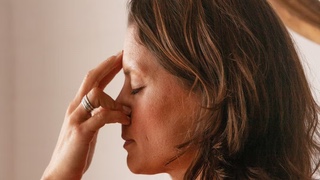
Prāṇāyāma begins with observation. As you lie there, relax your entire body and begin to observe your breath. After several minutes, you will notice that your breath has become slower and slightly deeper, because you have relaxed. As you breathe normally, notice where you feel the breath in your body. Does your abdomen move with each breath? Do you feel your ribs move when you inhale and exhale? At the end of a normal exhalation, pause for a second or two before taking your next inhalation. It should be soft and smooth. If you feel tense, or are gasping for air, your pause was too long. Add a slight retention at the end of the exhalation several times. Then try taking a slightly deeper inhalation. To initiate the breath, move your ribs outward to the side. Instead of forcing the breath in, move the ribs to allow it in. When you have taken that slightly deeper breath, pause for a second before you slowly and smoothly exhale.

If you feel tension anywhere in the body, or if you find yourself gasping for air, you have done too much and have been too aggressive. If you feel relaxed and calm in your body, especially in your head, practice the complete cycle: a short pause at the end of an exhalation; then a slow, relaxed inhalation initiated by the rib cage moving outward; a slight pause at the end of the inhalation; then a slow, complete exhalation followed by a short pause. All of this should be done without any tension in the body. If you feel tense or nervous at any time, simply return to normal breathing, observe your breath, and relax. Practice this pranayama as long as you can stay focused and relaxed. Start slowly and build up your practice over time.

Seated Prāṇāyāma
Sitting properly takes a great deal of effort and strength. In order to do prāṇāyāma in a seated position without strain, the body must be quite supple and strong. A steady āsana practice will build the necessary strength and flexibility to sit correctly. When you’re learning to do seated prāṇāyāma, it is essential that you feel stable in the posture before adding the breath. If you cannot take a deeper inhalation without strain while seated, just practice sitting without adding the breath. You can continue to learn the breath while lying down. When the seated posture is correct, the breath will come. Don’t force it.

Sit in a simple cross-legged position. Use enough blankets under your hips so that your knees are parallel to or below your hips, not above them. In an attempt to lift the spine, many of us harden the lumbar spine and draw it inward, which moves us to the front of our sitting bones. To sit correctly, center yourself on the points of the sitting bones and draw the front spine and side chest up without creating hardness in the low back. Release the back of the neck and move the head down.

When you practice prāṇāyāma in a seated position, you must move the head down to create jālandhara bandha. A lifted head brings pressure to the heart, brain, eyes, and ears.

Post-Prāṇāyāma Śavāsana
After practicing prāṇāyāma of any kind, it is important to end with śavāsana in order to soothe the nerves and erase any tension that you may have inadvertently created during the practice. Also, after prāṇāyāma, you should wait at least 30 minutes before practicing āsanas. It is too jarring to the nervous system to go immediately from the quiet, calming practice of prāṇāyāma to the more active, physically demanding practice āsana. Allow for a gentle transition between your prāṇāyāma and any activity you choose to engage in following the practice.

To set yourself up properly place one thin, folded blanket on the floor. Lie over it so that the blanket is perpendicular to the spine and below the base of the shoulder blades. Place another folded blanket under the head. Allow the shoulders to rest on the floor. This support creates a gentle lift for the sternum, which is soothing to the nerves.

“Super Agers” Author and Dr. Eric Topol Interview Transcript

Often we’re warned about the risks of an aging population, the so-called demographic gray zone, the drain on the economy, medical services, and so much more. But author and Dr. Eric Topol suggests that’s no longer the case.

He argues that, in fact, new technology and medicine will provide us with vibrant, healthy lives much later on. Now he joins Walter Isaacson to discuss what he calls a breakthrough moment in the history of human healthcare.

Thank you. And Dr. Eric Topol, welcome back to the show.

Great to be with you again, Walter.

You know, this book, “Super Agers,” it’s a lot different than the books about how to age well and stuff because it’s so evidence-based.
Were you showing this sort of as a counterpart to all these bestsellers that have all sorts of new theories but aren’t evidence-based?

That certainly was part of it. I think you know, the idea that we’d already been active trying to hunt down the source of healthy aging, of super-agers, of welderly, whatever you want to call these remarkable folks, was very different than what’s out there.

And so you know, trying to set the record straight, putting in some around 1,800 citations, but really, as you said, Walter, going over the real exciting advances in the science, too.

We always talk about lifespan. We want to increase lifespan. And you talk about healthspan. Why do you focus that way?

Yeah, I don’t see the reason to promote longevity if you’re not also getting as much healthspan out of it as possible. Because if you have someone of advanced age and they’re so frail or demented or something that’s really compromised terribly their quality of life, that isn’t what we’re aspiring to do.

The real goal is just to get as many fully healthy years as possible. And we’re not doing that now. Most of the American population are the elderly, not the welderly or the super-agers. But I [believe] we have the capacity now to flip this. And over the years ahead, we’d have a lot more welderly and super-agers than people with chronic age-related diseases.

You both begin the book and you end the book with a couple of patients. I think it’s Mrs. L.R. and Mr. R.P. Tell me why you use them.

Yeah, so Lee Rusall, who’s happy to be identified, but was referred in the book, as you said, Walter, to Mrs. L.R., she was a patient recently in my clinic, 98, and incredibly intact. And also with a great sense of humor and just having a very rich life.

And she made me think about our welderly study of the 1,400 people like her, the average age was in their late 80s, never been sick, no medications. These are a rarefied group of people.

It took us seven years, Walter, to find 1,400 of these folks.

Well, because she’s so emblematic of healthy aging and the striking features were her relatives, her parents and her two brothers died 30 or 40 years of age younger than her. She’s the last one standing.

So it wasn’t just purely genetic?

Not at all. And in fact, that’s what we found in our welderly study is that when we, not only was the familial pattern a lot like Lee Rusall, but we did whole genome sequencing, and we found very little that could account for this remarkable super aging status.

So let’s start looking at the factors for super ages and start with lifestyle, if you would, what you call lifestyle plus.

Yeah, because while we’ve concentrated largely on diet and exercise, sleep is equally important. And then there’s these other factors like social engagement, avoiding isolation, being out in nature.

These have really strong support, as do the environmental toxins of air pollution, of forever chemicals and the microplastics, nanoplastics story. So it all fits into a simple model that the things that promote inflammation, like a poor diet, ultra processed food, overdose of proteins, lack of deep sleep, the lack of exercise and physical activity, the toxins from our environment.

They all fit in the model that if you promote inflammation that occurs more as we age or immunosynthesis, the deterioration of our immune system as we age, which are intertwined, that’s where you get age related diseases.

You talk about sleep though. Can we go back to that? Because one of the surprising things in your book was you said you should get about seven to eight hours of sleep.
If you get less, it’s a problem. But you also said if you get more, it’s a problem.

That’s right. And the question is, even start to see over seven hours, do you see this adverse linkage?
The question there is, is it because people have depression or is it really something about too much sleep that is not helpful?

We don’t really know, but the population studies where of course, everyone’s different. And we emphasize that if you look at it from a big population level, seven hours, not often what’s referred to as eight plus is the optimal level. But obviously that’ll vary from one individual to another.

What does sleep do for us?

Yeah. That’s the big thing that we’ve learned in recent years. So the one component of sleep known as deep sleep, the slow wave of sleep typically occurs in the early hours of sleep. That is the critical time when we use our glymphatics, not lymphatics, but glymphatics in our brain.

These are the channels that get the waste products, these toxins that we accumulate through our brain metabolism each day. And at night or whenever you sleep, that’s when these glymphatics go to work and get these toxins out of our brain, which are very pro-inflammatory.

If you don’t get enough deep sleep, which as we get older, we lose our propensity for deep sleep. If you don’t get enough, you don’t get these waste products out. And not only that, but if you take medications like Ambien, everything points to that you get basically a backup of these toxins. You may get some more sleep, but you’re not doing anything regarding deep sleep and clearance of these waste products.

With alcohol, every year we seem to have some new studies saying one drink is horrible, one drink is great or whatever. There’s a new study out from the American Heart Association. I saw that you even have written about some. Tell me what you feel now about alcohol consumption.

Yeah, the point you’re making, Walter, it’s really the problem. Depending on which report, looking often at the same data, the conclusions are quite different. Overall, it does look like if you are at risk for cancer, particularly certain types of cancer like colon or esophageal and even breast cancer, if you’re more than one to two drinks a day, you’re getting into a risk zone. There is a convergence of that.

There’s also the National Academies of Medicine and the Circulation American Heart reports that say, “Hey, there really is some benefit of alcohol for men up to one drink per day or seven per week and for women, perhaps four or five per week.” So we have mixed data. The problem, again, is we’re trying to come up with these reports and recommendations for all people.

By the way, let me push back on the all people. Why can’t I sequence my genome, put it in a computer and have it tell me, “You’re okay with salt. Your cholesterol is not going to be affected by meat or it will be. And by the way, you can do alcohol or you can’t do alcohol.”

We should be doing that because we can do that right now, Walter. Like for example, you can get a polygenic risk score, which isn’t even require a full genome sequence. It will tell you every different cancer risk.

If your cancer risk is really low across the board, your concern about drinking alcohol would be less, not to go excessive. But we don’t do that. We treat everybody the same and this is really part of the problem. And that is the ticket to prevention as well.

Wait, well, why don’t we do that?

Yeah, it’s because the medical community is slow, slow, slow, so slow to adopt the body of knowledge. Everything sits in this research compartment, like a different orbit, Earth one, and the medical practices like Earth two. And it’s just really frustrating. It takes so long to take validated, compelling data and put it into daily medical practice.

One of the biggest differences between having a long lifespan and a healthy long lifespan or a health span is dementia and specifically Alzheimer’s. What causes Alzheimer’s?

Well, there’s been the amyloid hypothesis and the tau hypothesis. Basically the story is there’s misfolded proteins that get in the brain, develop in the brain, and we develop a very severe inflammation response. If we do that, we’re gonna more likely go on to Alzheimer’s disease.

Now, turns out a lot of healthy people may have these misfolded proteins, but they don’t have the inflammatory response to them. So you don’t have to worry about the amyloid hypothesis or the tau hypothesis.

Basically, what you want is to not have this misfolded protein and its inflammatory reaction occur in your brain. We have a way to do that now. We have a marker called P-tau-217 that a lot of people and doctors don’t know about. And it can tell us more than 20 years in advance that you are a high vulnerability.

So what happens if I learn 20 years in advance?

Yeah, that’s what’s great. It’s kind of like if you’ve been following, I suspect you have, because you follow a lot of stuff, the LDL and the cholesterol story. You lower the LDL and you have less heart disease.

The same thing, if you have a high P-tau-217, and the only reason to get it is because you have a familial pattern of Alzheimer’s, you have an APOE4 or a polygenic risk that’s increased.

Anyway, you’re at higher risk, you get the P-tau-217. And if you’re relatively young, you’re in the 40s or 50s, you’ve got a 20 year lead time. Now, when you start to lose weight, exercise, have a better diet, that’s not pro-inflammatory, sleep better with high quality deep sleep, those markers come down.

It’s remarkable. It’s modifiable.

And so we should be able to prevent Alzheimer’s because we have brain clocks, we have these markers, we have even healthspan clocks from these proteins in our blood now. So you can not just use these clocks to tell about risk and markers, but then you can use them to see if the interventions are working.

And one of the exciting things, I know you’re aware of this, but these GLP-1 drugs like Ozempic and Mungero, Zep-Bound, they are being tested for Alzheimer’s in people who are not overweight in large trials, which we’ll have in the beginning of next year. That may work because these agents, these drugs markedly reduce inflammation in the brain and in the body.

And we haven’t had any drugs like that previously.

So if we can control the inflammation process and these drugs, as well as other gut hormones are going to do that for us, we’re going to have a way, not just lifestyle factors, but in the high-risk people to bring down the markers, the metrics of the aging brain, the sick brain that’s emerging towards Alzheimer’s years before people ever get mild cognitive impairment.

Wow. You talk about Ozempic and the similar GLPs. How much of a miracle drug is that?

Well, we’ve never had a family of drugs like this. And I want to just submit to you that we’re still in the early phase of this. What we’ve learned, now there’s like 15 different gut hormones. We only are into two or three of these that talk to the brain and talk to the immune system. This gut-brain axis is one of the most important discoveries for our health in history. And this drug class reflects that.

As you know, these GLP-1 drugs are not just influencing diabetes, you know, favorable effects, improving people’s obesity status, but they’re also improving the heart, the kidney, the liver, I mean, virtually every organ. And the last one to be tested of major organs, which is in progress in large trials now is the brain.

But even if these, even if Ozempic, which is the lead one as far as these trials, even if that doesn’t hit, there’s many other of these gut hormones that are going to be in pill form, various combinations, some of which get in the brain far better. They don’t rely just on the gut to brain signaling.

That’s what’s going to take us to ability and these other anti-inflammatories to prevent these three diseases, cancer, neurodegenerative, and cardiovascular, because they all have common threads and they all take 20 years to take hold in our body.

The things you’ve talked about, the immunotherapies, the GLP and the Ozempics, all were part of basic science research that led to discoveries that may not have even been expected. And we move it from the lab bench to the bedside, but now we’re cutting basic science funding and the National Institutes of Health. How harmful is that going to be to the breakthroughs we’re just beginning to see?

Well, you’ve nailed it there because this is the most extraordinary time in my four decades in medicine where these discoveries, and of course, the multimodal AI to analyze all the person data is here and now. So we are at the extraordinary moment of a series of breakthroughs, some of which we’ve reviewed in our conversation.

And at the same time, we’re taking down the chance for building on this by seeing near $20 billion gutted out of the NIH. And then all the other public health and science agencies of our government are similarly being dismantled.

So our ability to follow through and build on this progress is going to be profoundly compromised. It will go forward, but at a different pace.

Wait, wait, let me put a fine point on it. You’re saying these cuts will cause more people to die of cancer?

Well, to put it another way, the advances that we could make in cancer to save lives and prevent cancer will be put many years forward. So the corollary of what you just said, I believe is true.

We’re missing the chance to have better treatments and preventions by not supporting our biomedical research engine, the crown jewel of the world, by just taking in a reckless way, taking away its support. It’s no doubt going to hurt the health of a large number of people in the United States.

Tell me about health inequities in the United States and whether that’s a problem for overall health.

It’s a big issue. And it’s one of the biggest concerns is the things that we’ve been talking about, the prevention of age-related disease. The people who are the most indigent, the lowest socioeconomic status have the most to gain, the most need, and they may be the least to be able to be advantaged here.

So you have to go after this. You can’t just assume when you have some new thing that the people who need it the most are going to get it. And we could make inequities worse. And they’re already at a serious level in this country. So it’s certainly one of the concerns that I have.

Dr. Eric Tobel, thank you so much for joining us.

Thanks, Walter. I really enjoyed the conversation with you.