by Dana K. Davis and Jenn Sherer

Once called a “Parisian Yoga Witch” in an online article, Noëlle Perez-Christiaens was a genius and a pioneer in the area of posture. She was born in 1925 and died August 8, 2019. This intense woman began by traveling alone to India in 1959 at age 33 to study with the famous haṭha yoga teacher, BKS Iyengar. She had studied spirituality and religion and was hoping to deepen her knowledge in India.
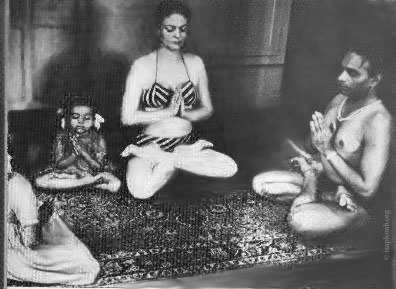 Noëlle was one of Iyengar’s first Western students, and spent 3 months, sometimes for 3 hours a day. Iyengar then was still teaching his pupils one-on-one at his home. During her stay in India, Noëlle was regarded virtually as one of the household, and this intimacy continued in their subsequent letters, where Iyengar wrote to her more as a colleague and friend than as a teacher.
He pushed her very hard. In her journal of her time in India (in the book Sparks of Divinity: the Teachings of BKS Iyengar from 1959 to 1975) she describes hurting everywhere, getting very sick and being exhausted. Yet she was devoted to Iyengar as her guru, and worked extremely hard to please him.
Struggling to Find the Missing Link
Back home in Paris, she worked with his teachings, and also later studied with him in Switzerland. Iyengar came to her yoga studio in Paris in 1971, 1972 and 1976 and during these visits, gave Noëlle insights that helped her realize that modern posture had become horribly misaligned.
She traveled to Africa and Portugal to study natural posture after Iyengar’s visits to Paris, where he had said that her students were not “on the axis”. She also felt heavy in the yoga poses, while Iyengar said one should feel light.
Her husband, Miguel, who she met in Portugal, was in natural alignment, or ‘Aplomb‘. Noëlle was able to study x-rays of the spines of people in natural ‘Aplomb’ and learned that people in less industrialized countries who carry weight on the head have a ‘natural arch‘ at the base of the spine, and their joints are aligned vertically. She changed the way she practiced and taught yoga as a result of these discoveries, and was able to find the lightness she had been searching for.
The Fruit of Her Work
Noëlle formed the Institut Superieur d’Aplomb in Paris in addition to her yoga studio (Institut de Yoga BKS Iyengar). In 1976 she self-published Sparks of Divinity: The Teachings of BKS Iyengar from 1959 to 1975 (in French & English). She would eventually write 27 books, only 2 of which have been translated into English (the other is Thus Spake BKS Iyengar). Always searching and learning, in 2008, in her 80s, she received her Doctorate in Ethnophysiology from the Ecole des Hautes Etudes en Sciences Sociales in Paris.
From there, Noëlle got the idea to study people who carry weight on their heads. She traveled far and wide to find and study people who used their spines and skeletons sustainably in their every day life. Her research began in India but also led her to places like Burkina Faso, Africa; Morocco, and Portugal. She was forced to prove her work to her peers that spines were used sustainably by these people, no matter what their ethnic background. Her research and findings are recorded in her 29 books. Noëlle’s on-going work and teachings can be found at Institut Superieur D’Aplomb in Paris, www.isaplomb.org. Up to her passing in August 2019 at the age of 92, she continued to conduct empirical research and leading trips for her students to experience the physical and spiritual qualities of consciousness and connectedness that spinal awareness gives people.
 Noëlle [was], as G. Lacombe says, a pupil of the first Iyengar, meaning the first period of B.K.S. Iyengar’s teaching, until 1975 – the period before he opened the Ramamani Iyengar Institute in Pune. After the center opened, the classes became very large: 50, 60 or more pupils.”
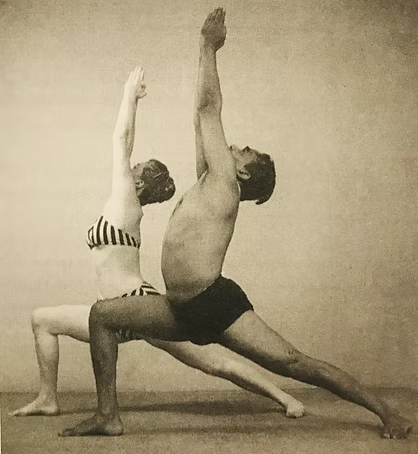
To my knowledge, Noëlle is one [of the few] to have really followed what Iyengar was asking: “observe !”, “complete surrendering”, “you have to search”, “you must have millions of eyes”, etc. and above all, what he said to her, one day in Pune: “Go and walk behind Indian women, and observe them closely, copy them. When your shadow matches theirs, you will have made progress.” When she really understood this, she realized that Iyengar was opening the way for an ethnographic research. The philosophical basis of Iyengar philosophy includes this ethnographic approach. That is the beginning of Noëlle’s research in ethnography. And after that the beginning of her research on people in natural Spinefulness.
Quotes from Sparks of Divinity
Here are a few quotes from Sparks of Divinity that I especially liked. You might find it interesting to apply these to your practice:
“Whether people are from the East or West, the tensions are there. Tensions are not stretches. If the stretching is good, relaxation is bound to be complete. A half-hearted stretch gives a half-hearted relaxation.” (from 1959)
“Sometimes the body says, ‘Yes,’ and the mind says, ‘Excuse me today.’ Sometimes the mind says, ‘Yes,’ and the body, ‘Excuse me.’ I always say, ‘Let us go ahead’.” (from 1959)
“Extension brings freedom” (from 1974)
“The whole body has to act. To extend a part, you must extend the whole.” (from 1974)
“As beginners, our intellect is only in the brain. You must have a million eyes, all over the body.” (not dated)
———-
Sparks of Divinity: The Teachings of BKS Iyengar from 1959 to 1975, Rodmell Press: Berkeley, 2012.
Photo of Miguel, Dana, and Noëlle from 2007, taken by Jean Couch.
 Rafael Durán