The following are excerpts from Thus Spake BKS Iyengar by Noelle Perez-Christiaens, ©Institut de Yoga BKS Iyengar-Paris 1979
3. SAMA
“EVERYTHING SHOULD BE SYMMETRICAL”
To understand this esoteric pronouncement, let us go back to the Sanskrit. The word sama means same, equal, similar, alike, identical to. We have encountered it in the second name of the posture tāḍāsana, samasthitiḥ. Saṃasthiti (with a point under the ‘ṃ‘) is an adjective signifying ease, comfort. In this word the notion of comfort and ease is inescapable. Samāna means homogenous, identical, of the same sort: samāyuj (YUJ being the root which gives us ‘yoga’) means to adjust, to join: samāyoga is a junction, a union. Here is the idea of two identical things joined or enrolled together in the same action.
Now I [believe] we are ready to scale the prodigious heights of the Master’s thought: “Everything should be symmetrical: that is why yoga is a basic art.” This sentence helps to understand the following: “Take each pore of the skin for a conscious eye; adjust and balance gently your body from inside with the help of these conscious eyes as it is difficult for normal eyes (the outside ones) to observe and correct the body position (adjusting it from both sides).” Here indeed is the notion of sama, a balance, a parallelism creating harmony. He continues with more precision of thought: “Geometrical adjustment – you must be balanced – use both sides of the mind.” Here we might use the Sanskrit samāyoga! He returns to the notion of parallelism in the body: “Challenge and counter-challenge should weigh evenly on both the left and right sides. Only then will lightness come.” Clearly an equal weight, that is to say, an equal absence of weight, must be felt on both sides for lightness to be tasted. In other words, tāḍāsana first passive, then active, should bring lightness to both right and left sides evenly, for the work of yoga to operate its wonders in us.
Here is another sentence on the observance of parallelism in life and therefore in its preparation, the work on the equality in one’s foundation in yoga: “When I ask you to stretch your spine, you stretch in the middle where Suṣumṇa* is, but you should relax in the middle and stretch both sides: śakti will be free only then.” How can one better express the work of ‘active’ tāḍāsana, of the unimpeded diaphragm? When I think of the years I had to labour in order finally to be able to relax in the middle, instead of concentrating, [by letting] my ‘wings’, as Iyengar calls floating ribs, work peacefully! Yet I [only] first ‘heard’ this admonition in 1965.
Once Śakti is free, Kuṇḍalinī awakens, floods the whole being with incredible warmth, and hurdles it into the cosmic dance of Energy which is It and is manifested in the relative.
[*Suṣumṇa is the main energy channel in the subtle body, running along the spine and connecting the chakras from the base to the crown of the head. It is considered essential for the flow of vital life force energy, or praņā, and is associated with spiritual awakening and meditation practices.]
4. KRAMAYOGA
“RHYTHMICAL STRETCHING OF THE SPINE”
We come now to an even more impenetrable notion, that of rhythmical stretching. “Rhythm has to be observed in yoga,” says Iyengar. Do you ‘see’ what he means? I didn’t. [Although] as early as 1959, he wrote me: “In āsana, too, maintain a detached attitude to the body and at the same time do not neglect to stretch fully. Rushing to things saps the strength. The mind should be calm and everything should be done in rhythm.”
Later, the phrase “rhythmical stretching of the spine” [finally] pierced my ear-drum. Could this [also] be contained in sama?
Rather, why not, in Krama? Krama comes from the root KRAM, which means to advance, to go towards, to approach. The dictionary reveals interesting meanings for Krama which enlighten for us one of the least known aspects of Iyengar’s thought and teaching. These are: order, succession, series, and even ‘way of acting.’ Kramayoga means suite, succession, ordering. Thanks to Mademoiselle Esnoul, we can add ‘rhythm’ to this list. Kramayoga means rhythm.
Fine, but how can one do a yoga posture with rhythm? How can one stretch one’s spine rhythmically? There is a notion of ‘stepping’ in KRAM; to take steps, to advance with regular even steps. But I still didn’t understand: to me, rhythm denoted a regular beat in time. Cardiac rhythm, or respiratory rhythm, or the rhythm of my metronome at the piano, were all familiar examples of rhythm to me – ones in which the beat became more or less frequent in time.
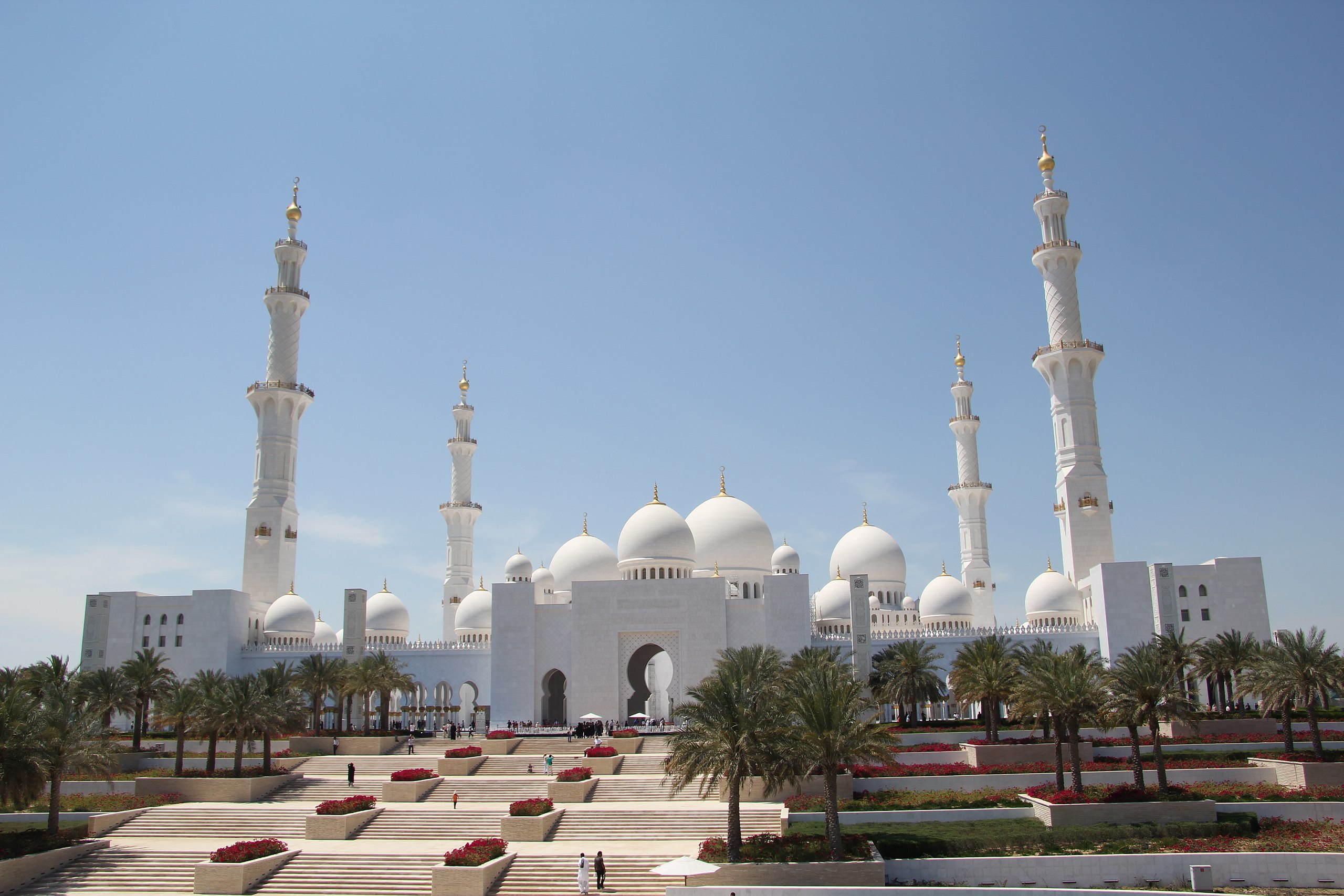 In the course of my research, I came across a book on Sufism which described a certain mosque (also serving as a university) consisting of a central courtyard around which a certain number of pavilions were rhythmically distributed. The accompanying diagram clearly showed that these pavilions were harmoniously placed equidistant one from another, creating a beautiful, harmonious whole.
Then light dawned, and I understood finally how to make my students do backbends: little by little, [all the while] creating an equal space between each vertebra. Rather than a disharmonious and dangerous angle in the lower back, the goal [instead must be] a smooth curve embodying the spine from sacrum to the last vertebra of the nape. In order to achieve this, we must apply the saying previously cited: [avoiding all] compression in the spine, no matter how small, in the spine, [ensuring] no posterior muscle work, [instead leaving] the job to the big operator, the diaphragm and its team (which Iyengar calls the work of the ‘anterior muscles of the spine’). Then Suṣumṇa is free. ‘The way of the Lord has been prepared.’ And Kuṇḍalinī or Śakti awakens and circulates. Then you could almost cook an egg on the pupil’s back, such is the heat generated! [In addition] the silence created by the intensity of the concentration needed to maintain a stable foundation is so intense that an infinite peace seeps in all over, and the minutes ago by unnoticed.
In Gstaad, Iyengar explained to A. that the nipples [must] spread out in backbends. Women don’t feel the same thing as men as they have more skin to stretch there. How can the nipples be spread out if the thorax isn’t, and how can it be stretched if all there was to do was bend at the waist, and force all the weight on the hands? This sensation can be felt only when a way to separate the thoracic vertebrae is found. Then the back establishes little by little a rhythmic and harmonious curve, and extension of the chest ensues, and only then do the nipples spread outwards. [However], never forget the master’s warning: “Don’t strain your back!“
 Rafael Durán