DUMP THE SLUMP

by Julie Gudmestad
Published in Yoga Journal, November 2005

Good posture is possible even without your mom nagging you. One key is stretching and strengthening the muscles around your shoulder blades.

FOR MANY PEOPLE, PROPER posture in the shoulders is elusive. On the few occasions when you straighten up, you briefly taste that sweet spot of stability. Most of the time, though, you probably live in slump land-or you go to the opposite extreme and adopt a military posture, pushing your chest forward and up and wrenching your shoulder blades back toward your spine. But when your shoulder blade alignment is just right-when none of the surrounding muscles are short, tense, overstretched, or weak-it feels marvelous.

The difficulty, of course, is in finding and maintaining that posture. But it’s worth the effort; not only do you look better when you stand up straight, but you’ll also have fewer aches and pains in your neck and back and you’ll be able to practice yoga more easily. If you spend too much time looking like a soldier at attention, the tightness in the muscles between your shoulder blades will make it harder to raise your arms overhead, whether you’re reaching for a top shelf, pressing back into Adhomukha śvānāsana (Downward-facing dog pose), or reaching for the sky in Vṛkṣāsana (Tree pose). And if you slump, you probably have a hard time doing backbends and have a limited range of movement in your shoulders.

https://www.youtube.com/watch?v=D3GVKjeY1FM&t=240s

Firm Foundation
ALONG WITH THEIR ROLE in posture, the scapulae (shoulder blades) act as the foundation for the arms. The stability and mobility of your shoulder blades depend almost entirely on the muscles that attach to them. That’s because each scapula contacts the rest of the skeleton only in a small joint at the clavicle (collarbone). Fifteen muscles attach to each scapula, and their actions are complicated, so we’ll focus on just two opposing muscle groups that are crucial for both good posture and complete shoulder function: the adductors, which pull your shoulder blades toward your spine, and the abductors, which draw them away from it.

At Ease
IF “ATTENTION” IS YOUR default position, you need to teach the muscles that adduct your scapulae (your trapezius and rhomboids) to soften. The “traps” lie just under the skin and run from the base of the skull and the spine out to the shoulder blades, covering most of your middle and upper back. The middle trapezius, whose fibers run horizontally from the upper- and middle-back vertebrae to the inner edge of the scapula, does much of the work of pulling the shoulder blade toward the spine. It gets help from the upper and lower parts of the trapezius: Along with pulling the shoulder blade toward the spine, the upper trap lifts it, while the lower trap pulls it down. But those actions usually cancel each other out, so when the whole muscle contracts it pulls the shoulder blade toward the spine. Immediately beneath the trapezius lies the rhomboid. Running between the upper-back vertebrae and the inner edge of the scapula, this muscle exerts an upward pull as well as a strong adduction.

Several yoga poses can help you stretch your traps and rhomboids. In Balāsana (Child’s pose), you can breathe into the space between your shoulder blades to relax and lengthen the muscles. In Garuḍāsana (Eagle pose), you’ll feel both scapulae pull away from the spine, especially when you lift your elbows and your breastbone. After you unwind your arms, imagine you’re opening space for your heart and lungs, not just by expanding your chest and front rib cage but also by widening the space between your shoulder blades.

Stand Tall
IF YOU’RE LIKE MANY Americans, you slump in your middle and upper back: Your chest tends to collapse and your scapulae are far apart. This is no surprise; many of us spend most of our time hunched over doing things like typing on a computer, driving, reading, or working at kitchen counters. Fatigue and depression and even exercises that strengthen your chest, like Sūryanamaskāra (Sun salutations), can also contribute to slumping. All this rounding shortens and strengthens the abductors while weakening and overstretching the adductors.

The primary abductor—the main muscle that pulls your shoulder blade away from your spine—is the serratus anterior. It attaches on the front of your ribs, wraps back around your side, moves into your body between the shoulder blade and the back of the ribs, and anchors on the front side of the shoulder blade along the edge nearest to the spine. But plenty of other muscles can contribute to a sagging scapula: the pectoralis major, which runs from the sternum and collarbone to the outer humerus (upper arm bone); the biceps brachii, the large muscle on the front of the upper arm; the pectoralis minor, which attaches to the front of the ribs and inserts on the top front of the scapula; and the latissimus dorsi, which originates on the middle and lower spine, winds up through the armpit, and inserts on both the shoulder blade and inner humerus.

Get Support
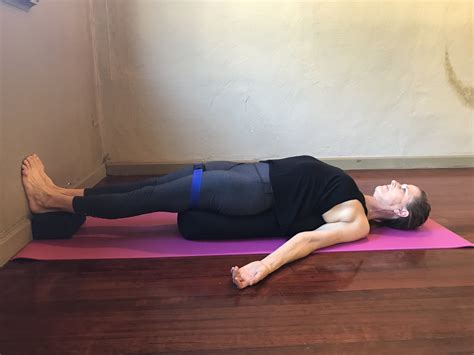
TO COUNTERACT AN UPPER-BACK slump, try some chest-opening supported backbends. The support allows you to hold the pose longer and get a deeper, more relaxing stretch. Lying back over a prop that extends along your spine will elongate the serratus, the pectoralis major, and the biceps. If you’re stiff, use a rolled sticky mat; if you’re more flexible, put two yoga blocks in line, separating them by a few inches so the support is about two feet long and six inches high. Lie back so one end of the support is near your lowest rib and the other supports your head. (If the back of your neck is compressed and your chin sticks up, place a pillow or folded blanket under your head.) Then open your arms out to the sides, about 90° to your torso, and rest them on the floor. Keep your elbows straight to get some biceps stretch along with your chest opening; to increase the pectoralis major stretch, bend your elbows to 90° so that your lower arms rest on the floor alongside your ears. If your upper back rounds, do this pose for a few minutes every day.

To stretch the “lats,” the pectoralis minor, and the lower part of the pectoralis major, put your roll (or a block, placed so it’s six inches high) the long way across your midback, about the level of your lower breastbone. (Be sure to support your head if your chin juts up.) Stretch your arms up toward the ceiling and then overhead, down toward the floor; lengthen them away from the sides of your ribs to maximize the stretch. (Use a prop to support your hands if your shoulders are painfully tight.) Breathe smoothly and stay in this position for a few minutes, visualizing your “pecs” and lats releasing and lengthening.

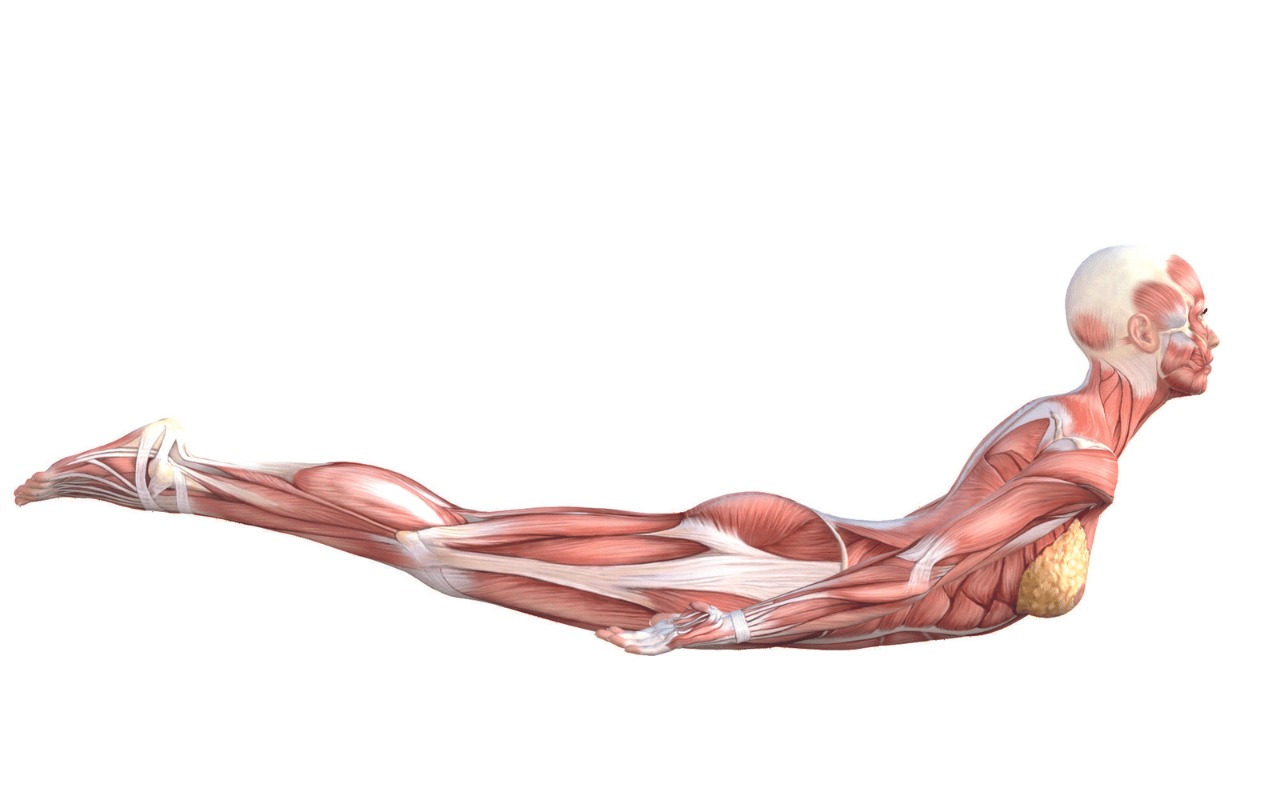
If you tend to slump in your upper back, you need to stretch your abductors-the muscles that draw your shoulder blades away from your spine-but also strengthen your scapular adductors, the rhomboids and the trapezius. To do this, practice variations of Śalabhāsana (Locust pose). Lie face-down and lift your nose and breastbone a few inches-if you feel some discomfort in your lower back, you’re probably lifting too high. With your arms by your sides, lift them and stretch them and your shoulders toward your feet. This strengthens the rhomboids and the lower traps. Next, reach your arms straight out to the sides (or, if that’s too difficult, bend your elbows and lightly touch your ears): You’ll feel the rhomboids and the entire trapezius working to pull the scapulae toward the spine.

Practice these two variations every other day, gradually holding them longer until you can stay in each position for 30 seconds. Combine this strengthening with the chest-opening stretches, and before you know it you’ll be a slumper no more. You’ll find your shoulder blades resting in that “just right” place, and you’ll be sitting, standing, and practicing yoga with a new freedom and stability in your chest, upper back, and shoulders.

Save Your Neck

by Julie Gudmestad, Yoga Journal, July/August 2001

Practiced with careful alignment, yoga poses can help alleviate past neck problems and prevent future ones.

JUDGING FROM THE COMPLAINTS OF my physical therapy clients, chronic neck tension is a modern American epidemic. Even the more benign consequences – the painful crick in your neck, the dull headache radiating from the back of your skull – can be mighty annoying. The more serious ones, like pinched nerves, arthritis, and damaged discs, can be debilitating.

Fortunately, yoga can do wonders for neck problems while simultaneously teaching safer, healthier posture habits. But some of the poses that can help you, like Śīrṣāsana (Headstand) and Sarvāṅgāsana (Shoulderstand), can also do harm if performed incorrectly. It’s important to approach them with knowledge of proper alignment.

Let’s take a look at the muscles of the back of the neck. Why do they cause so much trouble, and how can we use yoga to help them function better? The primary muscles of the back of the neck are the levator scapulae [above], which extend from the cervical (neck) vertebrae to each inner upper scapula (shoulder blade). Lying on top of the levators and also inserting on the shoulder blades are the upper trapezius muscles [below- orange], which originate on the base of the skull and the neck vertebrae. Together, these muscles lift the scapula and backbend the neck. The levators and trapezius muscles also help to turn the head and sidebend the neck.

The stress of a busy lifestyle with deadlines, difficult people, and lack of sleep certainly tightens neck and jaw muscles. A forward head posture is also a factor for many people. An average head weighs 12 to 15 pounds, when that weight sits forward of the central line of the spine, the muscles on the back of the neck have to work very hard to hold the head up against the pull of gravity.

Whether due to stress or poor head-neck alignment, chronic tightness in the levator scapulae and the upper trapezius can lead to significant neck pain. As the muscles pull down on the base of the skull and upper neck, they also pull up on the scapula. All this adds up to compression on the cervical vertebra. Such tightness and compression can lead to arthritis, cause nerve pressure that makes pain radiate down the arm, and increase the likelihood of neck muscle injuries.

Do no harm
JUST AS IN MEDICINE, a key rule in haṭha yoga is “First, do no harm.” It’s crucial to avoid common yoga mistakes that can result in neck injury. If you come to yoga after years of neck tension, the muscles at the back of your neck will probably be quite short and tight, limiting your ability to bring your head toward your chest. Since you need a great deal of this neck flexion to do Shoulderstand, forcing a tight neck into the pose can strain the muscles and ligaments. Even worse, forced flexion can cause cervical vertebrae discs to bulge or herniated, serious injuries that may take many months to heal.

Many people habitually tighten their neck and shoulder muscles when they concentrate, and it’s easy to carry that habit over into yoga. This can be especially true in backbends. Students tend to overcontract the neck, sticking the chin out and up and compressing the back of the neck. This action can result in an unpleasant headache after backbends such as Bhujāngāsana (Cobra), Śalabhāsana (Locust), and Ūrdhva dhanurāsana (Upward-facing bow).

Fortunately, one backbend actually lengthens the back of the neck. Doing Setubandha (Bridge pose) supported on bolsters for a few minutes three or four times a week can help prepare you for Shoulderstand.

Decompress your neck
IT’S HELPFUL TO LEARN HOW TO relax, lengthen, and decompress your neck before you try to do it in a pose. Here’s a simple exercise to prepare you for keeping your shoulders down and neck relaxed in yoga poses. Hold an object weighing one to two pounds in each hand, letting the weight of the objects pull the shoulder blades down. Make sure that you keep the breastbone lifting up so that the tops of the shoulders don’t pull down and forward, collapsing the chest. Now set the objects down and see if you can find the muscles you need to pull your shoulder blades down just as the weights did.

These muscles are called the lower trapezius [second skeleton- plumb] . They attach to the vertebrae of the midback and insert on the inner border of the shoulder blades. They are the antagonist muscles to the upper trapezius (traps)– in other words, they perform the opposite action – and are very important posture muscles, helping support the spine in the midback. Unfortunately, when the lower traps are too weak to counteract the pull of the stronger and tighter upper traps, the scapulae will tend to ride up, compressing your neck.

Now let’s take these lessons and apply them in an āsana. Stand with your legs ready for Vīrabhadrāsana II (Warrior II). Lift your breastbone up and pull the scapula down: This action requires release and lengthening in the upper traps and contraction and firmness in the lower traps. Next, lift your arms out to the sides to shoulder height, turning your palms up. Feel how turning the palms up helps bring the shoulders down and activates the lower traps. Keeping that action and position of the shoulder blades, turn the palms back down; you now have the correct shoulder and arm position for Warrior II and many of the other standing poses.

It is also important to incorporate this action into Headstand, so that you can protect your neck from compression. When you’re upside down, gravity pulls the shoulders toward the ears, so you need extra awareness and strength in the lower traps. While in Headstand, have a helper put a finger on each shoulder blade at the base of the neck and gently draw the fingers away from the floor, lifting your scapulae toward your hips. At first you may get disoriented while upside down, but once you’ve felt the proper direction of lift, you should find it easier to engage your lower traps.

Before you begin working on Headstand, you should probably spend at least several months working on a variety of other poses to strengthen your back and neck muscles and improve the alignment of your spine. It’s also a good idea to be strong in all of the arm and shoulder muscles before trying Headstand. The small cervical vertebrae are designed to support only the weight of the head, but when we do Headstand, they are supporting nearly the full weight of your body. Unless you have developed enough strength in the arm and shoulder muscles to take a little of the weight off your head and to balance the body if is shifts around slightly in Headstand, you can injure your neck. Work often on Adhomukha śvānāsana (Downward-facing dog) and Handstand to build the strength and endurance that will help prepare you for a safer Headstand.

One final thought about Headstand: A normally curved neck will bear the weight of Headstand much more easily and safely than an overly curved or overly flattened neck. To check your own neck curve, stand in front of a mirror. With a normal curve, your chin should be level and you should be looking into your own eyes in the mirror. Put several fingers of one hand across the back of the neck. The tissues there should feel soft, and the neck should curve slightly forward. Now drop your chin and feel how the tissues become hard and the curve flattens. Then lift the chin and feel how the back of the neck compresses. In Headstand, if your head contacts the floor toward the forehead, your neck curve increases and the back of the neck compresses. If your contact point is toward the back of the head, your neck flattens. When you do Headstand, make sure you are centered on the very middle of your head. Look in a mirror while you’re in Headstand – or have a teacher look at you – and make sure that your eyes look straight ahead, your neck curve is normal, and the back of your neck is soft.

Practicing yoga poses with conscious awareness of your head, neck, and shoulder alignment will help you gradually break the habit of chronic neck tension. The benefits to your health and well-being will be many – and you probably won’t be seeking an appointment with me for a yoga-related neck injury.

BEGINNER’S MIND

During āsana practice, we are not only training the body to do the physical poses, but we are also training the mind to be present. It is the nature of the mind to wander: our attention is easily drawn to sounds, thoughts, memories, and worries. By paying attention to the teacher’s cues, we are bringing the mind into the pose and into the current moment as we learn to straighten a knee, rotate a shoulder or stretch the fingers.

We can also develop focus by coming into our practice with ‘Beginner’s Mind’, in which we practice noticing things just as they are, without assumptions about our bodies or the poses. We might notice the touch of our feet on the floor, the pattern of each breath, and how the spine changes in each pose. Beginner’s Mind implies an openness to learning and receptivity in body and mind.

You can initiate Beginner’s Mind at the beginning of a practice session by sitting or standing quietly in a tall and spacious position. Relax your jaws and soften your eyes, as though your eyes are going out of focus. Allow your field of vision to widen, so that you’re aware of your peripheral vision rather than the narrow focus we use to read.

This softening of external visual focus allows your inner focus to become clearer, and you can become more aware of sensations of the poses as you practice. As you move from pose to pose, notice whether your mind wanders or becomes judgmental, and pause again to soften your gaze and allow your attention to expand into the pose. Whether beginning or advanced, all yoga students can benefit from practicing Beginner’s Mind.
Julie Gudmestad, April 2021

Julie wrote the “Anatomy of a Yoga” column in Yoga Journal magazine for 7 years. She has also written a series of articles aimed at instructors in the “For Teachers” column for Yoga Journal as well as an article for Yoga International.

THE LONG AND SHORT OF LEGS

by Julie Gudmestad
Published in Yoga Journal, September/October 2004

Many people struggle to lengthen their hamstrings, but working too aggressively can lead to injury. Here are some crucial tips for getting a safe stretch.

I WAS TEACHING AN out-of-town workshop and was just about to start a class when one of the students approached me. Looking a bit worried, she described a nagging pain at one of her sitting bones. The spot was tender to sit on, she said, and decidedly painful in some asanas. “What’s causing the pain?” she asked. “What can I do about it?”

Sadly, I hear this complaint with increasing frequency as I talk with yoga students from all over the country. The problem usually arises in experienced practitioners with very flexible hamstrings—often women, though not always. The pain lingers on and on, with little or no progress toward healing. If these students were to discontinue all the poses that elicit the pain, their practice would be significantly limited. Often, they don’t seek medical attention, because it seems like a relatively minor problem; instead, they opt to self-treat by practicing lots of poses that stretch the sore area.

There are a number of conditions that can cause pain at the sitting bone, including some serious lower back and sacroiliac injuries. If the pain is intense—especially if it is associated with pain in the back or farther down the leg—the situation should be evaluated by a health care provider who can establish an appropriate treatment plan. However, chances are very good that strained, overstretched hamstring muscles are the culprit. And if they are, there’s good news: By changing his or her yoga practice, the student can support the hamstrings’ natural healing process.

The Sitting Bone’s Connected to the…
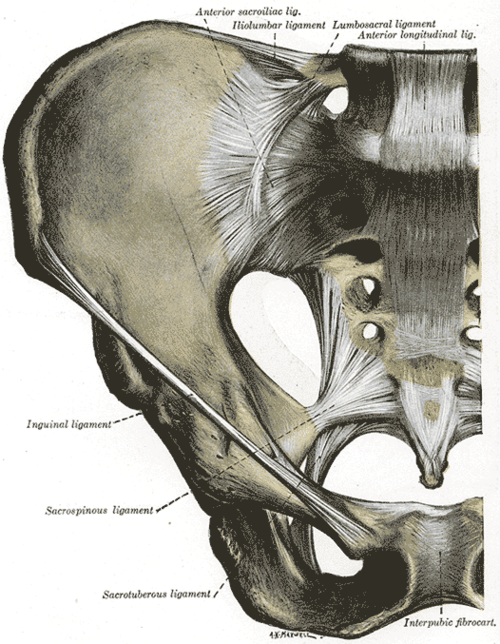
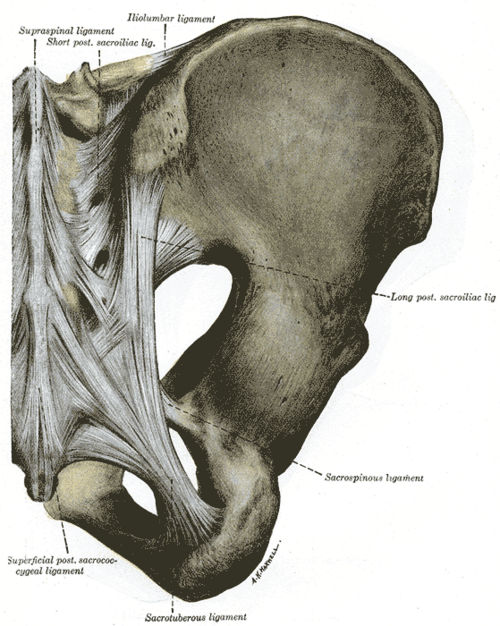
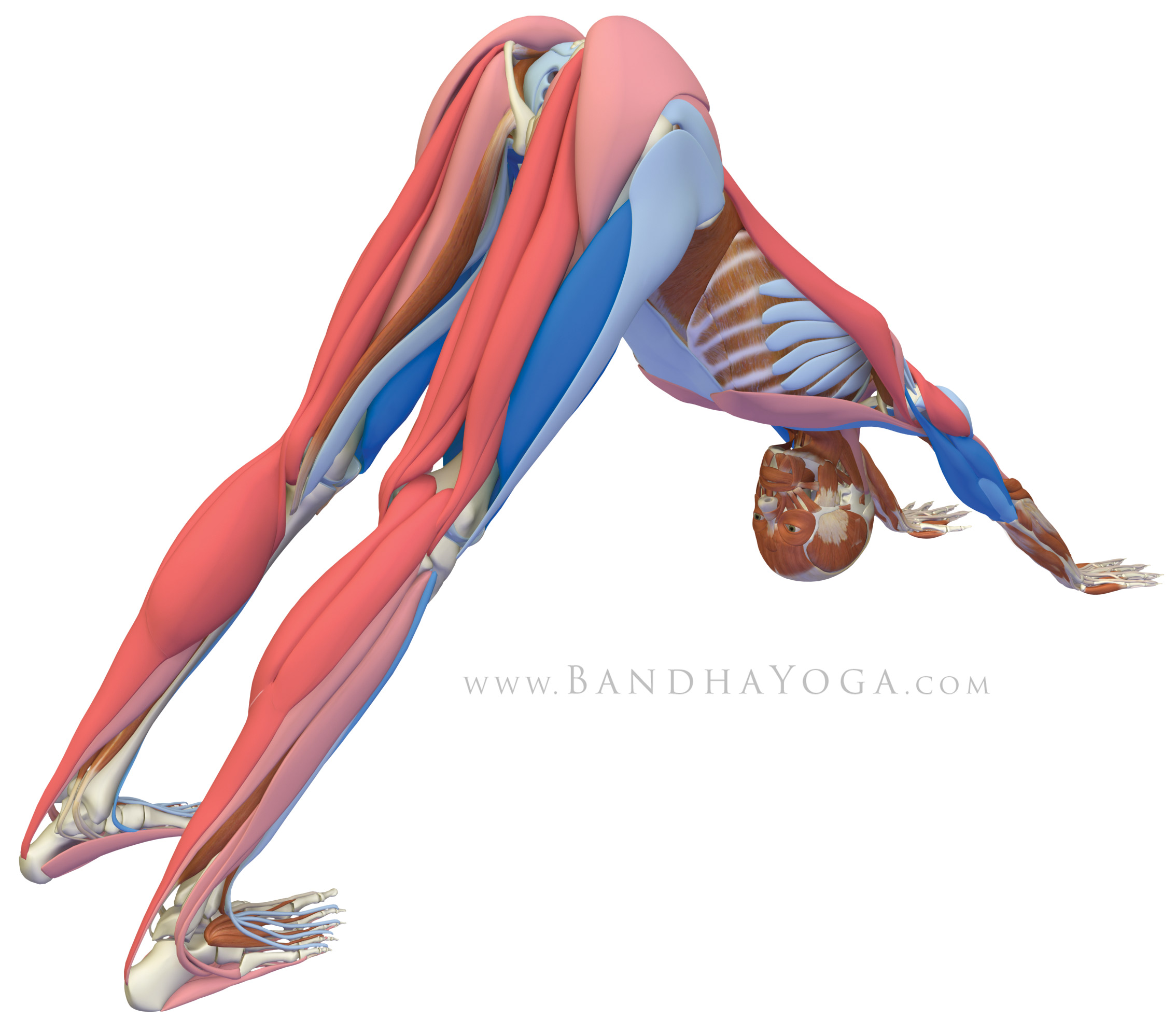
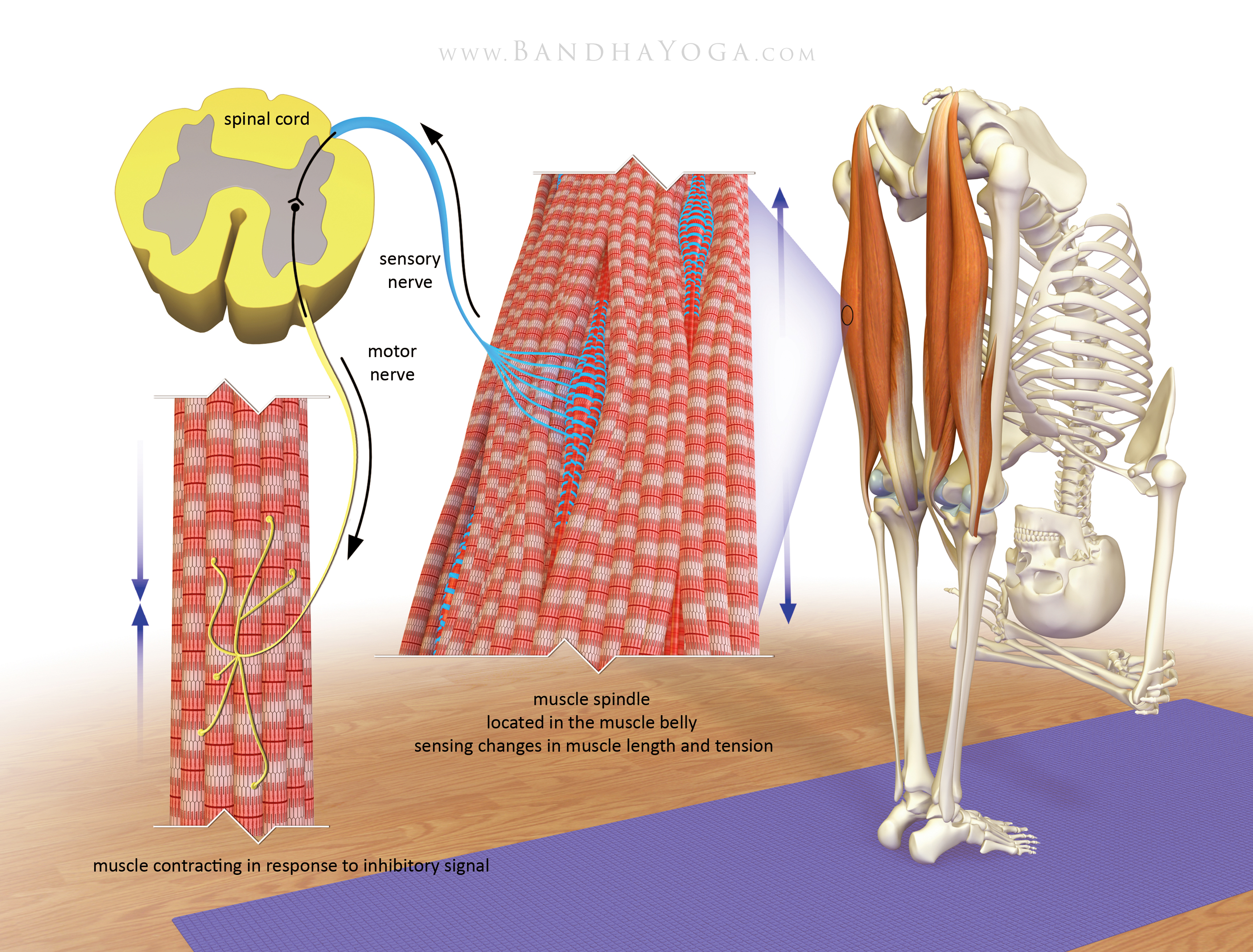
THE HAMSTRINGS ARE THE large group of three muscles that fill the back of the thigh. Two of the muscles, the semitendinosis and the semimembranosis, are in the medial (inner) section of the thigh. The third, the biceps femoris, is in the lateral (outer) portion of the back of the thigh. All three muscles originate on the ischial tuberosity—the bony protuberance at the bottom of the pelvis that is commonly called the sitting bone—and the biceps femoris has an additional attachment on the back of the femur, or thighbone. The hamstrings insert below the knee on the two lower leg bones, the tibia and fibula.

Most people can feel the hamstrings with their own hands—the muscles are the closest ones to the skin of the back of the thigh—and can follow them all the way down to the knee. It’s even easier to find the hamstring tendons behind and just above the knee. To do this, place your heel out in front of you while sitting on the floor or in a chair. Keeping your knee partially bent, dig your heel into the floor as if you were trying to pull the heel toward you. When you do this, the tendons will stand out and be easy to see and touch.

The hamstrings have two primary actions: knee flexion (bending the knee) and hip extension. When you’re squatting, your hips are flexed; you bring them into extension when you stand upright, placing the thighbones in line with the torso. When you stand on your right leg in Vīrabhadrāsana III (Warrior Pose III) and lift your left leg to hold it parallel to the floor, your left hamstrings are creating hip extension. When you lie on your stomach, bend your knees, and lift your feet so you can grab your ankles for Dhanurāsana (Bow Pose), the hamstrings are creating knee flexion. (The hamstrings also assist in rotational actions at the hip and knee.) To stretch your hamstrings, you need to keep your knee straight and flex your hip (in other words, fold the front of the thigh and the abdomen toward each other). One of yoga’s classic hamstring stretches is Uttānāsana (Standing Forward Bend), in which the knees are straight, the torso hangs down, and the abdomen eventually rests on the front of the thighs.

Too Much of a Good Thing
WHY DO SO MANY YOGA students develop the nagging, frustrating pain that indicates strained hamstrings? Think about the poses that usually make up your yoga practice. On an average day, do you do lots of poses that stretch your hamstrings? Do you do many standing forward bends, such as Uttānāsana and Prasārita pādottānāsana (Wide-legged standing forward bend), and many seated forward bends? Chances are, the answer is yes; most students include quite a few of these poses in each practice session. Several other standing poses also lengthen the hamstrings, including Trikoṇāsana (Triangle pose) and Pārśvottānāsana (Intense side stretch pose). And let’s not forget Adhomukha śvānāsana (Downward-facing dog pose). If you practice Aṣṭāṅga Yoga, Power Yoga, or a similar flowing yoga style, you probably do dozens of Down dogs every time you’re on the mat. All of this stretching can cause the hamstrings to become very flexible and even overstretched in relation to the other leg and hip muscles.

The plot thickens if you don’t do much to strengthen your hamstrings. These long, vulnerable muscles are then liable to develop microscopic tears if a big load is placed on them, whether by stretching or contracting; they simply don’t have the structural integrity to handle the intense pull developed by a big stretch or the internal tension developed by a big contraction, and the tissue breaks down.

I’ve never seen a practitioner create a dramatic and debilitating rupture to the main body of a hamstring by doing yoga, although such injuries are common in sports activities that demand more explosive hamstring movements and sudden violent stretching, such as football, baseball, soccer, and weightlifting. Instead, the usual breakdown in yoga students seems to be microscopic tearing where the hamstrings attach to the ischial tuberosities. The body responds to those tears with pain and inflammation, which includes swelling, so of course it’s uncomfortable to sit on the sitting bones. The muscle still functions, but it will probably be uncomfortable to stretch or contract it.

A Repair Manual
THE FIRST LESSON MANY yoga students with injured hamstrings need to learn is that stretching isn’t always appropriate for injured or painful body parts. When you tear soft tissue, including muscles, tendons, and ligaments, your body begins its repairs by stitching tiny fibers of connective tissue across the damaged area. If you stretch the injured tissue, the tiny fibers can be torn loose, disrupting the healing process and lengthening the time needed for complete repair. In fact, if you repeatedly disturb the healing process, the tissue may never heal completely and the injured area can become chronically painful and inflamed. In addition, if the area does eventually heal, the repeated tearing and healing can create heavy scar tissue, which tends to receive less blood flow and be less pliable than normal tissue, setting the stage for reinjury.

By now it should be clear why my first recommendation to students with strained hamstrings is to stop stretching them immediately. Poses that put a lot of leverage on the hamstrings, like seated and standing forward bends, should be completely avoided during the healing process. Some other poses that normally pull on the hamstrings can be modified so they can be included in your practice without reinjuring the hamstrings. In Trikoṇāsana, for example, don’t lower your torso to your maximum; instead, place your hand on a block or a chair, removing the temptation to push too deeply into the pose. A similar modification with two blocks can be used for Pārśvottānāsana.

In Supta pādānguṣṭhāsana (Reclining Hand-to-Big-Toe Pose), don’t hold on to your big toe; instead, use a belt to catch your foot, and don’t pull on it forcefully. In Utthita hasta pādānguṣṭhāsana (Extended Hand-to-Big-Toe Pose), rest your foot on a low ledge or piece of furniture so you feel no stretch in the back of the leg. In both poses, focus on strengthening the legs and lengthening your spine rather than on stretching your hamstrings. The bottom line in these modifications: Never elicit hamstring pain in any pose.

Patience, Patience, Patience
ONCE YOU STOP STRETCHING and reinjuring your hamstrings, the real healing can begin. Unfortunately, the hamstrings are notoriously slow to heal. Give them several weeks of rest at the very least. The healing progress is usually so gradual that you won’t notice a day-to-day improvement. It’s more likely that after a few weeks, you’ll look back and realize that the pain and stiffness have decreased.

When you are aware that your hamstrings have improved and are less sensitive to movement, it’s a good idea to add some mild strengthening to your healing regimen. Put on a heavy shoe, a boot, or a one-pound ankle weight and lie on your stomach. Keeping your thigh on the floor, lift your foot about a foot off the floor; this causes the hamstrings to contract as they flex the knee. Don’t do more than 10 repetitions per session for the first week or so, then gradually increase to three sets of 10. (Aim for three sessions each week.) One pound is a very light resistance; if even this small amount of weight causes discomfort, you’re not ready yet to begin strengthening. Wait another week or two and then try again. Remember that patience must be your mantra; sometimes the hamstrings can take three to six months to heal completely.

Strengthening is important to recovery not only because it increases circulation, which promotes healing, but also because strong, healthy muscle tissue is much less likely to tear in the future. So whether you are recovering from hamstring problems or simply want to prevent them, it’s very important in your asana sessions to regularly include poses that strengthen the hamstrings, like Vīrabhadrāsana I and II and Setubandha sarvāṅgāsana (Bridge Pose). (To make sure you’re engaging your hamstrings in Bridge, draw the tops of your shins back toward your tailbone.) If you want to supplement your yoga with other activities, walking and running are good hamstring strengtheners and also have the benefit of pumping life-giving blood through the muscle tissues. (Cycling is fine too, but it will build your hamstrings significantly only if your feet are clipped to the pedals.)

In general, it’s best to stretch your hamstrings only after they’ve been warmed up by a walk or a series of active poses in which you don’t push the edges of your hamstring flexibility. Be sure to practice a wide variety of poses, and avoid making hamstring stretches the narrow focus of your yoga sessions. Finally, don’t be too aggressive in your hamstring stretches. Feeling pain in these poses can be a signal that you’re doing microscopic damage to the muscles. Learn to be patient and present with the sensation of stretch rather than pushing it so far that it becomes pain. Your hamstrings are too central to most yoga poses—and to the rest of your life—to risk injuring them.

Thus Spake BKS Iyengar, Part V

The following are excerpts from Thus Spake BKS Iyengar by Noelle Perez-Christiaens,

©Institut de Yoga BKS Iyengar-Paris 1979

9. PHALA
“THE FRUIT”
Phala (pronounced with a ‘p’ followed by an aspirate ‘h; and not with an ‘f’ sound) also signifies the result, the reward. Already in the Sanskrit we find one meaning attributed to the word ‘fruit’ in our Western languages. It comes from the root PHAL, to burst, to cleave, to emit heat (as in fire). A fruit comes away of its own accord in the hand, when it is ripe, and can burst under the pressure of its own juices. Think of apricots or plumbs on a hot day.

Phalayoga is a reward, the obtaining of the result designated by the word ‘yoga’; it is to harness oneself (yoked) to a work, not to let any of the vital forces that one can bind together, bale together to use for the same end, be dispersed. Then the fruits of our labours will come by themselves, at the right season. Iyengar says, “All would find their own fruits if they would only listen.” (X51) Most students miss the fruits of their labours because they haven’t listened properly to the Master. As Christ said, “They have ears and hear not, eyes and see not.

At this point. I think it good to recall that it is not enough simply to hear, but that we must ‘listen’ with particular attention, with that conscious perception which takes us back to manas. We have to work so hard at hearing! Hearing means understanding, too. Manas must refine the sense of hearing that, finally, we can listen, that in listening we can hear, and thus we may understand what to do and what not to do: “It is never a question of ‘what am I doing? but of ‘What am I not doing?’” (J3)

Then the fruits of the synthesis will be given of their own accord, and will fall into our hands like ripe pears.

—One must not seek, one must search.

—One must not see, one must look at.

—One must not hear, one must listen to.

—One must not touch, one must palpate.

—One must not smell, one must sniff.

(X249)

10. PRAŅIDHĀNA
“COMPLETE SURRENDERING”
Another piece of advice from Patañjali: “the surrender to Iśvara brings samādhi,” he wrote (II.1, 32, 44).

In the word praņidhana, prana gives the idea of forward movement and intensity. Dhāna comes from the root DAH, which means to put, to place, to set up, to establish. Praņidhāna is thus to be placed, stretched towards something; it’s also to give oneself over to, the respectful conduct of a pupil towards the master; it’s attention sustained, the complete surrender to the master’s hands, or to a [guide for aiding the yogin on the path to spiritual emancipation] (Iśvara).

How will Iyengar go about making us feel this surrender to Iśvara concretely, in our own bones, against all anguish and fear? Through a surrender beyond all reckoning, beyond all self-defense mechanisms, to the guru who is, for the pupil, the ‘rough map’ passing on the BEING, before the ‘interior guru‘ is awakened. Iyengar uses the word ‘surrender’ to make us grasp this complete self-abandon to Cosmic Forces, to Energy, through its various manifestations which touch us. “Surrender to me,” meaning in effect, “relax your action against me,” was the order I received every time the Master [Iyengar] came to correct a mistake in a posture. Everything was tensed, contracted, either by the false balance (because I was out of plumb), or by the ridiculous effort I thought I had to make to do what was required of me. If I hadn’t relaxed, Iyengar could have hurt me or himself; first he took a step back, then the order came, and with it went all my resistance and hesitation, and he adjusted everything little by little.

This surrender, by breaking the chain of distracting thoughts, increases the intensity of one’s concentration.” (J58) Obviously, confidence increases with practice. The Master insists on this point, seeing numerous pupils who do not truly hold fast to what he asks for: “If you do not surrender to your Guru (in life), at least at the time of learning, surrender. If not, the ego is responsible for that pride.” (Q13) He might have added, “Unless the disciple gives her/his ego and follows the guru’s instruction s/he cannot make physical, mental, or spiritual progress.” (Q14)

And so, as a result of continual surrender, surrender without argument, in spite of her/his fears, little by little the pupil (who already has many years of practice and ‘passivity’ behind her/him) becomes ready for the spark of meditation which captures her/him in a posture, during a lecture, on a walk… Where is s/he? Is it in her/his body, or out of it* that s/he seizes upon the light that is dissolving her/him? Who is s/he? S/he perceives directly without intermediary help that only Energy exists, and in intense fear, s/he tastes of this extraordinary harmony. But nothing terrible happens, for s/he is so used to confronting fear through the complete surrender to her/his guru. “The highest form of surrender is meditation.” (X127) In meditation there si nothing left but the BEING: IT, and nothing else.

* Cf., II Corinthians 12:2, ‘whether in the body or out of it, I do not know

Noëlle Perez-Christiaens, A Grand Dame of Yoga (1925 – 2019)

Founder of the Institut Supérieur d’Aplomb,
and the Institut de Yoga B.K.S. Iyengar de Paris

Infos Yoga magazine, N˚ 129, November 7, 2020, by Anaïs Le Flohic

Summer 2019: I’ve been training with Serge Gastineau and Catherine Bellières for a year now, and I’ve questioned almost everything I’ve ever learned about yoga before. Regularly during the seminars, Serge talks to us about the work of Noëlle Perez and where our physiological lumbar arch should be.

I’ve spotted Noëlle Perez’s books on the shelf of the A.Y.L.A. association’s library at the Atelier Yoga in Nantes. Their covers are all worn, a little outdated, and faded. But I don’t dare touch them: it all seems a bit obscure and complicated, and I have little knowledge of anatomy.

During the April seminar, it all clicks during the lunch break, [when] Catherine explains to us how Noëlle Perez demonstrated that bone calcification occurs differently in different populations. Beyond individual anatomical differences, it varies depending on our lifestyles, particularly when it comes to hip joint function. We’re sitting near the bookcase, and Catherine pulls out one of Noëlle Perez’s books and passes it around among the trainees.

At the end of the day I decide to borrow one at random because the title is scary, Pathology of Yoga: Beware! Yoga Can Be Dangerous for You. Without realizing that I’ve just found a treasure, it will take me more than three months to open it on August 8, 2019, the date Noëlle Perez passed away.

She is an extraordinary personality, whose valuable writings are more relevant than ever. At 34, she had visited yoga teachers in Europe and found none who satisfied her, so she went to Pune, India in 1959. She became one of B.K.S. Iyengar’s first Western students and one of his closest. Back in Paris, she opened the B.K.S. Iyengar Yoga Institute, the first in France, inaugurated by Iyengar [himself] in the 1960s.

She practiced yoga for years, and over time, several joints became very painful, even after meeting Iyengar. This was because there was a misunderstanding on both sides: she didn’t always correctly interpret what he was explaining, and he was used to Indians, generally very supple, who remained upright. He couldn’t imagine that someone could have lost their balance.

The veil began to lift in 1976, in two stages. On the one hand, during a visit to Parisian museums with Iyengar. In the exhibition dedicated to Ramses, the Master showed her all the statues that were slumped forward. Conversely, at the Guimet Museum, he pointed out to her how Indian statues were upright and how light they appeared.

On the other hand, Noëlle Perez attended an exhibition on “The Origins of Man” organized by Professor Yves Coppens. She has a flash of inspiration in front of a comparative chart between monkeys and humans, accompanied by the following caption: “The calcaneus thickens; from now on, it will bear all the weight.” This shortening of the main bone of the human foot is what allows for upright posture.

She finally understandood what it means to be upright; the weight falls on the heels: “That’s what Iyengar had tried to make me feel, but I hadn’t understood a thing. Immediately, I put the weight on my heels, hollowing my groin and moving my pelvis back as if to sit down, and I felt all the tension in my back disappear.”

This would become her major research focus; throughout her life, she constantly warned (and “shouted daredevil,” as she put it) that we Westerners had lost our composure, while trying to bring us back to this awareness of correct alignment.

She possessed a colossal capacity for work, like all those who had truly practiced yoga. Her concentration and endurance were highly developed. Throughout her career, she wrote more than 50 books. At 83, she completed a 2,500-page doctoral thesis at the École des Hautes Études en Sciences sociales. Her interests were numerous and far broader than yoga, encompassing ethnology, anthropology, the history of religions, and more.

Regarding yoga more specifically, throughout her life, she maintained a commitment to accuracy and extreme precision in her remarks. As she humorously notes in one of her books, she’s a Capricorn with Virgo ascendant, which helps! A sign of great teaching skills, capable of explaining the same thing dozens of times, each time in a different way, to make herself understood by as many people as possible.

Noëlle Perez took into account the obstacles linked to language differences: Iyengar’s mother tongue is Kannada, from the state of Karnataka. His thinking is steeped in Sanskrit and Eastern culture. He expressed himself in Indian English, which she herself transcribes into French. There are bound to be errors, if not unintentional distortions, in some of his remarks. All of this is magnificently exposed in Sparks of Divinity and Thus Spoke B.K.S. Iyengar. She explains: “When we want to understand the depth of centuries-old Indian experience conveyed by Iyengar’s thought… in a language that is not his own!!!” …we must at all costs discover which Sanskrit word, which Eastern concept he translates into an English word. Otherwise, we’re sure to miss the point and understand only a small part of the Indian message he’s trying to convey to us.”

Her books are both technical and accessible, written in a style full of wit and anecdotes; boredom is never present! They are richly illustrated with photos, unfortunately often of poor quality; the resources at the time were not those of today.

One of the great things about her books is that she explains how she herself injured herself for years in yoga postures. She uses her experiences to inform the teaching and transmission of yoga. She even goes so far as to publish examples of photos of herself in awkward positions even though she didn’t know it, which is probably a unique case in the history of yoga! Throughout her life, she has maintained the attitude of a researcher, an explorer, and a tester of different avenues. She has a desire to alert yoga practitioners and teachers, and the enormous ability to question herself thoroughly. In my opinion, one could even go so far as to say that she promotes a form of prevention in public health.

Her private life, from which she regularly draws examples (her great-grandmother Man’line, her dog Panta, etc.), is astonishing in more than one way. Childless, she devotes her life to yoga and her field research, punctuated by numerous travels to the four corners of the planet. Her research on how carrying loads on the head shapes the spine took her to Setúbal, Portugal. There, over 50, she met Miguel da Fonseca, a fish unloader (fish auctioneer) who would become her husband.

She would closely involve him in her work; he would be her daily guide. Having remained poised throughout her life—an essential element for practicing her profession without damaging her back—he would show her in a thousand ways, and in every day of her life, how to proceed.

Noëlle Perez is not known for being easygoing, as she herself admits. She is outspoken (“śavāsana is not snoozing!”) and doesn’t mince words when she considers a piece of work to be of poor quality. People say of her: “If you want to be corrected in yoga, go see Noëlle. She’s not easy, but with her you’ll learn.” I believe that, simply put, her high standards with her students were commensurate with her total commitment to yoga.

Noëlle Perez truly wanted her work to be disseminated, known, and extended; she has written as much on several occasions.

Given the accuracy of her vision and the strength with which she demonstrated her theories, supported by countless examples, photos, and experiments, it is surprising that Noëlle Perez is not better known in the yoga community. Apart from the website of the Institut Supérieur d’Aplomb, there is little information about her online; her books are no longer published. Perhaps her iconoclastic vision, which called many things into question, was too disturbing?

I sincerely hope that this article will contribute to her influence and inspire you to discover more about her.

Bibliography

– Warning! Yoga Can Be Dangerous for You – Pathology of Yoga, B.K.S. Iyengar Yoga Institute, 1980.

– Being Aplomb, first edition: B.K.S. Iyengar Yoga Institute, 1977; Second edition, fully revised and corrected: Institut Supérieur d’Aplomb (ISA), 1983

– Thus Spoke B.K.S. Iyengar, B.K.S. Iyengar Yoga Institute, 1979.

– Carrying on Oneself – Carrying oneself, carrying, behaving, transporting, loading and unloading oneself without damage – Contribution to the study of a universal category of techniques: carrying loads on oneself. Dissertation in social anthropology and ethnology, defended on May 20, 2008, Ecole des Hautes Etudes en Sciences Sociales.

The author Anaïs Le Flohic is a yoga teacher in Rennes, France.

Thus Spake BKS Iyengar, Part IV

The following are excerpts from Thus Spake BKS Iyengar by Noelle Perez-Christiaens,

©Institut de Yoga BKS Iyengar-Paris 1979

7. ĀTMAN
MERGING THE INDIVIDUAL SOUL (JIVĀTMAN)
WITH THE UNIVERSAL SOUL (PARAMĀTMAN)’
In many books dealing with Being one sees very knowledgeable distinctions between the Self and the self, the Self and myself, often rendered by the Latin ego. When someone speaks to you of ‘yourself,’ you know what s/he means. When someone speaks of the Self, you had so studied Einstein’s idea of Energy that it seemed to you there was nothing but It — all matter being, in the final analysis, energy — and that beyond the notion of person, of individual (of myself), there was a Source of Energy great and universal and neuter, as long as It was not manifested in some creation or other.

And as you realized that this energy Source is universal, that it underlies all creation, is the manifestation of everything, and precedes everything, at the same time you realized why Sanskrit — a language wherein the use of capital letters is unknown — doesn’t need to differentiate between the Self and the self. I remember being very perplexed when Iyengar said, “It’s the same;” those were the days before I discarded the notion of a personal God!

I was left with the problem of finding a translation for ātman, so often translated [as] ‘self.’ Mlle Esnoul came to my aid and suggested the translation ‘I’ or ‘me.’

We can say, then, that the fusion of the ātman in the Ātman is that of ‘me’ in the Being, an experience so dumbfounding, so inexpressible, of annihilation.

Doesn’t Iyengar say, over and over again that, “‘myself’ and ‘the self’ are one and the same?” In 1959 he wrote me, “When the mind is no longer a screen, the Soul (Ātman, the Being) is free and it shines as pure as crystal with no reflection on it. As the self is free from contact of things, that is the state of experiencing Samādhi.” (A45) I first used the French word ‘âme’ to translate ātman, which Iyengar expressed [as] ‘self’ or ‘soul.’ But after my experience of 1977, I see perfectly well that they might all be rendered by ‘BEING.’ Indeed, at the instant when thought is stopped by the energizing capture, an immense silence installs itself in one, and the BEING is revealed. No ’whys’ or ‘hows’ of a relative nature from the level of duality come to disturb the fact of being without qualification or modality: BEING is all.

In 1963 Iyengar added, “When the mind is controlled, what remains? The soul. That is the very purpose of yoga.” (F25) In 1968 another lexical difficulty was clarified: “…the consciousness of the heart, where the true Self reveals itself.” (J59) In Sanskrit, ‘heart’ is Hṛdaya (or Hridaya); not the organ, but what we mean when we say, ‘the heart of the matter,’ ‘the heartland of the continent,’ ‘the heart of the forest;’ that is, the deepest, central part of a being, the source of life. It is indeed in the depths of a being, well below all surface impressions, that the BEING reveals itself, annihilates all, dissolves all, absorbs all in Itself.

But for us this cannot come to pass outside of life, that is outside of āsanas, which are like rough maps. Iyengar specifies, “As long as you do not live totally in the body you do not live totally in the Self. Total awareness.” (X177) Here we could transcribe all his instructions on skin, on sensations; we might not betray him saying, ‘my body, my dear guru’ or ‘the body must silence the intellect and put its feet firmly back on the ground!’ If the attention on what is happening inside is not substantiated and continuous, the danger of fragmentation is ever-present, and the intellectual brain thrashes about, keeping the individual on the surface of her/himself. The sentient, animal brain can put wo/man back where s/he belongs and give her/his intelligence – and not her/his intellect – the chance to think calmly. Only the experience of reality can help a being to regain her/his balance and approach the consciousness of HER/HIMSELF: the BEING the s/he is.

An āsana is a slice of life slowed down, a rough map which allows for observation and correction; thus the Master specifies: “The āsana is an enquiry: who am I? Throwing out the parts until only the self is left. The final pose is ‘I am’.” (X181)

How many years must one work, in order to finally succeed in putting the profound truth of such a sentence to the test? Yet those who have really let themselves be caught up, who are beyond basics, and who are willing to give up everything in order to let yoga perform its work of merciless ‘peeling,’ can probably begin to render thanks to Iyengar for the profound wisdom which dictated to her/him such a sentence, uttered luminously out of uncommon experience of life!

* Cf. L’Aplomb, base de l’équilibre psychosomatique-N. Perz-Christiaens, Part V Ch 3

8. STHIRA AND SUKHA
“TATRA STHIRA-SUKHAM ĀSANAM”
A FIRM, STABLE SITTING POSTURE
(Patañjali II.45)
When the great Patañjali wrote [the] sūtras he collected, for the benefit of his followers, instructions from the great yogi of his time. We know that the sūtra designates a particular literary genre consisting of ‘stringing pearls on a thread’ (sūtra); it’s a rosary of mnemonic texts for teaching. Thus we won’t find plentiful explanations for beginners in the sūtras; rather a succinct resumé useful to the experienced pupil who can read ‘between’ the lines.

Now Patañjali says that the correct seat or foundation for meditation must be sthira and sukham. As we have seen for samasthithi*, sthira comes from the root STHA, which also gives the adjective ‘stable.’ Sukham is an adjective signifying the comfort of a wheel whose hub is well-centered. It’s a word right out of the experience of the nomadic peoples – Indians of today – who travel in ox-carts along bumpy country roads.

These two adjectives are thus extremely important for us, not only in the case of the posture for meditation, which does indeed require a very good seat, but also in that of any other posture, sitting or standing. In all postures the foundation is of prime importance. For the practice of yoga will lead us little by little towards samādhi along the bumpy roads of our lives.

How does Iyengar translate these basic requirements for a good seat, in order to bring them within our reach? “In mediation, the mind is still but razor-sharp, silent but vibrant with energy. This state cannot be achieved without a firm, stable, sitting posture, where the spine ascends and the mind descends, and dissolves in the consciousness of heart (Hṛdaya, the centre), where the true Self reveals itself.” (J59) When the foundation is comfortable enough for the spine to be effortlessly erect, then concentration can descend to be absorbed, dissolved, in the Being.

Several years later [BKS] returned to the same idea, “When you sit, first stability, then firmness.” (Q46) It’s of primary importance to note that the Master is addressing himself to Westerners, so often sprawled in seats they think are comfortable: for he has avoided the original notion of ‘comfort’ (sukham) which would be falsely interpreted by us and replaced it with ‘firm,’ an important word for the choice of a seat. Indeed, so that the spine may surrender absolutely to Gravity, comfort demands that the seat be firm and soft: firm at the base and soft under the skin. Then the foundation is perfect if the correct height has been found. From all the sit is evident that nothing can be done on a poor seat, maladapted to that which is being practiced (duke, uncomfortable).

Other sayings come to perfect this new enlightenment: “It is the job of the spine to keep the brain alert and in position” (J64); this is true of any posture. A spine out of plumb results in compensations in the vertebra, the incorrect positioning of the skull, and ultimately a brain out of plumb. Then the brain anesthetizes itself, shuts itself off from discomfort, and a Westerner can live without suffering too much, but also without evolving towards the goal s/he took on when s/he began to practice yoga! In a lesson Iyengar explicitly said, “I showed you the tension on my face in that concentration, remember? This is that tension known as rigid stillness. The rigid stillness is not a state of silence. The rigidity is a vibration.” (Q56) It is patently true, when a stable, comfortable seat has finally been experienced, that there could not be the slightest rigidity or the slightest tension. As soon as I hold up my back, or activate the muscles of the back, my spine will conform to the idea I am imposing upon it; but it will immediately lose all mobility, all adaptability, to the slightest prompting of the Breath which comes from a total surrender to gravity. As soon as one holds, one becomes rigid, and as Iyengar says elsewhere, “rigidity is a form of egotism,” a return to oneself, an expression of deeply felt infantile pleasure of the active ego!

Along this road to meditation, towards the complete dissolution of everything that makes me see myself as a person opposed to the Being, the comfortable foundation in gravity permitting absolute mobility is the basis for absolute immobility. This may seem incompressible to beginners. By ‘absolute immobility’ I mean not that which we think we are producing, which is rigidity, but that stability given by a complete non-resistance to gravity. It is in the perfect silence of all manifestations of my ego that finally the Being is manifested, the Being that I am without having realized it.

Patañjali frequently opposes sukha (su-kha, the good hub), comfort, ease, wellbeing; and dukha (du-kha, the uncomfortable hub), lack of ease, discomfort. Sukha alone is the true way. -(Patañjali II.7-8, and 46).

*Cf., L’Aplomb, base de l’equilibre psychosomatique, N.  Perez-Christiaens, Part V, Ch 3

Thus Spake BKS Iyengar, Part III

The following are excerpts from Thus Spake BKS Iyengar by Noelle Perez-Christiaens, ©Institut de Yoga BKS Iyengar-Paris 1979

5. KRAMAKĀLAYOGA
CHRONOLOGY’
As it was discussed in Yoga YUJ*, the word yoga expresses an idea of junction, of binding, of linking together several things to form a new entity. We have just seen that krama gives the idea of advancing, approaching, going towards. Kāla is time. Kramayoga was a rhythmical succession; kramakālayoga indicates the same succession in time. It’s a ‘chronological’ junction, the junction of successive moments in time, a series of moments or a series in time.

Iyengar is very attracted to this notion of time, which is a simple impression of the relative [one] in which we live until we experience samādhi, but he tries to prepare the pupil for the dissolution of time in infinity, to lead him slowly, towards the notion of a time beyond time, of a perpetual instant, a never-ending present. He therefore has to break the notion of time in our heads, especially the notion of time as a real entity which advances (KRAM). Thus he speaks of ‘chronological authority’, by which he means the authority of a clock which obliges us to stay in a posture the length of time we have decided to devote to it. He immediately breaks this notion: “Sit in this āsana and accept chronological authority. Chronological authority is no authority, as time is just movement in space.” (X33) And then returns to this idea in another way, “Do not do chronological timing without acting psychologically. The brain must work.” (X56)

We need a time of daily practice, until our whole lives are composed of daily yoga. But this time of work must not be a dead time, stupidly lent to obedience. The intelligence, the mind, must use this time and through it dip into eternity. A clue to this might be found in another reference to time: “Chronological time and psychological time are quite different.” (X280) We have all had the experience of seemingly endless moments, and days which fly by.

But we must admit that we would prefer to think of the word ‘chronometric’ rather than the word ‘chronological.’ The latter refers to an arrangement of dates and times of occurrence. Whith this in mind, the three sayings are much clearer and more comprehensible: “The authority of a time-piece is no authority, as time is just a movement in space.” (X33)

Only the perpetual present IS.

* Cf. Yoga YUJ, Noelle Perez-Christiaens, Paris

6. MANAS
PIT YUR BRAIN IN YOUR BUTTOCKS
At first glance, this sentence must leave you speechless; how to put an organ, the brain, down into a muscle, the buttocks? Why did he not say, for instance, ‘pay attention to your buttocks,’ or even ‘your buttocks must become intelligent?’ The Master used neither a word derived from ‘intelligence,’ nor one derived from ‘attention.’ Why not? For years I wondered why he named the organ and not its function.

And then, one day, having begun the translation of Pataňjali’s Yogasūtras with Mlle Anne Marie Esnoul, I came across the word manas several times, alone and in composition. Here are a few examples:
– (I.30): durmanasya, which she translated [as] ‘anxiety’ (dur expresses a discomfort)
– (I.34): manasaḥshiti,translated [as] ‘stability of mind’
– (II.40): saumansya, translated [as] ‘benevolence’ (sau, from SU, which means ‘beautiful’, ‘good’, ‘well’)

But each time Mlle Esnoul expressed a discomfort — the exact meaning of manas cannot be rendered in our languages by one word. She explained that it was ‘the attention which produces the perception of the bodily sensations.’
– Could we not translate it [as] ‘attention’?
– No, replied the Sanskrit scholar, attention is translated otherwise.
– Then perhaps [as] ‘perception?’
– No, there is another expression in Sanskrit for ‘perception.’
– Is it a faculty of the mind?
– Not for an Indian. Consider Iyengar: he translated it neither [as] ‘mind’ nor [as] ‘spirit’ in English. It’s a sensory faculty. It’s on the physical level with the senses, like a sixth sense. It’s the attention of the organ itself which allows it to perceive the vibrations it is responsible for collecting and transmitting to the brain.

Then I finally understood why Iyengar, wanting to use a physical word referring to the senses, chose ‘brain.’ In asking for the brain to be put down into the buttocks, he awakes in the pupil the idea of attention and perception, of efficacious concentration to make the buttocks become conscious of their responsibility within the entirety of the synthesis that is a posture.

Then other sayings became clear, ones to which I hadn’t paid enough attention [to] before: “What is the use of merely developing the muscles if the brain is not working?” Here again is the brain, tied to the physical world, to help the body become conscious, to perceive. This is the whole idea of manas. [Once more, referencing] the physical union: “The brain is the heaviest limb in our bodies.” (X194) Let us examine an even more recondite saying: “Move the ears deep inside, the brain resting on the mind. At the same time, the brain is looking at the mind so as not to allow the mind to create any vibration in you trunk, and the mind is watching the brain so that the brain is not cut off from the observation, from that humility.” (Q55) Here again, the brain is joined to the trunk, to the ear – a sensory organ – to the concrete sensory reality over which it watches so as not to allow it to err or to be disturbed by the mind, observing it in order to perceive all its subtlety.

It is difficult to understand right away what is hidden in the refined use of a word which may seem to be evoked in an unusual fashion!

Thus Spake BKS Iyengar, Part II

The following are excerpts from Thus Spake BKS Iyengar by Noelle Perez-Christiaens, ©Institut de Yoga BKS Iyengar-Paris 1979

3. SAMA
EVERYTHING SHOULD BE SYMMETRICAL
To understand this esoteric pronouncement, let us go back to the Sanskrit. The word sama means same, equal, similar, alike, identical to. We have encountered it in the second name of the posture tāḍāsana, samasthitiḥ. Saṃasthiti (with a point under the ‘‘) is an adjective signifying ease, comfort. In this word the notion of comfort and ease is inescapable. Samāna means homogenous, identical, of the same sort: samāyuj (YUJ being the root which gives us ‘yoga’) means to adjust, to join: samāyoga is a junction, a union. Here is the idea of two identical things joined or enrolled together in the same action.

Now I [believe] we are ready to scale the prodigious heights of the Master’s thought: “Everything should be symmetrical: that is why yoga is a basic art.” This sentence helps to understand the following: “Take each pore of the skin for a conscious eye; adjust and balance gently your body from inside with the help of these conscious eyes as it is difficult for normal eyes (the outside ones) to observe and correct the body position (adjusting it from both sides).” Here indeed is the notion of sama, a balance, a parallelism creating harmony. He continues with more precision of thought: “Geometrical adjustment – you must be balanced – use both sides of the mind.” Here we might use the Sanskrit samāyoga! He returns to the notion of parallelism in the body: “Challenge and counter-challenge should weigh evenly on both the left and right sides. Only then will lightness come.” Clearly an equal weight, that is to say, an equal absence of weight, must be felt on both sides for lightness to be tasted. In other words, tāḍāsana first passive, then active, should bring lightness to both right and left sides evenly, for the work of yoga to operate its wonders in us.

Here is another sentence on the observance of parallelism in life and therefore in its preparation, the work on the equality in one’s foundation in yoga: “When I ask you to stretch your spine, you stretch in the middle where Suṣumṇa* is, but you should relax in the middle and stretch both sides: śakti will be free only then.” How can one better express the work of ‘active’ tāḍāsana, of the unimpeded diaphragm? When I think of the years I had to labour in order finally to be able to relax in the middle, instead of concentrating, [by letting] my ‘wings’, as Iyengar calls floating ribs, work peacefully! Yet I [only] first ‘heard’ this admonition in 1965.

Once Śakti is free, Kuṇḍalinī awakens, floods the whole being with incredible warmth, and hurdles it into the cosmic dance of Energy which is It and is manifested in the relative.

[*Suṣumṇa is the main energy channel in the subtle body, running along the spine and connecting the chakras from the base to the crown of the head. It is considered essential for the flow of vital life force energy, or praņā, and is associated with spiritual awakening and meditation practices.]

4. KRAMAYOGA
RHYTHMICAL STRETCHING OF THE SPINE
We come now to an even more impenetrable notion, that of rhythmical stretching. “Rhythm has to be observed in yoga,” says Iyengar. Do you ‘see’ what he means? I didn’t. [Although] as early as 1959, he wrote me: “In āsana, too, maintain a detached attitude to the body and at the same time do not neglect to stretch fully. Rushing to things saps the strength. The mind should be calm and everything should be done in rhythm.”

Later, the phrase “rhythmical stretching of the spine” [finally] pierced my ear-drum. Could this [also] be contained in sama?

Rather, why not, in Krama? Krama comes from the root KRAM, which means to advance, to go towards, to approach. The dictionary reveals interesting meanings for Krama which enlighten for us one of the least known aspects of Iyengar’s thought and teaching. These are: order, succession, series, and even ‘way of acting.’ Kramayoga means suite, succession, ordering. Thanks to Mademoiselle Esnoul, we can add ‘rhythm’ to this list. Kramayoga means rhythm.

Fine, but how can one do a yoga posture with rhythm? How can one stretch one’s spine rhythmically? There is a notion of ‘stepping’ in KRAM; to take steps, to advance with regular even steps. But I still didn’t understand: to me, rhythm denoted a regular beat in time. Cardiac rhythm, or respiratory rhythm, or the rhythm of my metronome at the piano, were all familiar examples of rhythm to me – ones in which the beat became more or less frequent in time.

In the course of my research, I came across a book on Sufism which described a certain mosque (also serving as a university) consisting of a central courtyard around which a certain number of pavilions were rhythmically distributed. The accompanying diagram clearly showed that these pavilions were harmoniously placed equidistant one from another, creating a beautiful, harmonious whole.

Then light dawned, and I understood finally how to make my students do backbends: little by little, [all the while] creating an equal space between each vertebra. Rather than a disharmonious and dangerous angle in the lower back, the goal [instead must be] a smooth curve embodying the spine from sacrum to the last vertebra of the nape. In order to achieve this, we must apply the saying previously cited: [avoiding all] compression in the spine, no matter how small, in the spine, [ensuring] no posterior muscle work, [instead leaving] the job to the big operator, the diaphragm and its team (which Iyengar calls the work of the ‘anterior muscles of the spine’). Then Suṣumṇa is free. ‘The way of the Lord has been prepared.’ And Kuṇḍalinī or Śakti awakens and circulates. Then you could almost cook an egg on the pupil’s back, such is the heat generated! [In addition] the silence created by the intensity of the concentration needed to maintain a stable foundation is so intense that an infinite peace seeps in all over, and the minutes ago by unnoticed.

In Gstaad, Iyengar explained to A. that the nipples [must] spread out in backbends. Women don’t feel the same thing as men as they have more skin to stretch there. How can the nipples be spread out if the thorax isn’t, and how can it be stretched if all there was to do was bend at the waist, and force all the weight on the hands? This sensation can be felt only when a way to separate the thoracic vertebrae is found. Then the back establishes little by little a rhythmic and harmonious curve, and extension of the chest ensues, and only then do the nipples spread outwards. [However], never forget the master’s warning: “Don’t strain your back!

Noëlle Perez-Christiaens – a Posture Pioneer


by Dana K. Davis and Jenn Sherer

Once called a “Parisian Yoga Witch” in an online article, Noëlle Perez-Christiaens was a genius and a pioneer in the area of posture. She was born in 1925 and died August 8, 2019. This intense woman began by traveling alone to India in 1959 at age 33 to study with the famous haṭha yoga teacher, BKS Iyengar. She had studied spirituality and religion and was hoping to deepen her knowledge in India.

Noëlle was one of Iyengar’s first Western students, and spent 3 months, sometimes for 3 hours a day. Iyengar then was still teaching his pupils one-on-one at his home. During her stay in India, Noëlle was regarded virtually as one of the household, and this intimacy continued in their subsequent letters, where Iyengar wrote to her more as a colleague and friend than as a teacher.

He pushed her very hard. In her journal of her time in India (in the book Sparks of Divinity: the Teachings of BKS Iyengar from 1959 to 1975) she describes hurting everywhere, getting very sick and being exhausted. Yet she was devoted to Iyengar as her guru, and worked extremely hard to please him.

Struggling to Find the Missing Link
Back home in Paris, she worked with his teachings, and also later studied with him in Switzerland. Iyengar came to her yoga studio in Paris in 1971, 1972 and 1976 and during these visits, gave Noëlle insights that helped her realize that modern posture had become horribly misaligned.

She traveled to Africa and Portugal to study natural posture after Iyengar’s visits to Paris, where he had said that her students were not “on the axis”. She also felt heavy in the yoga poses, while Iyengar said one should feel light.

Her husband, Miguel, who she met in Portugal, was in natural alignment, or ‘Aplomb‘. Noëlle was able to study x-rays of the spines of people in natural ‘Aplomb’ and learned that people in less industrialized countries who carry weight on the head have a ‘natural arch‘ at the base of the spine, and their joints are aligned vertically. She changed the way she practiced and taught yoga as a result of these discoveries, and was able to find the lightness she had been searching for.

The Fruit of Her Work
Noëlle formed the Institut Superieur d’Aplomb in Paris in addition to her yoga studio (Institut de Yoga BKS Iyengar). In 1976 she self-published Sparks of Divinity: The Teachings of BKS Iyengar from 1959 to 1975 (in French & English). She would eventually write 27 books, only 2 of which have been translated into English (the other is Thus Spake BKS Iyengar). Always searching and learning, in 2008, in her 80s, she received her Doctorate in Ethnophysiology from the Ecole des Hautes Etudes en Sciences Sociales in Paris.

From there, Noëlle got the idea to study people who carry weight on their heads.  She traveled far and wide to find and study people who used their spines and skeletons sustainably in their every day life. Her research began in India but also led her to places like Burkina Faso, Africa; Morocco, and Portugal. She was forced to prove her work to her peers that spines were used sustainably by these people, no matter what their ethnic background. Her research and findings are recorded in her 29 books. Noëlle’s on-going work and teachings can be found at Institut Superieur D’Aplomb in Paris, www.isaplomb.org. Up to her passing in August 2019 at the age of 92, she continued to conduct empirical research and leading trips for her students to experience the physical and spiritual qualities of consciousness and connectedness that spinal awareness gives people.

Noëlle [was], as G. Lacombe says, a pupil of the first Iyengar, meaning the first period of B.K.S. Iyengar’s teaching, until 1975 – the period before he opened the Ramamani Iyengar Institute in Pune.  After the center opened, the classes became very large: 50, 60 or more pupils.”

To my knowledge, Noëlle is one [of the few] to have really followed what Iyengar was asking: “observe !”, “complete surrendering”, “you have to search”, “you must have millions of eyes”, etc. and above all, what he said to her, one day in Pune: “Go and walk behind Indian women, and observe them closely, copy them. When your shadow matches theirs, you will have made progress.”  When she really understood this, she realized that Iyengar was opening the way for an ethnographic research. The philosophical basis of Iyengar philosophy includes this ethnographic approach. That is the beginning of Noëlle’s research in ethnography. And after that the beginning of her research on people in natural Spinefulness.

Quotes from Sparks of Divinity
Here are a few quotes from Sparks of Divinity that I especially liked. You might find it interesting to apply these to your practice:

“Whether people are from the East or West, the tensions are there. Tensions are not stretches. If the stretching is good, relaxation is bound to be complete. A half-hearted stretch gives a half-hearted relaxation.” (from 1959)

“Sometimes the body says, ‘Yes,’ and the mind says, ‘Excuse me today.’ Sometimes the mind says, ‘Yes,’ and the body, ‘Excuse me.’ I always say, ‘Let us go ahead’.” (from 1959)

“Extension brings freedom” (from 1974)

“The whole body has to act. To extend a part, you must extend the whole.” (from 1974)

“As beginners, our intellect is only in the brain. You must have a million eyes, all over the body.” (not dated)

———-

Sparks of Divinity: The Teachings of BKS Iyengar from 1959 to 1975, Rodmell Press: Berkeley, 2012.

Photo of Miguel, Dana, and Noëlle from 2007, taken by Jean Couch.