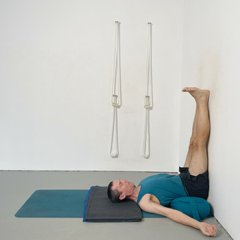
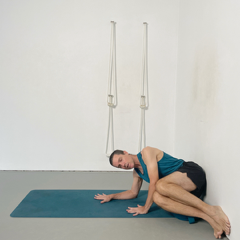
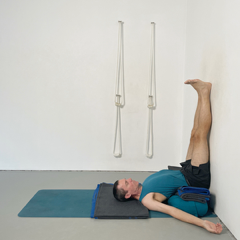
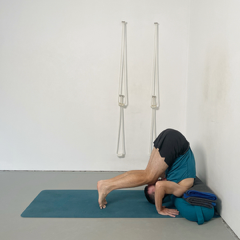
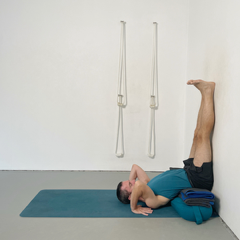
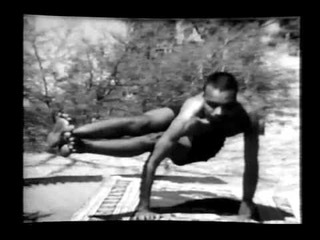
Noëlle Perez-Christiaens – a Posture Pioneer


by Dana K. Davis and Jenn Sherer

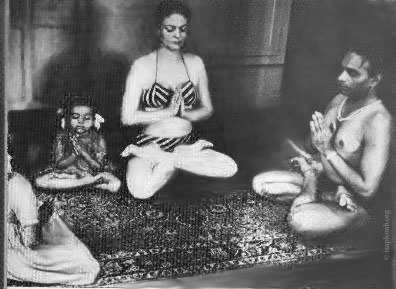
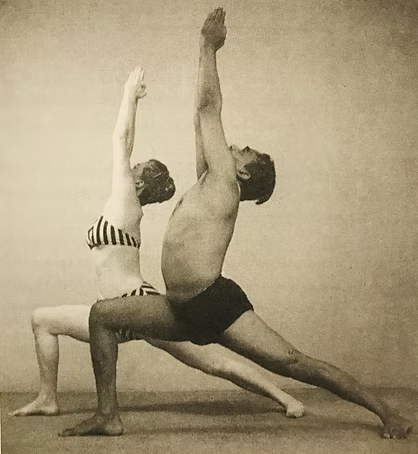
Once called a “Parisian Yoga Witch” in an online article, Noëlle Perez-Christiaens was a genius and a pioneer in the area of posture. She was born in 1925 and died August 8, 2019. This intense woman began by traveling alone to India in 1959 at age 33 to study with the famous haṭha yoga teacher, BKS Iyengar. She had studied spirituality and religion and was hoping to deepen her knowledge in India.

Noëlle was one of Iyengar’s first Western students, and spent 3 months, sometimes for 3 hours a day. Iyengar then was still teaching his pupils one-on-one at his home. During her stay in India, Noëlle was regarded virtually as one of the household, and this intimacy continued in their subsequent letters, where Iyengar wrote to her more as a colleague and friend than as a teacher.

He pushed her very hard. In her journal of her time in India (in the book Sparks of Divinity: the Teachings of BKS Iyengar from 1959 to 1975) she describes hurting everywhere, getting very sick and being exhausted. Yet she was devoted to Iyengar as her guru, and worked extremely hard to please him.

Struggling to Find the Missing Link
Back home in Paris, she worked with his teachings, and also later studied with him in Switzerland. Iyengar came to her yoga studio in Paris in 1971, 1972 and 1976 and during these visits, gave Noëlle insights that helped her realize that modern posture had become horribly misaligned.

She traveled to Africa and Portugal to study natural posture after Iyengar’s visits to Paris, where he had said that her students were not “on the axis”. She also felt heavy in the yoga poses, while Iyengar said one should feel light.

Her husband, Miguel, who she met in Portugal, was in natural alignment, or ‘Aplomb‘. Noëlle was able to study x-rays of the spines of people in natural ‘Aplomb’ and learned that people in less industrialized countries who carry weight on the head have a ‘natural arch‘ at the base of the spine, and their joints are aligned vertically. She changed the way she practiced and taught yoga as a result of these discoveries, and was able to find the lightness she had been searching for.

The Fruit of Her Work
Noëlle formed the Institut Superieur d’Aplomb in Paris in addition to her yoga studio (Institut de Yoga BKS Iyengar). In 1976 she self-published Sparks of Divinity: The Teachings of BKS Iyengar from 1959 to 1975 (in French & English). She would eventually write 27 books, only 2 of which have been translated into English (the other is Thus Spake BKS Iyengar). Always searching and learning, in 2008, in her 80s, she received her Doctorate in Ethnophysiology from the Ecole des Hautes Etudes en Sciences Sociales in Paris.

From there, Noëlle got the idea to study people who carry weight on their heads.  She traveled far and wide to find and study people who used their spines and skeletons sustainably in their every day life. Her research began in India but also led her to places like Burkina Faso, Africa; Morocco, and Portugal. She was forced to prove her work to her peers that spines were used sustainably by these people, no matter what their ethnic background. Her research and findings are recorded in her 29 books. Noëlle’s on-going work and teachings can be found at Institut Superieur D’Aplomb in Paris, www.isaplomb.org. Up to her passing in August 2019 at the age of 92, she continued to conduct empirical research and leading trips for her students to experience the physical and spiritual qualities of consciousness and connectedness that spinal awareness gives people.

Noëlle [was], as G. Lacombe says, a pupil of the first Iyengar, meaning the first period of B.K.S. Iyengar’s teaching, until 1975 – the period before he opened the Ramamani Iyengar Institute in Pune.  After the center opened, the classes became very large: 50, 60 or more pupils.”

To my knowledge, Noëlle is one [of the few] to have really followed what Iyengar was asking: “observe !”, “complete surrendering”, “you have to search”, “you must have millions of eyes”, etc. and above all, what he said to her, one day in Pune: “Go and walk behind Indian women, and observe them closely, copy them. When your shadow matches theirs, you will have made progress.”  When she really understood this, she realized that Iyengar was opening the way for an ethnographic research. The philosophical basis of Iyengar philosophy includes this ethnographic approach. That is the beginning of Noëlle’s research in ethnography. And after that the beginning of her research on people in natural Spinefulness.

Quotes from Sparks of Divinity
Here are a few quotes from Sparks of Divinity that I especially liked. You might find it interesting to apply these to your practice:

“Whether people are from the East or West, the tensions are there. Tensions are not stretches. If the stretching is good, relaxation is bound to be complete. A half-hearted stretch gives a half-hearted relaxation.” (from 1959)

“Sometimes the body says, ‘Yes,’ and the mind says, ‘Excuse me today.’ Sometimes the mind says, ‘Yes,’ and the body, ‘Excuse me.’ I always say, ‘Let us go ahead’.” (from 1959)

“Extension brings freedom” (from 1974)

“The whole body has to act. To extend a part, you must extend the whole.” (from 1974)

“As beginners, our intellect is only in the brain. You must have a million eyes, all over the body.” (not dated)

———-

Sparks of Divinity: The Teachings of BKS Iyengar from 1959 to 1975, Rodmell Press: Berkeley, 2012.

Photo of Miguel, Dana, and Noëlle from 2007, taken by Jean Couch.

Thus Spake BKS Iyengar, Part I

The following are excerpts from Thus Spake BKS Iyengar by Noelle Perez-Christiaens, ©Institut de Yoga BKS Iyengar-Paris 1979

1. RASA
YOU HAVE TO SAVOUR THE FRAGRANCE OF A POSTURE”
‘Fragrance’ is a sensory word—how can a posture have fragrance? This word expresses an agreeable sensation — how can an insufferably difficult posture produce an agreeable sensation? In this simple little word many have a chance to see that they are on the wrong track as they work to the breaking point with so much love and goodwill!

I discovered that the Sanskrit word Iyengar is translating is rasa (Patañjali, II.9). Rasa comes from the root RAS: to taste, to relish a taste; rasajña is one who savours, knows enjoyment; rasajñatva means poetic taste; rasayoga (in the plural) is a harmonious group of flavours.

Rasa is a sort of magnetic current flowing from the artist to her/his circle of auditors and back again, charged with the artistic emotion s/he created in them. It’s a tenuous, vibrating whole through which the spirit passes and transforms an ordinary Indian and makes her/ him thrill to eternal Vibration. It is el duende, which makes the matador sublime and enraptures the enthusiastic plaza, making the people rock in vibrations too powerful for simple mortals, unless they have been hoisted to that level. All this is rasa.

Is this what one experiences when toiling over ‘our’ postures or when one proudly performs fifty or a hundred backbends at a go? No. We are clearly on the wrong track: go seek elsewhere that which the Master would like to bring us to savour with him! Careful, though: Indians are excellent merchants, all Easterners are more cunning than we are, and if we are looking for something other than true fragrance, we will end by getting what we seek. Iyengar has said this clearly: “In ancient times, pupils went in search of gurus. Now gurus go in search of pupils. The is why spirituality has lost its fragrance.” (J81)

Here is a serious warning! From time to time, [we must] step back and ask ourselves sincerely what is it we are looking for, and if, we haven’t foundered in an easy, superficial, and highly physical yoga: whether we taste the rasa or not will give us our answer.

2. BRAHMĀSŪTRA
WATCH YOUR MEDIAN LINE”
Several ideas, which Iyengar describes differently, all express the same sensation, and seem all to be included in what treatises of Indian dance and sculpture call Brahmāsūtra, the thread of Brahmā. Among the sensations which Iyengar tries to make us feel are the axis, parallelism or symmetry, and the ‘median line’. Perhaps there are others: these three seem to me to be the essential ones.

As we will deal with the axis later, I will only allude to it here. However, I will try to define the sensation of the thread of Brahmā, of symmetry of the two sides of the body, or the parallel work of each side along the median line [an anatomical line created at the juncture of the medial or saggital, and frontal or coronal planes]. I believe that it does seem as though this is what Iyengar is saying several different ways.

In ancient India, no artist could begin work without having had a solid preparation in yoga, including āsana, prāṇāyāma, and [dhyāna] meditation. [S/]He therefore had to have practiced a balanced posture in a seated position, without which no cosmic reintegration is possible. It is evident, then, that the notion of ‘thread of Brahmā‘ or ‘plumb-line’ is well placed in the sūtras concerned with the dance and the proportions of statutes.

The different yoga postures are for us more and more subtle forms of balancing, or more and more refined foundations for concentration. As Iyengar says so well, they are application of an art in which the body is the material to model for the stone to chisel according to the idea the artist wishes to express. In sum, we are the stone, the sculptor is Brahmā, and the technique used is yoga. When we say ‘Brahmā‘ we might as well say: Harmony, Air, Silence, Peace, or Gravity. All of these are tangible manifestations of the non-manifested Energy, which remains quite esoteric a notion as long as It has not caught us up in Itself.

Among these tangible manifestations of Creative Energy, certain [ones] are fruits, like Harmony and Silence; others are rather agents like Air and Gravity. Without Gravity, the Air could not balance anything on the earth.

In the article The Dance and Sculpture in Classical Indian Art,* Kapila Malik Vātsyāyan writes, “Vertically, the human figure is conceived as composed of two halves, one on each side of the median line, the Brahmāsūtra, a fixed and invariable line representing the immutable force of gravity.” In a flash, we have here two notions Iyengar dwells upon: on the one hand, the axis of gravity every being must submit to, or live under pain of sprains and inflammations, in a state of constant aggression against the Cosmos – speaking of ahimsa (non-violence) but living in a state of himsa (aggression, injury); and on the other hand, the median line of the human body. Our task is always to bring the later to coincide with the former. How does the Master attempt to make us understand this median line? “The crown of the head, the centre of the forehead, the root of the nose, the tip of the nose, the middle of the sternum, all should be on the line.” (Q40) How could he be more explicit? We can well understand why he recommends to us, “always watch your median line.” (L2)

We find an echo of this in Vātsyāyan, “All movements are visualized in relation to the vertical median.” Several lines later, we read, “In Indian sculpture the study of flexion or bhañgā is essentially the study of the distribution of masses and the codification of the laws of balance.” We should not be surprised when Iyengar explains that our efforts of passivity and activity, “must test and ‘weigh’ the masses of the body on each side, as one estimates the weight of a piece of fruit in the hand.” He adds that this work of passivity and activity must balance weight evenly on each side of the body, “should weigh evenly on both the left and the right sides. Only then will lightness come.” (X322) Once all the weight has been brought gently back on to the median line and entrusted the thread of Brahmā, to Gravity, what could be left weighing heavily against it? Obviously, this work demands an enormous degree of attention. It’s a slow road but a sure one, towards great lightness — and freedom.

Iyengar explains this thought in other terms, “The right and left have to meet in the centre.”(Q40)  Consider the force conveyed by the word ‘meet’, as in the expression ‘to meet one’s death.’

Returning to Vātsyāyan, we find: “We call samabhañgā a position which is perfectly balanced: the two halves of the body, one on each side of the Brahmasūtra, are of equal weight and the distribution of the total weight is perfect. The physical balance produces a spiral and emotional balance. This is why gods and goddesses, and also humans in a state of peace (śanti), stillness, and collected thought are shown in samabhañga.” She adds that “all the sattvika pictures of Indian sculpture are shown in this attitude.

Iyengar continues: “that (meeting in the centre) means you are completely in contact; if there is looseness, there is no contact at all: the self and the body have lost the contact, so you learn nothing.” (Q40)

We could also quote many other sayings of the Master on the frantic search for balance, the gift of Brahmā the creator, which must not be held by the muscles but by the spirit, but we will content ourselves with one: “You have to work to obtain a perfect balance between both sides of the body” (K14) — here is the Brahmāsūtra again!

Echoing this union, Iyengar evokes, which arises out of the balance in Gravity, Vātsyāyan writes from a balanced creation in sculpture or dance (and we would add yoga) emanates “an aesthetic joy close to that supreme happiness that results from the union of the soul with God.” I believe his translator thought this was the best image to express the idea of the union of the ātman in the Ātman, or as Iyengar says, “the union of the Jivātman in the Parāmātman,” as we will see later on.

This work of constantly relinquishing one’s weight to gravity, to live on the thread of Brahmā and not to leave it, brings one gradually to taste rāsa. Rāsa will carry the true seeker on to ĀNANDA (Bliss).

*in Diogene, 1964, 45-48, pp 25-38

A last sentence from Vātsyāyan gives us a glimpse of the secrets of Indian mystical doctrine, which Iyengar does his utmost to transmit to us: “The position of samabhanga to which the dancer (of bharatanatyam) returns is of primary importance in Indian choreography, and , with rare exceptions, corresponds to a posture expressing the serenity of perfect balance.” She adds, “It is a position in which the weight is equally distributed between the two halves of the body.”

Bit by bit, we see the intricacy of the ideas: the centre and the two sides, the plumb-line, the thread of Brahmā, the perfect balance in the total surrender of one’s weight to Gravity. All these notions form a background against which one seems to see Iyengar as if in filagree. Two concise terms from Sanskrit appear to have produced this, Brahmāsūtra and Sama. We turn next to sama.

How to Use Yoga Props Effectively

Using yoga props can help you find balance and alignment. We break down basic poses to reeducate and still the mind by awakening the body’s intelligence.
by Leslie Peters

Yoga props reeducate and still the mind by awakening the body’s intelligence
Yoga is a complex subject with this very simple definition: yogah cittavrtti nirodhah (the Yoga Sūtra, I.2), which translated means, “Yoga is the cessation of movements in the consciousness,” according to B.K.S. Iyengar in his book Light on the Yoga Sūtras of Patañjali. Yogis divide consciousness (citta) into three parts: mind, ego, and intelligence. In his book, Light on Life, Iyengar compared these constituent parts to layers. The outermost layer is the mind. It is responsible for sifting through all of the information it receives through the five senses, as in “I’m hungry” or “I’m cold.” Because the mind constantly generates thoughts and images, Iyengar likened it to a computer that can’t stop itself from processing, or drawing distinctions, or making considered choices.

The ego is the innermost layer of consciousness. It is what gives us the sense of our separateness, or “I-ness,” and the feeling that we are at the center of everything. The ego is valuable because it is important to know that you are not the stranger sitting next to you on the bus or the tree in your front yard. But the ego has earned a negative reputation because it also holds on to all desires, achievements, prejudices, and opinions and identifies itself as being the sum total of any successes, worries, possessions, jobs, and whatever else that one has amassed. The ego clings to life and often lives in its glorious past or in the fearful future.

In between the mind and the ego lies the middle layer, intelligence. The distinguishing characteristics of intelligence are its capacity to perceive itself and its ability to choose to do something it hasn’t done before. In other words, intelligence is the part of our consciousness that enables us to objectively observe ourselves (including the mind and ego) and initiate change. Iyengar described intelligence as “the revolutionary of our consciousness.”

Iyengar wrote that when one layer of consciousness is active, it expands, causing the other layers to retract. So when we activate our intelligence, we force the overactive mind and clinging ego to recede, giving us the experience of stillness that is yoga.

The Importance of Yoga Props
Most of us think the physical brain is the only place where intelligence and perception occur. But Iyengar said that view devalues the innate intelligence of the body—the yogi’s vehicle on the path to stilling the consciousness. He insisted that intelligence can be cultivated in every cell of the body. One of the methods he developed for expanding intelligence is to use props while practicing yogāsana.

The skin is our first layer of intelligence, and the nerves in the skin feed information to the mind, Iyengar said. Since an average square inch of skin contains more than a thousand nerve endings, when a prop touches the skin, our consciousness is awakened and enlivened. Intelligence is developed not because we feel something but because we can observe where the prop touches us and where it doesn’t, and in what way the prop teaches us something new. “Every prop must make an imprint on the body,” Iyengar insisted, so that intelligence can be cultivated. There is no purpose to using a prop if we don’t learn something from it.

Stilling the fluctuations in our consciousness is a relentless, difficult, and demanding discipline. Therefore, fervor, or tapas, is essential if one wishes to progress along the path of yoga. Iyengar explained that tapas ignites the lamp of intelligence and that it is the duty of the guru to ignite the fire in each of his students and to shed the light of intelligence where there is darkness or ignorance. He likened props to gurus, meant to guide the student on the path. “Real gurus are rare and do not come often,” he often said. When the guru is not there in person, props can be used to guide the practitioner toward correct action and maximum intelligence. When used in this way, props can engage us in a process of observation, discernment, and reflection. This process will expand our intelligence and begin to teach us how to still the fluctuations of our consciousness.

Yogāsana Prop Sequence

1. Adho Mukha Śvānāsana (Downward-Facing Dog Pose)
Place a folded blanket on the floor and come onto your hands and knees. Place your hands on either side of the blanket as shown above, so they are shoulder-width apart and the middle fingers point straight ahead. Lift your knees off the floor and adjust your feet so that they are hip-width apart. Straighten your arms and legs. Rest your head on the blanket. If your head does not touch the blanket, either build up the height of support under your head or move your feet farther away from your hands. Stay for 1 to 3 minutes. Repeat the pose without the blanket and notice any differences. Compare the stretch of the legs and the extension in the spine when your head is supported and when it is not. Observe whether the arms and legs stretch better when the head rests on a support.

While you are in the pose, study yourself. It is easy to feel the places that are in contact with the floor or that are stretching. Use your intelligence to penetrate the places where you have no awareness. Iyengar says that while we are in the pose we must study the pose, not merely stay in it. Recharge the pose by pressing the hands into the floor. This will intensify the stretch of the legs. Be sure that both sides of the torso are in line and are the same length as the center of the torso. Observe where your intelligence recedes.

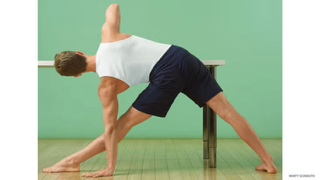
2. Utthita Trikoṇāsana (Extended Triangle Pose)
Stand facing a dining table or the back of a sofa. Separate your feet. Turn the right foot in slightly and turn the left leg out so that the left foot is parallel to your prop. Stretch your arms out to the side and, keeping the legs straight, move the left hand to the floor and stretch the right arm up. Observe the muscles in your upper back. Do you feel thickness in the trapezius muscles? (These are the large triangular muscles located where the neck and back meet.)

Observe the distance between the spine and your right and left shoulder blades. It is common for the bottom shoulder blade to move away from the spine while the top shoulder blade drops down toward the spine. Ideally, both shoulder blades should be equidistant from the spine. Most of us can’t feel what the top shoulder blade is doing in Trikonasana. We can feel the arm stretching, but that doesn’t necessarily mean the lift is there. In order to adjust and correct the pose, bend your right arm and press your right thumb into the top of your prop to move the top shoulder blade up and away from the spine and to move the trapezius muscle away from the head. The press of the thumb helps you access that shoulder blade in a way that is not possible without the resistance. Stay in the pose for 1 minute. Repeat the pose on the other side.

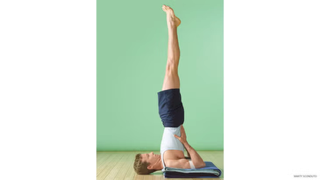
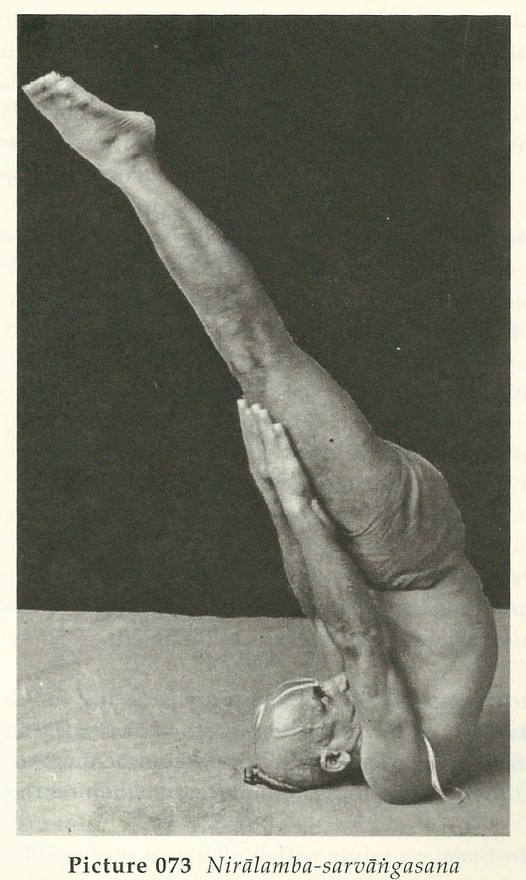
3. Sālamba Sarvāṅgāsana (Supported Shoulderstand)
Place a neatly folded stack of three blankets on the floor. Make a loop in a belt that is large enough so that when you slip it on your arms just above the elbows, the elbows are in line with your shoulders. Don’t make the loop too small or too large. Place the belt around the arms just above the elbows. Lie on your back with your shoulders on the blankets and head on the floor (your neck should not be on the blankets). As you lie there, notice where the belt touches the arms. Does the belt touch both arms in the same place and in the same way? Lift your legs up to come into Shoulderstand. Place your hands on your back. Keep your legs straight. Do not turn your head while in the pose.

According to Iyengar, the belt is used in this pose to educate the skin and muscles of the arm. It is not used as a support, nor does it stabilize the arms and keep them from moving apart. The feedback from the belt should give you answers to questions such as: Where does the belt touch each arm? Where do I feel the belt? Where don’t I feel the belt? Is one arm pulling toward the belt? If the belt feels different on each arm, which arm is doing the correct action?

Use the feeling of the belt against the arms to constantly adjust your pose. The biceps should rotate from the inside out. The more you turn the biceps out, the more the shoulder blades go up. When you come out of the pose, look to see whether the belt left a mark on your arms. It shouldn’t have. If a mark is there, it is an indication that your arm was pressing against the belt. The next time you practice the pose, see if you can correct the action in that arm.

[All yogāsana practice must be followed by śavāsana.] To set yourself up properly place one thin, folded blanket on the floor. Lie over it so that the blanket is perpendicular to the spine and below the base of the shoulder blades. Place another folded blanket under the head. Allow the shoulders to rest on the floor. This support creates a gentle lift for the sternum, which is soothing to the nerves. [Now, while focusing on your breath with closed lids, let go.]

Post

Leslie Peters was executive director of the B.K.S. Iyengar Yoga Institute of Los Angeles, and is now president and co-founder at Peters & Love.

How to Obtain Samādhi Through Your Prāṇāyāma Practice

Practicing prāṇāyāma is essential if you hope to experience samādhi, yoga‘s true purpose

by Leslie Peters

You’ve probably heard that the word yoga comes from the Sanskrit root yuj, which means to yoke or unite. And that the ultimate goal of yoga is liberation, also known as samādhi,through the union of the individual self with the universal soul. But just how do we unite what we perceive as a small individual self with something as vast, invisible, and ineffable as the universal soul?

An ancient yoga textbook, the Haṭha Yoga Pradīpikā, offers this simple answer: “Breath is the key to ultimate emancipation.” The Upaniṣads, the Hindu sacred scriptures, likewise equate pāṇa, in the form of breath, with the universal soul. When it is done properly and when a yoga practitioner is ready, prāṇāyāma, the yogic practice of regulating and channeling one’s breath, can provide a bridge between the individual self and the universal soul.

B.K.S. Iyengar explains how the three stages of the breath in prāṇāyāma—inhalation (pūraka), retention (antara kumbhaka), and exhalation (rechaka)—can connect us to the universal soul. During our inhalation, we are inviting prana to come in. According to Iyengar, the individual self must then move out of the way in order to make room for the soul. Iyengar believes that through this process, we are able to generate energy, expansion, and awareness within.

Iyengar tells us to think of the contact of the breath against the inner lung as the connection between universal soul and individual self. When we consciously stop the flow of breath (retention), we organize the mind’s thoughts and the body’s experience. The length of the retention varies. It should last just until the content (prāṇa) begins to move away from the container (the lung). We must keep the mind connected to the experience of the body to know when it’s time to exhale.

Practicing Prāṇāyāma to Relieve Stress
It is our goal to know at exactly what second the soul and the self begin to release away from each other. That is exactly when the exhalation should begin. Developing the ability to feel something as subtle as when the universal soul and the individual self begin to separate in the course of a breath takes regular practice and is what prāṇāyāma is all about.

Iyengar believes that in normal breathing, the brain initiates the action of inhalation and draws energy to itself. This keeps the brain in a state of tension. When the brain is tense, the breath is constricted. But in prāṇāyāma, the brain remains passive, and the lungs, bones, and muscles of the torso initiate the inhalation. Rather than suck in air, the lungs, diaphragm, ribs, and abdomen receive the breath. In describing the practice, Iyengar says that the breath must “be enticed or cajoled, like catching a horse in a field, not by chasing after it, but by standing still with an apple in one’s hand. Nothing can be forced; receptivity is everything.” We are to do prāṇāyāma with our intelligence, as opposed to our brains, Iyengar says.

By practicing prāṇāyāma and regulating the flow of prāṇa with measured observation and distribution of the breath, the mind becomes still. When this happens, we can allow the energy we normally spend engaging with and processing the world to bend inward.

According to Iyengar, āsana practice makes the body fit for prāṇāyāma, and prāṇāyāma practice makes the mind fit for meditation. In order for us to reach the ultimate union of our individual self with the universal soul, we must first experience dhyāna, or true meditation.

Iyengar insists that true meditation cannot be done if the practitioner “is under stress, has a weak body, weak lungs, hard muscles, collapsed spine, fluctuating mind, mental agitation, or timidity.” Furthermore, he says that sitting quietly is not considered true meditation, nor does he recognize meditation as a stress reliever. He believes that the practitioner should already have achieved a stressless state in the body and brain before meditation can occur. When performed correctly and without strain, prāṇāyāma cools and rests the brain and floods the body with vital energy. It relieves stress and, therefore, prepares us for true meditation.

Moving from Āsana to Prāṇāyāma
Patañjali wrote in the Yoga Sūtra that moving from āsana to prāṇāyāma is a big step. He warned that we must build enough strength and stability in the body and nervous system through our āsana practice first, in order to withstand the increase in energy flow that prāṇāyāma generates. Prāṇāyāma is an advanced practice. It was only after many years of āsana practice that Iyengar says he slowly began to build a prāṇāyāma practice. It took him many more years and great effort to sustain it. He didn’t have the guidance of a teacher and made all the mistakes that Patañjali warned against. Because making these mistakes can be quite harmful, Iyengar advises that if you want to practice prāṇāyāma, you should do so only if you have a teacher with whom to work.

Iyengar also cautions that if at any time during the practice of prāṇāyāma you experience pain in the head or tension in your temples, it means that you are initiating the breath from your brain, not your lungs. If this happens, return to normal breathing and relax.

Achieving Prāṇāyāma Through Śavāsana
In the ancient yogic texts, the practice of prāṇāyāma was always taught in a seated position. However, Iyengar noticed that maintaining the correct seated posture required so much effort for many students that they were not able to practice the various breathing exercises without great strain. He decided that allowing practitioners to lie down in a variation of śavāsana, in which the spine and chest are supported, created enough relaxation so that the breathwork could be done safely. He recommends that students lie down if they are new to the practice or are ill or fatigued.

The drawback to lying down is that the breath is constricted because the back lungs press against the support. Longtime practitioners prefer to sit because the entire torso is free to move— in front, in back, and on the sides. In Light on Prāṇāyāma, Iyengar says the practitioner needs two essential things: a stable spine and a still, but alert, mind. Both of these are built up with a strong āsana practice. Given the hazards of forcing a prāṇāyāma practice, it’s best to build your practice slowly and with care.

When lying down for prāṇāyāma, use blankets to support the spine and head. When the props are positioned correctly, the chest opens and relaxation results. When positioned incorrectly, the lower back and neck harden. Lie so that the buttocks rest on the floor and the blankets support the sacral and lumbar regions of the back. Your height and level of flexibility will dictate the distance between your buttocks and the end of the bottom blanket as well as between the bottom edges of the two blankets. The end of the top blanket will be between three-fourths of an inch and an inch and a half from the edge of the bottom blanket. If your head tips back when you lie down, put a block under it with a blanket on top. The skin of the forehead should flow toward the eyebrows.

Prāṇāyāma begins with observation. As you lie there, relax your entire body and begin to observe your breath. After several minutes, you will notice that your breath has become slower and slightly deeper, because you have relaxed. As you breathe normally, notice where you feel the breath in your body. Does your abdomen move with each breath? Do you feel your ribs move when you inhale and exhale? At the end of a normal exhalation, pause for a second or two before taking your next inhalation. It should be soft and smooth. If you feel tense, or are gasping for air, your pause was too long. Add a slight retention at the end of the exhalation several times. Then try taking a slightly deeper inhalation. To initiate the breath, move your ribs outward to the side. Instead of forcing the breath in, move the ribs to allow it in. When you have taken that slightly deeper breath, pause for a second before you slowly and smoothly exhale.

If you feel tension anywhere in the body, or if you find yourself gasping for air, you have done too much and have been too aggressive. If you feel relaxed and calm in your body, especially in your head, practice the complete cycle: a short pause at the end of an exhalation; then a slow, relaxed inhalation initiated by the rib cage moving outward; a slight pause at the end of the inhalation; then a slow, complete exhalation followed by a short pause. All of this should be done without any tension in the body. If you feel tense or nervous at any time, simply return to normal breathing, observe your breath, and relax. Practice this pranayama as long as you can stay focused and relaxed. Start slowly and build up your practice over time.

Seated Prāṇāyāma
Sitting properly takes a great deal of effort and strength. In order to do prāṇāyāma in a seated position without strain, the body must be quite supple and strong. A steady āsana practice will build the necessary strength and flexibility to sit correctly. When you’re learning to do seated prāṇāyāma, it is essential that you feel stable in the posture before adding the breath. If you cannot take a deeper inhalation without strain while seated, just practice sitting without adding the breath. You can continue to learn the breath while lying down. When the seated posture is correct, the breath will come. Don’t force it.

Sit in a simple cross-legged position. Use enough blankets under your hips so that your knees are parallel to or below your hips, not above them. In an attempt to lift the spine, many of us harden the lumbar spine and draw it inward, which moves us to the front of our sitting bones. To sit correctly, center yourself on the points of the sitting bones and draw the front spine and side chest up without creating hardness in the low back. Release the back of the neck and move the head down.

When you practice prāṇāyāma in a seated position, you must move the head down to create jālandhara bandha. A lifted head brings pressure to the heart, brain, eyes, and ears.

Post-Prāṇāyāma Śavāsana
After practicing prāṇāyāma of any kind, it is important to end with śavāsana in order to soothe the nerves and erase any tension that you may have inadvertently created during the practice. Also, after prāṇāyāma, you should wait at least 30 minutes before practicing āsanas. It is too jarring to the nervous system to go immediately from the quiet, calming practice of prāṇāyāma to the more active, physically demanding practice āsana. Allow for a gentle transition between your prāṇāyāma and any activity you choose to engage in following the practice.

To set yourself up properly place one thin, folded blanket on the floor. Lie over it so that the blanket is perpendicular to the spine and below the base of the shoulder blades. Place another folded blanket under the head. Allow the shoulders to rest on the floor. This support creates a gentle lift for the sternum, which is soothing to the nerves.

“Super Agers” Author and Dr. Eric Topol Interview Transcript

Often we’re warned about the risks of an aging population, the so-called demographic gray zone, the drain on the economy, medical services, and so much more. But author and Dr. Eric Topol suggests that’s no longer the case.

He argues that, in fact, new technology and medicine will provide us with vibrant, healthy lives much later on. Now he joins Walter Isaacson to discuss what he calls a breakthrough moment in the history of human healthcare.

Thank you. And Dr. Eric Topol, welcome back to the show.

Great to be with you again, Walter.

You know, this book, “Super Agers,” it’s a lot different than the books about how to age well and stuff because it’s so evidence-based.
Were you showing this sort of as a counterpart to all these bestsellers that have all sorts of new theories but aren’t evidence-based?

That certainly was part of it. I think you know, the idea that we’d already been active trying to hunt down the source of healthy aging, of super-agers, of welderly, whatever you want to call these remarkable folks, was very different than what’s out there.

And so you know, trying to set the record straight, putting in some around 1,800 citations, but really, as you said, Walter, going over the real exciting advances in the science, too.

We always talk about lifespan. We want to increase lifespan. And you talk about healthspan. Why do you focus that way?

Yeah, I don’t see the reason to promote longevity if you’re not also getting as much healthspan out of it as possible. Because if you have someone of advanced age and they’re so frail or demented or something that’s really compromised terribly their quality of life, that isn’t what we’re aspiring to do.

The real goal is just to get as many fully healthy years as possible. And we’re not doing that now. Most of the American population are the elderly, not the welderly or the super-agers. But I [believe] we have the capacity now to flip this. And over the years ahead, we’d have a lot more welderly and super-agers than people with chronic age-related diseases.

You both begin the book and you end the book with a couple of patients. I think it’s Mrs. L.R. and Mr. R.P. Tell me why you use them.

Yeah, so Lee Rusall, who’s happy to be identified, but was referred in the book, as you said, Walter, to Mrs. L.R., she was a patient recently in my clinic, 98, and incredibly intact. And also with a great sense of humor and just having a very rich life.

And she made me think about our welderly study of the 1,400 people like her, the average age was in their late 80s, never been sick, no medications. These are a rarefied group of people.

It took us seven years, Walter, to find 1,400 of these folks.

Well, because she’s so emblematic of healthy aging and the striking features were her relatives, her parents and her two brothers died 30 or 40 years of age younger than her. She’s the last one standing.

So it wasn’t just purely genetic?

Not at all. And in fact, that’s what we found in our welderly study is that when we, not only was the familial pattern a lot like Lee Rusall, but we did whole genome sequencing, and we found very little that could account for this remarkable super aging status.

So let’s start looking at the factors for super ages and start with lifestyle, if you would, what you call lifestyle plus.

Yeah, because while we’ve concentrated largely on diet and exercise, sleep is equally important. And then there’s these other factors like social engagement, avoiding isolation, being out in nature.

These have really strong support, as do the environmental toxins of air pollution, of forever chemicals and the microplastics, nanoplastics story. So it all fits into a simple model that the things that promote inflammation, like a poor diet, ultra processed food, overdose of proteins, lack of deep sleep, the lack of exercise and physical activity, the toxins from our environment.

They all fit in the model that if you promote inflammation that occurs more as we age or immunosynthesis, the deterioration of our immune system as we age, which are intertwined, that’s where you get age related diseases.

You talk about sleep though. Can we go back to that? Because one of the surprising things in your book was you said you should get about seven to eight hours of sleep.
If you get less, it’s a problem. But you also said if you get more, it’s a problem.

That’s right. And the question is, even start to see over seven hours, do you see this adverse linkage?
The question there is, is it because people have depression or is it really something about too much sleep that is not helpful?

We don’t really know, but the population studies where of course, everyone’s different. And we emphasize that if you look at it from a big population level, seven hours, not often what’s referred to as eight plus is the optimal level. But obviously that’ll vary from one individual to another.

What does sleep do for us?

Yeah. That’s the big thing that we’ve learned in recent years. So the one component of sleep known as deep sleep, the slow wave of sleep typically occurs in the early hours of sleep. That is the critical time when we use our glymphatics, not lymphatics, but glymphatics in our brain.

These are the channels that get the waste products, these toxins that we accumulate through our brain metabolism each day. And at night or whenever you sleep, that’s when these glymphatics go to work and get these toxins out of our brain, which are very pro-inflammatory.

If you don’t get enough deep sleep, which as we get older, we lose our propensity for deep sleep. If you don’t get enough, you don’t get these waste products out. And not only that, but if you take medications like Ambien, everything points to that you get basically a backup of these toxins. You may get some more sleep, but you’re not doing anything regarding deep sleep and clearance of these waste products.

With alcohol, every year we seem to have some new studies saying one drink is horrible, one drink is great or whatever. There’s a new study out from the American Heart Association. I saw that you even have written about some. Tell me what you feel now about alcohol consumption.

Yeah, the point you’re making, Walter, it’s really the problem. Depending on which report, looking often at the same data, the conclusions are quite different. Overall, it does look like if you are at risk for cancer, particularly certain types of cancer like colon or esophageal and even breast cancer, if you’re more than one to two drinks a day, you’re getting into a risk zone. There is a convergence of that.

There’s also the National Academies of Medicine and the Circulation American Heart reports that say, “Hey, there really is some benefit of alcohol for men up to one drink per day or seven per week and for women, perhaps four or five per week.” So we have mixed data. The problem, again, is we’re trying to come up with these reports and recommendations for all people.

By the way, let me push back on the all people. Why can’t I sequence my genome, put it in a computer and have it tell me, “You’re okay with salt. Your cholesterol is not going to be affected by meat or it will be. And by the way, you can do alcohol or you can’t do alcohol.”

We should be doing that because we can do that right now, Walter. Like for example, you can get a polygenic risk score, which isn’t even require a full genome sequence. It will tell you every different cancer risk.

If your cancer risk is really low across the board, your concern about drinking alcohol would be less, not to go excessive. But we don’t do that. We treat everybody the same and this is really part of the problem. And that is the ticket to prevention as well.

Wait, well, why don’t we do that?

Yeah, it’s because the medical community is slow, slow, slow, so slow to adopt the body of knowledge. Everything sits in this research compartment, like a different orbit, Earth one, and the medical practices like Earth two. And it’s just really frustrating. It takes so long to take validated, compelling data and put it into daily medical practice.

One of the biggest differences between having a long lifespan and a healthy long lifespan or a health span is dementia and specifically Alzheimer’s. What causes Alzheimer’s?

Well, there’s been the amyloid hypothesis and the tau hypothesis. Basically the story is there’s misfolded proteins that get in the brain, develop in the brain, and we develop a very severe inflammation response. If we do that, we’re gonna more likely go on to Alzheimer’s disease.

Now, turns out a lot of healthy people may have these misfolded proteins, but they don’t have the inflammatory response to them. So you don’t have to worry about the amyloid hypothesis or the tau hypothesis.

Basically, what you want is to not have this misfolded protein and its inflammatory reaction occur in your brain. We have a way to do that now. We have a marker called P-tau-217 that a lot of people and doctors don’t know about. And it can tell us more than 20 years in advance that you are a high vulnerability.

So what happens if I learn 20 years in advance?

Yeah, that’s what’s great. It’s kind of like if you’ve been following, I suspect you have, because you follow a lot of stuff, the LDL and the cholesterol story. You lower the LDL and you have less heart disease.

The same thing, if you have a high P-tau-217, and the only reason to get it is because you have a familial pattern of Alzheimer’s, you have an APOE4 or a polygenic risk that’s increased.

Anyway, you’re at higher risk, you get the P-tau-217. And if you’re relatively young, you’re in the 40s or 50s, you’ve got a 20 year lead time. Now, when you start to lose weight, exercise, have a better diet, that’s not pro-inflammatory, sleep better with high quality deep sleep, those markers come down.

It’s remarkable. It’s modifiable.

And so we should be able to prevent Alzheimer’s because we have brain clocks, we have these markers, we have even healthspan clocks from these proteins in our blood now. So you can not just use these clocks to tell about risk and markers, but then you can use them to see if the interventions are working.

And one of the exciting things, I know you’re aware of this, but these GLP-1 drugs like Ozempic and Mungero, Zep-Bound, they are being tested for Alzheimer’s in people who are not overweight in large trials, which we’ll have in the beginning of next year. That may work because these agents, these drugs markedly reduce inflammation in the brain and in the body.

And we haven’t had any drugs like that previously.

So if we can control the inflammation process and these drugs, as well as other gut hormones are going to do that for us, we’re going to have a way, not just lifestyle factors, but in the high-risk people to bring down the markers, the metrics of the aging brain, the sick brain that’s emerging towards Alzheimer’s years before people ever get mild cognitive impairment.

Wow. You talk about Ozempic and the similar GLPs. How much of a miracle drug is that?

Well, we’ve never had a family of drugs like this. And I want to just submit to you that we’re still in the early phase of this. What we’ve learned, now there’s like 15 different gut hormones. We only are into two or three of these that talk to the brain and talk to the immune system. This gut-brain axis is one of the most important discoveries for our health in history. And this drug class reflects that.

As you know, these GLP-1 drugs are not just influencing diabetes, you know, favorable effects, improving people’s obesity status, but they’re also improving the heart, the kidney, the liver, I mean, virtually every organ. And the last one to be tested of major organs, which is in progress in large trials now is the brain.

But even if these, even if Ozempic, which is the lead one as far as these trials, even if that doesn’t hit, there’s many other of these gut hormones that are going to be in pill form, various combinations, some of which get in the brain far better. They don’t rely just on the gut to brain signaling.

That’s what’s going to take us to ability and these other anti-inflammatories to prevent these three diseases, cancer, neurodegenerative, and cardiovascular, because they all have common threads and they all take 20 years to take hold in our body.

The things you’ve talked about, the immunotherapies, the GLP and the Ozempics, all were part of basic science research that led to discoveries that may not have even been expected. And we move it from the lab bench to the bedside, but now we’re cutting basic science funding and the National Institutes of Health. How harmful is that going to be to the breakthroughs we’re just beginning to see?

Well, you’ve nailed it there because this is the most extraordinary time in my four decades in medicine where these discoveries, and of course, the multimodal AI to analyze all the person data is here and now. So we are at the extraordinary moment of a series of breakthroughs, some of which we’ve reviewed in our conversation.

And at the same time, we’re taking down the chance for building on this by seeing near $20 billion gutted out of the NIH. And then all the other public health and science agencies of our government are similarly being dismantled.

So our ability to follow through and build on this progress is going to be profoundly compromised. It will go forward, but at a different pace.

Wait, wait, let me put a fine point on it. You’re saying these cuts will cause more people to die of cancer?

Well, to put it another way, the advances that we could make in cancer to save lives and prevent cancer will be put many years forward. So the corollary of what you just said, I believe is true.

We’re missing the chance to have better treatments and preventions by not supporting our biomedical research engine, the crown jewel of the world, by just taking in a reckless way, taking away its support. It’s no doubt going to hurt the health of a large number of people in the United States.

Tell me about health inequities in the United States and whether that’s a problem for overall health.

It’s a big issue. And it’s one of the biggest concerns is the things that we’ve been talking about, the prevention of age-related disease. The people who are the most indigent, the lowest socioeconomic status have the most to gain, the most need, and they may be the least to be able to be advantaged here.

So you have to go after this. You can’t just assume when you have some new thing that the people who need it the most are going to get it. And we could make inequities worse. And they’re already at a serious level in this country. So it’s certainly one of the concerns that I have.

Dr. Eric Tobel, thank you so much for joining us.

Thanks, Walter. I really enjoyed the conversation with you.

Kṛṣṇamacharya’s Legacy:

Modern Yoga’s Inventor

You may not even know it but Kṛṣṇamacharya’s legacy has influenced or perhaps even invented your yoga.

By Fernando Pagés Ruiz, updated Jan 20, 2025
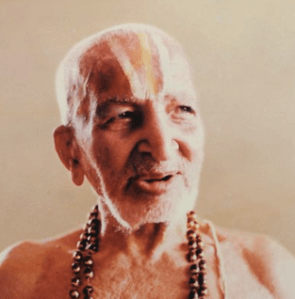
Whether you practice the dynamic series of Pattabhi Jois, the refined alignments of B.K.S. Iyengar, the classical postures of Indra Devi, or the customized vinyāsa of Viniyoga, your practice stems from one source: a five-foot, two-inch Brahmin born more than one hundred years ago in a small South Indian village.

He never crossed an ocean, but Kṛṣṇamacharya’s yoga has spread through Europe, Asia, and the Americas. Today it’s difficult to find an āsana tradition he hasn’t influenced. Even if you learned from a yogi now outside the traditions associated with Kṛṣṇamacharya, there’s a good chance your teacher trained in the Iyengar [Method], Aṣṭāṅga, or Viniyoga lineages before developing another style. Rodney Yee, for instance, who appears in many popular videos, studied with Iyengar. Richard Hittleman, a well-known TV yogi of the 1970s, trained with Devi. Other teachers have borrowed from several Kṛṣṇamacharya-based styles, creating unique approaches such as Ganga White’s White Lotus Yoga and Manny Finger’s ISHTA Yoga. Most teachers, even from styles not directly linked to Kṛṣṇamacharya—Sivananda Yoga and Bikram Yoga, for example—have been influenced by some aspect of Kṛṣṇamacharya’s teachings.

Many of his contributions have been so thoroughly integrated into the fabric of yoga that their source has been forgotten. It’s been said that he’s responsible for the modern emphasis on Śīrṣāsana (headstand) and Sarvāṅgāsana (shoulderstand). He was a pioneer in refining postures, sequencing them optimally, and ascribing therapeutic value to specific āsanas. By combining prāṇāyāma and āsana, he made the postures an integral part of meditation instead of just a step leading toward it.
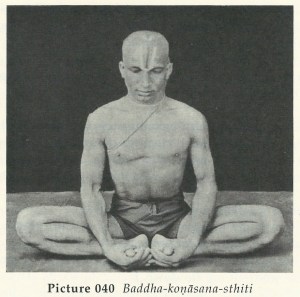
In fact, Kṛṣṇamacharya’s influence can be seen most clearly in the emphasis on āsana practice that’s become the signature of yoga today. Probably no yogi before him developed the physical practices so deliberately. In the process, he transformed haṭha—once an obscure backwater of yoga—into its central current. Yoga’s resurgence in India owes a great deal to his countless lecture tours and demonstrations during the 1930s, and his four most famous disciples—Jois, Iyengar, Devi, and Kṛṣṇamacharya’s son, T.K.V. Desikachar—played a huge role in popularizing yoga in the West.

Recovering Yoga’s Roots
When Yoga Journal asked me to profile Kṛṣṇamacharya’s legacy, I thought that tracing the story of someone who died barely a decade ago would be an easy job. But I discovered that Kṛṣṇamacharya remains a mystery, even to his family. He never wrote a full memoir or took credit for his many innovations. His life lies shrouded in myth. Those who knew him well have grown old. If we lose their recollections, we risk losing more than the story of one of yoga’s most remarkable adepts; we risk losing a clear understanding of the history of the vibrant tradition we’ve inherited.

It’s intriguing to consider how the evolution of this multifaceted man’s personality still influences the yoga we practice today. Kṛṣṇamacharya began his teaching career by perfecting a strict, idealized version of haṭhayoga. Then, as the currents of history impelled him to adapt, he became one of yoga’s great reformers. Some of his students remember him as an exacting, volatile teacher; B.K.S. Iyengar told me Kṛṣṇamacharya could have been a saint, were he not so ill-tempered and self-centered. Others recall a gentle mentor who cherished their individuality. Desikachar, for example, describes his father as a kind person who often placed his late guru’s sandals on top of his own head in an act of humility.

Both of these men remain fiercely loyal to their guru, but they knew Kṛṣṇamacharya at different stages of his life; it’s as if they recall two different people. Seemingly opposite characteristics can still be seen in the contrasting tones of the traditions he inspired—some gentle, some strict, each appealing to different personalities and lending depth and variety to our still-evolving practice of haṭhayoga.

Emerging From the Shadows
The yoga world Kṛṣṇamacharya inherited at his birth in 1888 looked very different from that of today. Under the pressure of British colonial rule, haṭhayoga had fallen by the wayside. Just a small circle of Indian practitioners remained. But in the mid-nineteenth and early twentieth centuries, a Hindu revivalist movement breathed new life into India’s heritage. As a young man, Kṛṣṇamacharya immersed himself in this pursuit, learning many classical Indian disciplines, including Sanskrit, logic, ritual, law, and the basics of Indian medicine. In time, he would channel this broad background into the study of yoga, where he synthesized the wisdom of these traditions.

According to biographical notes Kṛṣṇamacharya made near the end of his life, his father initiated him into yoga at age five, when he began to teach him Patañjali’s sūtras and told him that their family had descended from a revered ninth-century yogi, Nāthamuni. Although his father died before Kṛṣṇamacharya reached puberty, he instilled in his son a general thirst for knowledge and a specific desire to study yoga. In another manuscript, Kṛṣṇamacharya wrote that “while still an urchin,” he learned 24 āsanas from a swami of the Sringeri Math, the same temple that gave birth to Sivananda Yogananda’s lineage. Then, at age 16, he made a pilgrimage to Nāthamuni’s shrine at Alvar Tirunagari, where he encountered his legendary forefather during an extraordinary vision.

As Kṛṣṇamacharya always told the story, he found an old man at the temple’s gate who pointed him toward a nearby mango grove. Kṛṣṇamacharya walked to the grove, where he collapsed, exhausted. When he got up, he noticed three yogis had gathered. His ancestor Nāthamuni sat in the middle. Kṛṣṇamacharya prostrated himself and asked for instruction. For hours, Nāthamuni sang verses to him from the Yogarahasya (The Essence of Yoga), a text lost more than one thousand years before. Kṛṣṇamacharya memorized and later transcribed these verses.

The seeds of many elements of Kṛṣṇamacharya’s innovative teachings can be found in this text, which is available in an English translation (Yogarahasya, translated by T.K.V. Desikachar, Kṛṣṇamacharya Yoga Mandiram, 1998). Though the tale of its authorship may seem fanciful, it points to an important trait in Kṛṣṇamacharya’s personality: He never claimed originality. In his view, yoga belonged to God. All of his ideas, original or not, he attributed to ancient texts or to his guru.

After his experience at Nāthamuni’s shrine, Kṛṣṇamacharya continued his exploration of a panoply of Indian classical disciplines, obtaining degrees in philology, logic, divinity, and music. He practiced yoga from rudiments he learned through texts and the occasional interview with a yogi, but he longed to study yoga more deeply, as his father had recommended. A university teacher saw Kṛṣṇamacharya practicing his āsanas and advised him to seek out a master called Sri Ramamohan Brahmachari, one of the few remaining haṭhayoga masters.

We know little about Brahmachari except that he lived with his spouse and three children in a remote cave. By Kṛṣṇamacharya’s account, he spent seven years with this teacher, memorizing the Yoga Sūtra of Patañjali, learning āsanas and prāṇāyāma, and studying the therapeutic aspects of yoga. During his apprenticeship, Kṛṣṇamacharya claimed, he mastered 3,000 āsanas and developed some of his most remarkable skills, such as stopping his pulse. In exchange for instruction, Brahmachari asked his loyal student to return to his homeland to teach yoga and establish a household.

Kṛṣṇamacharya’s education had prepared him for a position at any number of prestigious institutions, but he renounced this opportunity, choosing to honor his guru’s parting request. Despite all his training, Kṛṣṇamacharya returned home to poverty. In the 1920s, teaching yoga wasn’t profitable. Students were few, and Kṛṣṇamacharya was forced to take a job as a foreman at a coffee plantation. But on his days off, he traveled throughout the province giving lectures and yoga demonstrations. Kṛṣṇamacharya sought to popularize yoga by demonstrating the siddhis, the supranormal abilities of the yogic body. These demonstrations, designed to stimulate interest in a dying tradition, included suspending his pulse, stopping cars with his bare hands, performing difficult āsanas, and lifting heavy objects with his teeth. To teach people about yoga, Kṛṣṇamacharya felt, he first had to get their attention.

Through an arranged marriage, Kṛṣṇamacharya honored his guru’s second request. Ancient yogis were renunciates, who lived in the forest without homes or families. But Kṛṣṇamacharya’s guru wanted him to learn about family life and teach a yoga that benefited the modern householder. At first, this proved a difficult pathway. The couple lived in such deep poverty that Kṛṣṇamacharya wore a loincloth sewn of fabric torn from his spouse’s sari. He would later recall this period as the hardest time of his life, but the hardships only steeled Kṛṣṇamacharya’s boundless determination to teach yoga.

Kṛṣṇamacharya’s fortunes improved in 1931 when he received an invitation to teach at the Sanskrit College in Mysore. There he received a good salary and the chance to devote himself to teaching yoga full time. The ruling family of Mysore had long championed all manner of indigenous arts, supporting the reinvigoration of Indian culture. They had already patronized haṭhayoga for more than a century, and their library housed one of the oldest illustrated āsana compilations now known, the Śrītattvanidhi (translated into English by Sanskrit scholar Norman E. Sjoman in The Yoga Tradition of the Mysore Palace).

For the next two decades, the Mahārājā of Mysore helped Kṛṣṇamacharya promote yoga throughout India, financing demonstrations and publications. A diabetic, the Mahārājā felt especially drawn to the connection between yoga and healing, and Kṛṣṇamacharya devoted much of his time to developing this link. But Kṛṣṇamacharya’s post at the Sanskrit College didn’t last. He was far too strict a disciplinarian, his students complained. Since the Mahārājā liked Kṛṣṇamacharya and didn’t want to lose his friendship and counsel, he proposed a solution; he offered Kṛṣṇamacharya the palace’s gymnastics hall as his own yogaśālā, or yoga school.

Thus began one of Kṛṣṇamacharya’s most fertile periods, during which he developed what is now known as Aṣṭāṅga Vinyasa Yoga. As Kṛṣṇamacharya’s pupils were primarily active young boys, he drew on many disciplines—including yoga, gymnastics, and Indian wrestling—to develop dynamically-performed āsana sequences aimed at building physical fitness. This vinyasa style uses the movements of Sūryanamaskāra (Sun Salutation) to lead into each āsana and then out again. Each movement is coordinated with prescribed breathing and dṛṣṭi, gaze points that focus the eyes, and instill meditative concentration. Eventually, Kṛṣṇamacharya standardized the pose sequences into three series consisting of primary, intermediate, and advanced āsanas. Students were grouped in order of experience and ability, memorizing and mastering each sequence before advancing to the next.

Though Kṛṣṇamacharya developed this manner of performing yoga during the 1930s, it remained virtually unknown in the West for almost 40 years. Recently, it’s become one of the most popular styles of yoga, mostly due to the work of one of Kṛṣṇamacharya’s most faithful and famous students, K. Pattabhi Jois*.

Pattabhi Jois met Kṛṣṇamacharya in the hard times before the Mysore years. As a robust boy of 12, Jois attended one of Kṛṣṇamacharya’s lectures. Intrigued by the āsana demonstration, Jois asked Kṛṣṇamacharya to teach him yoga. Lessons started the next day, hours before the school bell rang, and continued every morning for three years until Jois left home to attend the Sanskrit College. When Kṛṣṇamacharya received his teaching appointment at the college less than two years later, an overjoyed Pattabhi Jois resumed his yoga lessons.

Jois retained a wealth of detail from his years of study with Kṛṣṇamacharya. For decades, he has preserved that work with great devotion, refining and inflecting the āsana sequences without significant modification, much as a classical violinist might nuance the phrasing of a Mozart concerto without ever changing a note. Jois has often said that the concept of vinyāsa came from an ancient text called the Yoga Kuruntha. Unfortunately, the text has disappeared; no one now living has seen it. So many stories exist of its discovery and content—I’ve heard at least five conflicting accounts—that some question its authenticity. When I asked Jois if he’d ever read the text, he answered, “No, only Kṛṣṇamacharya.” Jois then downplayed the importance of this scripture, indicating several other texts that also shaped the yoga he learned from Kṛṣṇamacharya, including the Haṭhayogpradīpikā, the Yoga Sūtra, and the Bhagavad Gita.

Whatever the roots of Aṣṭāṅga Vinyasa, today it’s one of the most influential components of Kṛṣṇamacharya’s legacy. Perhaps this method, originally designed for youngsters, provides our high-energy, outwardly-focused culture with an approachable gateway to a path of deeper spirituality. Over the last three decades a steadily increasing number of yogis have been drawn to its precision and intensity. Many of them have made the pilgrimage to Mysore, where Jois, himself, offered instruction until his death in May, 2009.

Shattering a Tradition
Even as Kṛṣṇamacharya taught the young men and boys at the Mysore Palace, his public demonstrations attracted a more diverse audience. He enjoyed the challenge of presenting yoga to people of differing backgrounds. On the frequent tours he called ‘propaganda trips,’ he introduced yoga to British soldiers, Muslim mahārājās, and Indians of all religious beliefs. Kṛṣṇamacharya stressed that yoga could serve any creed and adjusted his approach to respect each student’s faith. But while he bridged cultural, religious, and class differences, Kṛṣṇamacharya’s attitude toward women remained patriarchal. Fate, however, played a trick on him: The first student to bring his yoga onto the world stage applied for instruction in a sari. And she was a Westerner to boot!

The woman, who became known as Indra Devi (she was born Zhenia Labunskaia, in pre-Soviet Latvia), was a friend of the Mysore royal family. After seeing one of Kṛṣṇamacharya’s demonstrations, she asked for instruction. At first, Kṛṣṇamacharya refused to teach her. He told her that his school accepted neither foreigners nor women. But Devi persisted, persuading the Mahārājās to prevail on his Brahmin. Reluctantly, Kṛṣṇmacharya started her lessons, subjecting her to strict dietary guidelines and difficult schedule aimed at breaking her resolve. She met every challenge Kṛṣṇamacharya imposed, eventually becoming his good friend as well as an exemplary pupil.

After a year-long apprenticeship, Kṛṣṇamacharya instructed Devi to become a yoga teacher. He asked her to bring a notebook, then spent several days dictating lessons on yogāsana instruction, diet, and prāṇāyāma. Drawing from this teaching, Devi eventually wrote the first best-selling book on haṭhayoga, Forever Young, Forever Healthy. Over the years after her studies with Kṛṣṇamacharya, Devi founded the first school of yoga in Shanghai, China, where Madame Chiang Kai-Shek became her student. Eventually, by convincing Soviet leaders that yoga was not a religion, she even opened the doors to yoga in the Soviet Union, where it had been illegal. In 1947 she moved to the United States. Living in Hollywood, she became known as the “First Lady of Yoga,” attracting celebrity students like Marilyn Monroe, Elizabeth Arden, Greta Garbo, and Gloria Swanson. Thanks to Devi, Kṛṣṇamacharya’s yoga enjoyed its first international vogue.

See also Is Yoga a Religion?

Although she studied with Kṛṣṇamacharya during the Mysore period, the yoga Indra Devi came to teach bears little resemblance to Jois’s Aṣṭāṅga Vinyasa. Foreshadowing the highly individualized yoga he would further develop in later years, Kṛṣṇamacharya taught Devi in a gentler fashion, accommodating but challenging her physical limitations.

Devi retained this gentle tone in her teaching. Though her style didn’t employ vinyasa, she used Kṛṣṇamacharya’s principles of sequencing so that her classes expressed a deliberate journey, beginning with standing postures, progressing toward a central āsana followed by complementary poses, then concluding with relaxation. As with Jois, Kṛṣṇamacharya taught her to combine prāṇāyāma and āsana. Students in her lineage still perform each posture with prescribed breathing techniques.

Devi added a devotional aspect to her work, which she calls Sai Yoga. The main pose of each class includes an invocation, so that the fulcrum of each practice involves a meditation in the form of an ecumenical prayer. Although she developed this concept on her own, it may have been present in embryonic form in the teachings she received from Kṛṣṇamacharya. In his later life, Kṛṣṇamacharya also recommended devotional chanting within āsana practice.

Though Devi died in April, 2002 at the age of 102, her six yoga schools are still active in Buenos Aires, Argentina. She still taught āsanas well into her nineties, and continued touring the world, bringing Kṛṣṇamacharya’s influence to a large following throughout North and South America. Her impact in the United States waned when she moved to Argentina in 1985, but her prestige in Latin America extends well beyond the yoga community.

You might be hard-pressed to find someone in Buenos Aires who doesn’t know of her. She’s touched every level of Latin society: The taxi driver who brought me to her house for an interview described her as “a very wise woman”; the next day, Argentina’s President Menem came for her blessings and advice. Devi’s six yoga schools deliver 15 āsana classes daily, and graduates from the four-year teacher-training program receive an internationally recognized college-level degree.

Instructing Iyengar
During the period when he was instructing Devi and Jois, Kṛṣṇamacharya also briefly taught a boy named B.K.S. Iyengar, who would grow up to play perhaps the most significant role of anyone in bringing haṭha yoga to the West. It’s hard to imagine how our yoga would look without Iyengar’s contributions, especially his precisely detailed, systematic articulation of each āsana, his research into therapeutic applications, and his multi-tiered, rigorous training system which has produced so many influential teachers.

It’s also hard to know just how much Kṛṣṇamacharya’s training affected Iyengar’s later development. Though intense, Iyengar’s tenure with his teacher lasted barely a year. Along with the burning devotion to yoga he evoked in Iyengar, perhaps Kṛṣṇamacharya planted the seeds which were later to germinate into Iyengar’s mature yoga. (Some of the characteristics for which Iyengar’s method of yoga is noted—particularly, pose modifications and using yoga to heal—are quite similar to those Kṛṣṇamacharya developed in his later work.) Perhaps any deep inquiry into haṭhayoga tends to produce parallel results. At any rate, Iyengar has always revered his childhood guru. He still says, “I’m a small model in yoga; my guruji was a great man.”

Iyengar’s destiny wasn’t apparent at first. When Kṛṣṇamacharya invited Iyengar into his household—Krishnamacharya’s wife was Iyengar’s sister—he predicted the stiff, sickly teenager would achieve no success in yoga. In fact, Iyengar’s account of his life with Kṛṣṇamacharya sounds like a Dickens novel. Kṛṣṇamacharya could be an extremely harsh taskmaster. At first, he barely bothered to teach Iyengar, who spent his days watering the gardens and performing other chores. Iyengar’s only friendship came from his roommate, a boy named Keshavamurthy, who happened to be Kṛṣṇamacharya’s favorite protégé. In a strange twist of fate, Keshavamurthy disappeared one morning and never returned. Kṛṣṇamacharya was only days away from an important demonstration at the yogaśālā and was relying on his star pupil to perform āsanas. Faced with this crisis, Kṛṣṇamacharya quickly began teaching Iyengar a series of difficult postures.

Iyengar practiced diligently and, on the day of the demonstration, surprised Kṛṣṇamacharya by performing exceptionally. After this, Kṛṣṇamacharya began instructing his determined pupil in earnest. Iyengar progressed rapidly, beginning to assist classes at the yogaśālā and accompanying Kṛṣṇamacharya on yoga demonstration tours. But Kṛṣṇamacharya continued his authoritarian style of instruction. Once, when Kṛṣṇamacharya asked him to demonstrate Hanumānāsana (full split), Iyengar complained that he had never learned the pose. “Do it!” Kṛṣṇamacharya commanded. Iyengar complied, tearing his hamstrings.

Iyengar’s brief apprenticeship ended abruptly. After a yoga demonstration in northern Karnāṭaka Province, a group of women asked Kṛṣṇamacharya for instruction. Kṛṣṇamacharya chose Iyengar, the youngest student with him, to lead the women in a segregated class, since men and women didn’t study together in those days. Iyengar’s teaching impressed them. At their request, Kṛṣṇamacharya assigned Iyengar to remain as their instructor.

Teaching represented a promotion for Iyengar, but it did little to improve his situation. Yoga teaching was still a marginal profession. At times, recalls Iyengar, he ate only one plate of rice in three days, sustaining himself mostly on tap water. But he single-mindedly devoted himself to yoga. In fact, Iyengar says, he was so obsessed that some neighbors and family considered him mad. He would practice for hours, using heavy cobblestones to force his legs into Baddha Koṇāsana (bound angle pose) and bending backward over a steam roller parked in the street to improve his Ūrdhvadhanurāsana (upward-facing bow pose). Out of concern for his well-being, Iyengar’s brother arranged his marriage to a 16 year-old named Ramamani. Fortunately for Iyengar, Ramamani respected his work and became an important partner in his investigation of the āsanas.

Several hundred miles away from his guru, Iyengar’s only way to learn more about āsanas was to explore poses with his own body and analyze their effects. With Ramamani’s help, Iyengar refined and advanced the āsanas he learned from Kṛṣṇamacharya.

Like Kṛṣṇamacharya, as Iyengar slowly gained pupils he modified and adapted postures to meet his students’ needs. And, like Kṛṣṇamacharya, Iyengar never hesitated to innovate. He largely abandoned his mentor’s vinyāsa style of practice. Instead, he constantly researched the nature of internal alignment, considering the effect of every body part, even the skin, in developing each pose. Since many people less fit than Kṛṣṇamacharya’s young students came to Iyengar for instruction, he learned to use props to help them. And since some of his students were sick, Iyengar began to develop āsana as a healing practice, creating specific therapeutic programs. In addition, Iyengar came to see the body as a temple and āsana as prayer. Iyengar’s emphasis on āsana didn’t always please his former teacher. Although Kṛṣṇamacharya praised Iyengar’s skill at āsana practice at Iyengar’s 60th birthday celebration, he also suggested that it was time for Iyengar to relinquish āsana and focus on meditation.

Through the 1930s, ’40s, and ’50s, Iyengar’s reputation as both a teacher and a healer grew. He acquired well-known, respected students like philosopher-sage Jiddhu Kṛṣṇamurti and violinist Yehudi Menuhim, who helped draw Western students to his teachings. By the 1960s, yoga was becoming a part of world culture, and Iyengar was recognized as one of its chief ambassadors.

Surviving the Lean Years
Even as his students prospered and spread his yoga gospel, Kṛṣṇamacharya himself again encountered hard times. By 1947, enrollment had dwindled at the yogaśālā. According to Jois, only three students remained. Government patronage ended; India gained their independence and the politicians who replaced the royal family of Mysore had little interest in yoga. Kṛṣṇamacharya struggled to maintain the school, but in 1950 it closed. A 60-year-old yoga teacher, Kṛṣṇamacharya found himself in the difficult position of having to start over.

Unlike some of his protégés, Kṛṣṇamacharya didn’t enjoy the perks of yoga’s growing popularity. He continued to study, teach, and evolve his yoga in near obscurity. Iyengar speculates that this lonely period changed Kṛṣṇamacharya’s disposition. As Iyengar sees it, Kṛṣṇamacharya could remain aloof under the protection of the Mahārājā. But on his own, having to find private students, Kṛṣṇamacharya had more motivation to adapt to society and to develop greater compassion.

As in the 1920s, Kṛṣṇamacharya struggled to find work, eventually leaving Mysore and accepting a teaching position at Vivekananda College in Chennai. New students slowly appeared, including people from all walks of life and in varying states of health, and Kṛṣṇamacharya discovered new ways to teach them. As students with less physical aptitude came, including some with disabilities, Kṛṣṇamacharya focused on adapting postures to each student’s capacity.

For example, he would instruct one student to perform Paścimottānāsana (seated forward extension) with knees straight to stretch the hamstrings, while a stiffer student might learn the same posture with knees bent. Similarly, he’d vary the breath to meet a student’s needs, sometimes strengthening the abdomen by emphasizing exhalation, other times supporting the back by emphasizing inhalation. Kṛṣṇamacharya varied the length, frequency, and sequencing of āsanas to help students achieve specific short-term goals, like recovering from a disease. As a student’s practice advanced, he would help them refine āsanas toward the ideal form. In his own individual way, Kṛṣṇamacharya helped his students move from a yoga that adapted to their limitations to a yoga that stretched their abilities. This approach, which is now usually referred to as Viniyoga, became the hallmark of Kṛṣṇamacharya’s teaching during his final decades.

Kṛṣṇamacharya seemed willing to apply such techniques to almost any health challenge. Once, a doctor asked him to help a stroke victim. Kṛṣṇamacharya manipulated the patient’s lifeless limbs into various postures, a kind of yogic physical therapy. As with so many of Kṛṣṇamacharya’s students, the man’s health improved—and so did Kṛṣṇamacharya’s fame as a healer.

It was this reputation as a healer that would attract Kṛṣṇamacharya’s last major disciple. But at the time, no one—least of all Kṛṣṇamacharya—would have guessed that his son, T.K.V. Desikachar, would become a renowned yogi who would convey the entire scope of Kṛṣṇamacharya’s career, and especially his later teachings, to the Western yoga world.

Keeping the Flame Alive
Although born into a family of yogis, Desikachar felt no desire to pursue the vocation. As a child, he ran away when his father asked him to do āsanas. Kṛṣṇamacharya caught him once, tied his hands and feet into Baddha Padmāsana (bound lotus pose), and left him tied up for half an hour. Pedagogy like this didn’t motivate Desikachar to study yoga, but eventually inspiration came by other means.

After graduating from college with a degree in engineering, Desikachar joined his family for a short visit. He was en route to Delhi, where he’d been offered a good job with a European firm. One morning, as Desikachar sat on the front step reading a newspaper, he spotted a hulking American car motoring up the narrow street in front of his father’s home. Just then, Kṛṣṇamacharya stepped out of the house, wearing only a dhoti and the sacred markings that signified his lifelong devotion to the god Viṣṇu. The car stopped and a middle-aged, European-looking woman sprang from the backseat, shouting “Professor, Professor!” She dashed up to Kṛṣṇamacharya, threw her arms around him, and hugged him.

The blood must have drained from Desikachar’s face as his father hugged her right back. In those days, Western ladies and Brāhmiṇs just did not hug—especially not in the middle of the street, and especially not a Brāhmiṇ as observant as Kṛṣṇnamacharya. When the woman left, “Why?!?” was all Desikachar could stammer. Kṛṣṇamacharya explained that the woman had been studying yoga with him. Thanks to Kṛṣṇamacharya’s help, she had managed to fall asleep the previous evening without drugs for the first time in 20 years. Perhaps Desikachar’s reaction to this revelation was providence or karma; certainly, this evidence of the power of yoga provided a curious epiphany that changed his life forever. In an instant, he resolved to learn what his father knew.

Kṛṣṇamacharya didn’t welcome his son’s newfound interest in yoga. He told Desikachar to pursue his engineering career and leave yoga alone. Desikachar refused to listen. He rejected the Delhi job, found work at a local firm, and pestered his father for lessons. Eventually, Kṛṣṇamacharya relented. But to assure himself of his son’s earnestness—or perhaps to discourage him—Kṛṣṇamacharya required Desikachar to begin lessons at 3:30 every morning. Desikachar agreed to submit to his father’s requirements but insisted on one condition of his own: No God. A hard-nosed engineer, Desikachar thought he had no need for religion. Kṛṣṇamacharya respected this wish, and they began their lessons with āsanas and chanting Patañjali’s Yoga Sūtra. Since they lived in a one-room apartment, the whole family was forced to join them, albeit half asleep. The lessons were to go on for 28 years, though not always quite so early.

During the years of tutoring his son, Kṛṣṇamacharya continued to refine the Viniyoga approach, tailoring yoga methods for the sick, pregnant women, young children—and, of course, those seeking spiritual enlightenment. He came to divide yoga practice into three stages representing youth, middle, and old age: First, develop muscular power and flexibility; second, maintain health during the years of working and raising a family; finally, go beyond the physical practice to focus on God.

Desikachar observed that, as students progressed, Kṛṣṇamacharya began stressing not just more advanced āsanas but also the spiritual aspects of yoga. Desikachar realized that his father felt that every action should be an act of devotion, that every āsana should lead toward inner calm. Similarly, Kṛṣṇamacharya’s emphasis on the breath was meant to convey spiritual implications along with physiological benefits.

According to Desikachar, Kṛṣṇamacharya described the cycle of breath as an act of surrender: “Inhale, and God approaches you. Hold the inhalation, and God remains with you. Exhale, and you approach God. Hold the exhalation, and surrender to God.”

During the last years of his life, Kṛṣṇamacharya introduced Vedic chanting into yoga practice, always adjusting the number of verses to match the time the student should hold the pose. This technique can help students maintain focus, and it also provides them with a step toward meditation.

When moving into the spiritual aspects of yoga, Kṛṣṇamacharya respected each student’s cultural background. One of his longtime students, Patricia Miller, who now teaches in Washington, D.C., recalls him leading a meditation by offering alternatives. He instructed students to close their eyes and observe the space between the brows, and then said, “Think of God. If not God, the sun. If not the sun, your parents.” Kṛṣṇamacharya set only one condition, explains Miller: “That we acknowledge a power greater than ourselves.”

Preserving a Legacy
Today Desikachar extends his father’s legacy by overseeing the Kṛṣṇamacharya Yoga Mandiram in Chennai, India, where all of Kṛṣṇamacharya’s contrasting approaches to yoga are being taught and his writings are translated and published. Over time, Desikachar embraced the full breadth of his father’s teaching, including his veneration of God. But Desikachar also understands Western skepticism and stresses the need to strip yoga of its Hindu trappings so that it remains a vehicle for all people.
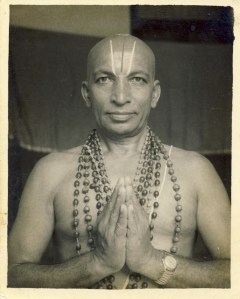
Kṛṣṇamacharya’s worldview was rooted in Vedic philosophy; the modern West is rooted in science. Informed by both, Desikachar sees his role as translator, conveying his father’s ancient wisdom to modern ears. The main focus of both Desikachar and his son, Kausthub, is sharing this ancient yoga wisdom with the next generation. “We owe children a better future,” he says. His organization provides yoga classes for children, including the disabled. In addition to publishing age-appropriate stories and spiritual guides, Kausthub is developing videos to demonstrate techniques for teaching yoga to youngsters using methods inspired by his grandfather’s work in Mysore.

Although Desikachar spent nearly three decades as Kṛṣṇamacharya’s pupil, he claims to have gleaned only the basics of his father’s teachings. Both Kṛṣṇamacharya’s interests and personality resembled a kaleidoscope; yoga was just a small part of what he knew. Kṛṣṇamacharya also pursued disciplines like philology, astrology, and music too. In his own Ayurvedic laboratory, he prepared herbal recipes.

In India, he’s still better known as a healer than as a yogi. He was also a gourmet cook, a horticulturist, and shrewd card player. But the encyclopedic learning that made him sometimes seem aloof or even arrogant in his youth—
“intellectually intoxicated,” as Iyengar politely characterizes him—eventually gave way to a yearning for communication. Kṛṣṇamacharya realized that much of the traditional Indian learning he treasured was disappearing, so he opened his storehouse of knowledge to anyone with a healthy interest and sufficient discipline. He felt that yoga had to adapt to the modern world or vanish.

An Indian maxim holds that every three centuries someone is born to re-energize a tradition. Perhaps Kṛṣṇamacharya was such an avatāra. While he had enormous respect for the past, he also didn’t hesitate to experiment and innovate. By developing and refining different approaches, he made yoga accessible to millions. That, in the end, is his greatest legacy.

As diverse as the practices in Kṛṣṇamacharya’s different lineages have become, passion and faith in yoga remain their common heritage. The tacit message his teaching provides is that yoga is not a static tradition; it’s a living, breathing art that grows constantly through each practitioner’s experiments and deepening experience.

* [Addendum]
The Economist obituary questioned Jois’s adherence to the yogic principle of brahmacharya or sexual continence, and made the accusation that some students received different ‘adjustments’;[9] further evidence and accusations soon emerged in 2009.[43][44] In 2010, it became public knowledge that Jois had systematically sexually abused some of his female and male yoga students, both in Mysuru and during his travels, until his death in 2009.[45] Some of this was straightforward sexual abuse, some under the guise of ‘adjustments’ and sometimes under the guise of ‘welcoming’ and ‘saying goodbye’ to students.[11][46] The number of victims is unknown, but women and men have described their experiences of abuse, with video and photographic evidence.[47] Some well known Aṣṭāṅga [Vinyāsa] Yoga teachers have come forward to corroborate the accusations.[48]In 2019, R. Sharath Jois published an acknowledgement of his sadness over his grandfather’s conduct, apologising to the students concerned, and encouraging them to forgive his grandfather. “It brings me immense pain that I also witnessed him giving improper adjustments”, Sharath wrote.[12][49]

Read Gregory Maehle’s Response to Karen Rain’s Interview About Sexual Abuse.
Thank you so much Gregor Maehle for your beautiful, honest, insightful and heartfelt response to my interview. Please don’t feel bad thinking that you could have or should have done something differently. I could have been one of the women who ‘simply smiled at you, shook their heads and walked on’ when you approached them about the sexual abuse. Thank you for believing me now, for understanding that sexual, spiritual and institutional abuse are complex and for not shaming me for not recognizing what was happening to me at the time.
I’ve been thinking that AY teachers who want to continue to venerate Pattabhi Jois and teach yoga adhering to his tradition/lineage/method ought to call it Vinyasa Yoga (honesty in advertising). And teachers like you and Monica Gauci and others are much more deserving of the label Aṣṭāṅga (8 limbed) Yoga teachers.

Are you a Yogi, Bhogi or Rogi?

By Renu Namjoshi

“A yogi has the senses under control and is able to withdraw or externalize them at will just as a tortoise is able to extend or withdraw its limbs.” ~Bhagavad Gita (2.58)

Are you a Yogi, Bhogi or Rogi – but hopefully not a Drohi?
These may sound like a nursery rhyme or something out of a Dr. Seuss book, however, they are words every aspiring yogi should be familiar with. Language is the gateway to understanding the teachings of any culture or philosophy. To assimilate the teachings of Yoga, some grasp of key Sanskrit words is essential otherwise many concepts can get lost in translation, or are only superficially assimilated.

Take the much misunderstood word Yogi, which has over the last few years had a meteoric assimilation in the English lexicon. I even heard it thrown around on Fox News recently. I would like to popularize three new words in the English language: Rogi, Bhogi and Drohi.

Most children in India have heard some version of this proverb from their elders:
One who eats once a day is a Yogi (divine wo/man). One who eats twice is a Bhogi (pleasure seeker). One who eats three times is a Rogi (plagued by ill-health). One who eats four times is a Drohi (destructive, menace to society).

On the simplest level this ancient proverb suggests different levels of appetites and points us in the direction of consuming less food and simplifying our diet, which goes a long way in creating purity of mind and body. However, over consumption of food is not the only thing we need to curtail to deepen our connection with the divine and become a Yogi. In our health and body oriented culture we often overlook that while consuming healthy food is important even more important is the quality of our inner consumption.

We all have large appetites fueled by an innate hunger to gratify our senses and validate our unique identity. Just as our taste buds can make us indulge in food, our eyes can feast on appealing visions, our ears become obsessed by certain types of sounds, and our touch craves unique sensations. Our muscles can gorge on exercise and even our minds can overindulge in captivating ideas, thoughts, and words. Furthermore, we often devour unhealthy emotions such as resentment, revenge, jealousy, guilt, and fear. We regularly overwhelm ourselves with other people’s harsh words and attitudes. Finally, all of us are guilty of guzzling down social media and the endless stimulation and distractions of the modern world.

While, our body and mind thrive on a balanced approach to fulfilling our innate yearnings, they are destroyed when we overindulge them, regardless of the object or cause of our enchantment (yes, even yoga can become an addiction). Excess of any type, and lack of time to withdraw our senses inwards (such as deep rest, sleep, and meditation) produces inordinate amount of stress on the body and mind. Scientific research also shows the result of stress and overconsumption on our hippocampus, which is smaller in depressed people because stress can suppress the production of new nerve cells needed for its regeneration.

Ironically, even obsession and excessive focus on bodily health can lead to ill health. While a healthy body is very helpful for our spiritual search, as it is one less distraction, it is by no means essential. It might surprise you to know that some of the greatest Yogis of our time were born with difficult health karma. Ramana Maharishi, one of the greatest Hindu saints of the last century died of cancer. It is said that the Buddha was always ill, and had to travel with his doctor. Or look at Physicist Stephen Hawking, one of the greatest scientific minds of our times, who has been paralyzed for the last 50 years.

A Yogi curtails her/his appetite and practices moderation in sensory gratification, no matter how enchanting or appealing the experience in front of her/him. S/he eats just enough to live and does not let her/his cravings overwhelm her/him.

We become Rogis when we chase a hunger, goal, person, emotion, experience, or desire without restrain, and exert ourselves beyond capacity. This overblown focus usually is a result of some deep seated psychological blocks that we are unaware of, which urge us forward and seem to have a life of their own. Our compulsions create self destructive behaviors that obliterate our peace of mind and fuel further cravings. Rogi in Sanskrit is another word for the ailing, sick, and invalid, as these compulsions and impulses raise our stress hormones, destroy our peace of mind, and the health of our body. We are Rogi’s when we identify solely with the body.

Bhogis are passionate, goal oriented people with strong opinions and often strong ambitions. They have a great hunger for success, recognition and enjoying life’s pleasures. Their happiness is outcome driven and as such they are constantly looking for satisfaction and validation through something outside of themselves. Most of us are bhogis and there is nothing particularly wrong with that. However, yoga teaches us that fulfillment of external/worldly desires is not the ultimate goal. If our happiness is based on waiting for a desire or goal to be fulfilled or getting “what we want” we are in a hopeless situation because that can never be realized. Desires and goals are always changing, growing, shifting. According to Shawn Achor, the author of “Scientific Proof that Happiness is a Choice,” every time we hit a success, our brain moves the goalpost of where success is”.

A Yogi is someone who has come to the realization that the excesses of the Rogi and the outcome driven happiness of the Bhogi are both ultimately fruitless. S/he is one who is striving for freedom from the unpredictable clutches of outer circumstances, and turns instead towards his inner sanctuary for joy that can always be accessed regardless of circumstances.

A Yogi does not have to be someone who does Yoga or renounces life and sits on a mountain top and meditates. Rather s/he is someone who performs her/his karma and obligations with the highest state of excellence. In practical terms, a Yogi is someone who meets challenges, not from the narrow perception of the personality (body/mind) but the expansiveness of spirit.

S/he sees life as a learning experience and proceeds with calmness, stability and equanimity.

Lastly, Drohis are traitors whose hunger is so deadly and toxic that s/he not only will destroy her/his life, but end up tormenting others around her/him as well.

Viparīta Karaṇi Explained

Step-by-Step Guide & Free Video Tutorial

Viparīta karaṇi [inverted action], commonly known as Supported Legs-Up-the-Wall Pose, is a deeply calming restorative inversion. Practiced regularly, it can relieve fatigue, calm the nervous system, reduce swelling in the legs, and support healthy circulation. In this Viparīta karaṇi tutorial, we’ll guide you through three key variations of Viparīta karaṇi—ranging from beginner-friendly to advanced—with a free instructional video and detailed images to support each stage of the pose.

Whether you’re a new student with tight hamstrings or an experienced practitioner aspiring to practice the forward roll entry, this Viparīta karaṇi tutorial will help you develop confidence and technique in this classic Iyengar Method posture.

1. Viparīta karaṇi for Beginners: Angled Bolster Setup

The first variation is ideal for newer students or anyone with tight hamstrings. Instead of placing the bolster parallel to the wall, it’s angled upward with a portion tucked up the wall to help elevate the pelvis and reduce strain in the legs.

Key setup points:
Bolster angled with roughly one-third tucked up the wall
A flat blanket cushions the head
Legs rest at approximately a 60-degree angle

Step-by-Step Instructions:

  • Press hands into the floor to lift the pelvis onto the bolster
  • Walk the feet and hips closer to the wall in stages

  • Only straighten the legs once the pelvis is securely supported

2. Intermediate Variation: Classical Setup with Side Entry

This version brings the hips directly into contact with the wall for a more traditional alignment. The bolster is now placed parallel to the wall, with a small gap left to allow the tailbone to drop slightly.

Setup details:
Bolster parallel to the wall with a few centimeters of space
Blanket under the head remains in place

Entry technique:

  • Sit sideways on the bolster
  • Hug knees and use the hands and forearms to rotate onto the back

  • Carefully swivel the legs up the wall while keeping both sitting bones in contact with the wall

3. Advanced Variation: Forward Roll Entry for Experienced Students

For those comfortable with inversions and looking to deepen their practice, this variation teaches how to forward roll into Viparīta karaṇi. This action allows for a higher lift under the pelvis, using additional blankets for support.

Setup:
Bolster positioned further from the wall with two neatly folded blankets stacked on top
Optional block at the wall to gauge distance

Technique overview:

  • Position hands forward of the head and place crown of head on the mat
  • Press hands firmly, tuck toes under, and lift knees

  • Walk in until shoulders contact the bolster, then use controlled pressure to bring the pelvis to the wall

  • Slide into position, ensuring even blanket distribution and correct spinal alignment

Key Benefits of Viparīta karaṇi
• Calms the nervous system
• Promotes a parasympathetic response, helping reduce anxiety and stress
• Supports circulation: Elevates the legs to help reduce swelling and fatigue
• Improves breath awareness: Gentle elevation of the chest and abdomen enhances natural respiratory rhythm
• Restores energy: Reverses the effects of gravity and long periods of standing or sitting
• Safe inversion alternative: Offers many of the benefits of shoulderstand with less strain

Watch the Free Class
This Viparīta karaṇi tutorial is available in full on Yoga Selection. You’ll receive step-by-step guidance for all three variations, detailed prop setups, and troubleshooting tips to help you build confidence—especially with the forward roll entry.
Viparīta karaṇi – Iyengar Method Tutorial for Beginners to Advanced + Step-by-Step Props Guide

FAQs
How long should I stay in Viparīta karaṇi? Anywhere from 5–15 minutes is typical. Longer holds allow for deeper relaxation, especially in restorative practices.

Can I do this pose if I have neck issues? Yes, but stick with the beginner or intermediate version. The forward roll should only be attempted once you’re confident and have no contraindications.

What props do I need? A yoga bolster, at least three blankets, and a block. You can modify with cushions or firm pillows if needed.

Is this pose safe during menstruation? Although Viparīta karaṇi is a rejuvenating restorative pose, it is still considered an inversion. Other poses such as Setubandha sarvāṅgāsana may be better choices during menstruation.

Final Thoughts on Viparīta karaṇi
Viparīta karaṇi offers a restorative pathway into the benefits of inversions. Whether you’re just starting or looking to refine your technique, the step-by-step guidance in this tutorial and accompanying class will help you practice with clarity, alignment, and confidence.

Originally posted here

To view Lois Steinberg’s version in Sālamba śīrṣāsana use the following link: 

Restraint


Restraints Abound
Most drivers are required to stay on the right side on two-way roads, yet others have to do so on the left. While on these roads we need to observe speed limits, turn lanes, detours, etc. Similarly, our cupboards separate our dishes and kitchenware. Some civil privileges such as voting require a minimum age, just as does retirement. The trades and professionals have parameters that need to be heeded. Recuperation sometimes comes with an extensive list of restrictions. Almost all begin education at a required age, and in this country are expected to graduate HS, at a minimum. Fewer still continue on, and achieve their terminal degrees in another 2-8 years.

A select few pursue self-development, while imposing additional restrictions. In this regard, we seek the advice of those who’ve already traveled this path. Bellur Kṛṣṇamachar Sundararaja Iyengar was such a guide for close to 1,000 certified Iyengar Method instructors in the US, with only a half-dozen of these residing in KS. Even after death, Mr. Iyengar continues to point the way via numerous writings. His pursuit was noteworthy. At 16, beginning āsana studies with his brother-in-law, the renown Śri Tirumalai Kṛṣṇamacharya, in Mysore. When 18, young Sundararaja was assigned to instruct in Pune, where he continued in his inquiry ’til the age of 95.

https://www.youtube.com/watch?v=LUvOuik-g4c&list=PLe3tTqewFmrRz4JS-yFKsKTHf6i8flb5t

BKS himself followed his teacher’s example, resisting the traditional path, and eventually becoming a householder. There is film of Sundararaja when twenty practicing the vinyāsa of his lineage. This third part, (āsana) of Patañjali’s aṣṭāṅgayoga (eight limbs of yoga) would often consume about 10 hrs each of these early days.

Patañjali’s Yoga Sūtras
In his pursuit, BKS eventually develop what his students endearingly came to call the Iyengar method of yoga. In time he wrote Light on the Yoga Sūtras of Patañjali, and later Core of the Yoga Sūtras. “As a mortal soul, it is a bit of an embarrassment for me with my limited intelligence to write on the immortal work of Patañjali on the subject of yoga.”

“Patañjali fills each sūtra with his experiential intelligence, stretching it like a thread (sūtra), and weaving it into a garland of pearls of wisdom to flavour and savour by those who love and live in yoga, as wise-[beings] in their lives. Each sūtra conveys the practice as well as the philosophy behind the practice, as a practical philosophy for aspirants and seekers (sādhakas) to follow in life.”

Patañjali begins his four-chapter (I-IV) sūtra compilation thusly, I.1, atha yogānuśāsanam, Now the teachings of yoga [are presented]. He then summarises in I.2, yogaś citta-vṛtti-nirodhaḥ, Yoga is the stilling of the changing states of mind.

Yoga is defined as restraint of fluctuations in the consciousness. It is the art of studying the behaviour of consciousness, which has three functions: cognition, conation or volition, and motion. Yoga shows ways of understanding the functionings of the mind, and helps to quieten their movements, leading one towards the undisturbed state of silence which dwells in the very seat of consciousness. Yoga is thus the art and science of mental discipline through which the mind becomes cultured and matured.”

“As the [changing states of the mind] must be restrained through the discipline of yoga, yoga is defined as citta vṛtti nirodhaḥ. A perfectly subdued and pure citta is divine, and at one with the soul.”

“Patañjali’s opening words are on the need for a disciplined code of conduct to educate us towards spiritual poise and peace under all circumstances. He defines yoga as the restraint of citta, which means consciousness. The term citta should not be understood to mean only the mind. Citta has three components: mind (manas), intelligence (buddhi), and ego (ahaṁkāra), which combine into one composite whole. The term ‘self’ represents a person as an individual entity. Its identity is separate from mind, intelligence, and ego depending upon the development of the individual.”

“Before describing the principles of yoga, Patañjali speaks of consciousness and the restraint of its movements.”

“Why did Patañjali begin the Yoga Sūtras with a discussion [in the first chapter] of so advanced a subject as the subtle aspect of consciousness? We may surmise that intellectual standards and spiritual knowledge were then of a higher and more refined level than they are now, and that the inner quest was more accessible to his contemporaries than it is to us.”

“The verb cit means to perceive, to notice, to know, to understand, to long for, to desire, and to remind. As a noun, cit means thought, emotion, intellect, feeling, disposition, vision, heart, soul, Brahman. Cinta means disturbed or anxious thoughts, and cintana means deliberate thinking. Both are facets of citta.”

Abhyāsa (practice) is the art of learning that which has to be learned through the cultivation of disciplined action. This involves long, zealous, calm, and persevering effort. Vairāgya (detachment or renunciation) is the art of avoiding that which should be avoided. Both require a positive and virtuous approach.”

Tapas is a burning desire for ascetic, devoted sādhanā (practice/quest), through yama, niyama, āsana, and prāṇāyāma, [the first four of Patañjali’s eight limbed system]. This cleanses the body and senses (karmendriya and jñānendriya), and frees one from afflictions (klesa nivṛtti).

“Steady and Comfortable”
Although the Iyengar method revolves about the core of yogāsana, little is said about these in the Yoga Sūtras (195 sūtras according to Vyāsa and Kṛṣṇnamacharya, and 196 according to others, including BKS Iyengar). First mentioned in II.29, yama-niyamāsana-prāṇāyāma-pratyāhāra-dhāraṇā-dhyāna-samādhayo ‘ṣṭav ańgāni, The eight limbs are abstentions, observances, posture, breath control, disengagement of the senses, concentration, meditation, and absorption.

Then on II.46, sthira-sukham āsanam, Posture should be steady and comfortable. Followed by II.47, prayatna-śaithilyānanta-samāpattibhyām, [such posture should be attained] by the relaxation of effort led by absorption in the infinite.

Continuing in II.48, tato dvandvānabhighāta, From this, one is not afflicted by the dualities of opposites. Finally in II.49, tasmin sati śvāsa-praśvāsayor gati-vicchedaḥ prāṇāyāmaḥ, When that [āsana] is accomplished, prāṇāyāmaḥ, breath control, [follows]. This consists of the regulation of the incoming and outgoing breaths .

“Today, the inner quest and the spiritual heights are difficult to attain through following Patañjali’s earlier expositions. We turn, therefore, to [the second] chapter, in which he introduces kriyāyoga, the yoga of action. Kriyāyoga gives us the practical disciplines needed to scale the spiritual heights. My own feeling is that the four padas (chapters) of the Yoga Sūtras describe different disciplines of the practice, the qualities and aspects of which vary according to the development of intelligence and refinement of consciousness of each sādhaka (seeker/aspirant).”

Sādhana is a discipline undertaken in the pursuit of a goal. Abhyāsa is repeated practice performed with observation and reflection. Kriyā, or action, also implies perfect execution with study and investigation. Therefore, sādhana, abhyāsa, and kriyā all mean one and the same thing.

Āsana [is] the positioning of the body as a whole with the involvement of the mind and soul. Āsana has two facets, pose and repose. Pose is the artistic assumption of a position. ‘Reposing in the pose’ means finding the perfection of a pose and maintaining it, reflecting in it with penetration of the intelligence and with dedication. When the seeker is closer to the soul, the āsanas come with instantaneous extension, repose, and poise. In the beginning, effort is required to master the āsanas. Effort involves hours, days, months, and several lifetimes of work.”

“When effortful effort in an āsana becomes effortless effort, one has mastered that āsana. In this way, each āsana has to become effortless. While performing the āsanas, one has to relax the cells of the brain, activate the cells of the vital organs, and of the structural and skeletal body. Then intelligence and consciousness may spread to each and every cell. The conjunction of effort, concentration, and balance in āsana forces us to live intensely in the present moment, a rare experience in modern life. This actuality, or being in the present, has both a strengthening and a cleansing effect: physically in the rejection of disease, mentally by ridding our mind of stagnated thoughts or prejudices; and, on a very high level where perception and action become one, by teaching us instantaneous correct action; that is to say, action which does not produce reaction. On that level we may also expunge the residual effects of past actions.”

All Encompassing Restraint
It is this all encompassing effort in the Iyengar method which involves not only the other first four limbs (yama, niyama, āsana, and prāṇāyāma) while in yogāsana, but also the three that follow (pratyāhāra, dhāraṇā, and dhyāna).

“…whatever āsana is performed, it should be done with a feeling of firmness, steadiness and endurance in the body; goodwill in the intelligence of the head, and awareness and delight in the intelligence of the heart. This is how each āsana should be understood, practised, and experienced. Performance of the āsana should be nourishing and illuminative. Some have taken this sūtra [II.47] to mean that any comfortable posture is suitable. If that were so, these would be āsanas of pleasure (bhogāsanas), not yogāsanas. This sūtra [II.47] defines the perfected āsana.”

“From the very first sūtra Patañjali demands the highest quality of attention to perfection. This discipline and attention must be applied to the practice of each āsana, to penetrate to its very depths in the remotest parts of the body. Even the meditational āsana has to be cultivated by the fibres, cells, joints, and muscles, in cooperation with the mind. If āsanas are not performed in this way they become stale and the performer becomes diseased (a rogi) rather than a yogi.”

“Nor does āsana refer exclusively to the sitting poses used for meditation. Some divide āsanas into those which cultivate the body and those which are used in meditation. But in any āsana the body has to be toned and the mind tuned so that one can stay longer with a firm body and a serene mind.”

Āsanas should be performed without creating aggressiveness (ahiṃsā) in the muscle spindles or the skin cells. Space must be created between muscle and skin so that the skin receives the actions of the muscles, joints, and ligaments. The skin then sends messages to the brain, mind, and intelligence which judge the appropriateness of those actions.”

“In this way, the principles of yama and niyama are involved and action and reflection harmonise. In addition the practice of a variety of āsanas clears the nervous system, causes the energy to flow in the system without obstruction and ensures an even distribution of that energy during prāṇāyāma.”

“Usually the mind is closer to the body and to the organs of action and perception than to the soul. As āsanas are refined they automatically become meditative as the intelligence is made to penetrate towards the core of being. Each āsana has five functions to perform. These are conative, cognitive, mental, intellectual, and spiritual.”

“Conative action is the exertion of the organs of action. Cognitive action is the perception of the results of that action. When the two are fused together, the discriminative faculty of the mind acts to guide the organs of action and perception to perform the āsanas more correctly; the rhythmic flow of energy, and awareness is experienced evenly and without interruption both centripetally, and centrifugally, throughout the channels of the body. A pure state of joy is felt in the cells and the mind. The body, mind, and soul are one. This is the manifestation of dhāraṇā, and dhyāna, in the practice of an āsana.”

“Patañjali’s explanation of dhāraṇā [concentration] and dhyāna [meditation] in the sūtras beautifully describes the correct performance of an āsana. He [writes], ‘the focusing of attention on a chosen point or area within the body as well as outside is concentration (dhāraṇā).’ Maintaining this intensity of awareness leads from one-pointed attention to non-specific attentiveness. When the attentive awareness between the consciousness of the practitioner and his [/her] practice is unbroken, this is dhyāna.”

In II.48, “Patañjali says that the pairs of opposites do not exist in the correct performance of an āsana clearly [implying] the involvement of dhāraṇā and dhyāna.”

“As praṇava (sacred syllable Ōṁ) has three letters ā, u, , which stand for generation, continuation, and culmination in words or actions, āsana too has three movements. The first is going into position – akāra (the first letter of the praṇava). The second is establishing and staying in the āsana – ukāra (the second letter of the praṇava). The third is coming out of the position – makāra (the third letter of the praṇava). In this way, an āsana mentally expresses the praṇava mantra of āu, without uttering it. If a practitioner with a clear intention retains the significance of āu and practices the āsanas, observing the three syllables of āu, [s/]he becomes involved silently in the awareness of āu.”*

“This way of practice diffuses the flame of the seer so that it radiates throughout the body. The sādhakas then experience stability in the physical, physiological, psychological, mental, and intellectual bodies. In short, the seer abides and feels each and every cell with unbiased attention.”*

* Core of the Yoga Sūtras, by BKS Iyengar
** all other quotations from Yoga Sūtras of Patañjali, by BKS Iyengar
*** Sūtra translations from The Yoga Sūtras of Patañjali, by Prof. Edwin Bryant

Can You Stand on One Leg for 10 Seconds?

The answer matters for aging.
Your sense of balance fades after 40—but it doesn’t have to. Here’s how to maintain it.

by Rae Witte, National Geographic May 01, 2025


If you can’t comfortably stand on one leg for 10 seconds, your body may be trying to tell you something. “Being able to stand on one leg is one of the most predictive measurements for aging,” says Clayton Skaggs, founder of the Central Institute for Human Performance (CIHP), the Karel Lewit Clinic, and Curious Gap Labs.

A 2024 Mayo Clinic study found that the ability to maintain balance standing on one leg indicates how well a person is aging more than strength or gait. Not only does it let us in on someone’s neuromuscular health, but it can also be a signal of other ailments.

“We utilize [balance] diagnostically to rule in or rule out other diseases,” says Paraminder Padgett, a neurological clinical specialist and physical therapy clinical supervisor at Dartmouth Hitchcock Medical Center. “We know inactivity can lead to poor balance, but problems in the brain can also lead to poor balance. One of our jobs is to help tease that out.”

That’s because a wide range of chronic conditions—diabetes, arthritis, multiple sclerosis, Parkinson’s, Alzheimer’s—can quietly erode your balance over time. Some affect nerves and proprioception, while others disrupt cognitive function and decision-making, all of which affect stability.

So while standing on one leg with your eyes closed might seem like a silly test, it’s actually a surprisingly comprehensive check-in. Balance is a complex, full-body symphony involving your eyes, ears, joints, muscles, and brain. Yet after age 40, these systems slowly decline due to the sedentary lifestyle many Americans ease into.

The result? A gradual loss of stability that can have serious consequences down the line: falls, fractures, and a shrinking world as people avoid movement they no longer trust. In 2021 alone, accidental falls caused 38,000 deaths among Americans over age 65. But here’s the hopeful part: it doesn’t have to be that way.

WHAT BALANCE DEPENDS ON—AND WHAT STARTS TO FADE
Good balance depends on the integration of our vision, somatosensory system (responsible for the sensory information of touch from our muscles, joints, skin, and fascia), and vestibular system within our ears. When any of these systems start to slip, your sense of equilibrium can go with it.

“Just like we have wrinkles on the outside of your body, you have wrinkles on the inside,” Padgett says. “If you use it right, the systems in the brain will continue to adapt to that degradation.”

In other words, use it or lose it. However, Skaggs says we don’t necessarily need to expect these systems to dwindle as we reach the magic age of 40. “These concepts of variation are misinterpreted relative to folks just not taking care of their health,” he says. While some physical decline is natural—like changes in muscle mass, joint mobility, or sensory precision—what we think of as “normal aging” is often a reflection of long-term neglect.

“When someone is trying to get out of a chair and starts to notice that they can’t do that without using their hands, then that internal model will cause them to keep using their hands,” Skaggs says. “It will become their new way of getting out of the chair, leading to more weakness and less ability to use their legs to get out of their chair.” These accommodations and precautions within these movements expedite their loss.

HOW TO PROTECT—AND EVEN RESTORE—YOUR BALANCE
The good news is that balance isn’t a fixed trait. It can be trained, rebuilt, and maintained at any age—if you keep your body moving and your brain engaged.

“We are designed for our trunk balancing efforts. Your core should be dominating as a point of stability, for standing on one leg, for getting up and off the toilet or reaching down to get something in your kitchen,” Skaggs says. “When it’s not, your upper back, your hamstrings, your pectoral muscles start jumping in to help you do these simple things.” That starts becoming the pattern, and your proximal stability systems wane.

For many, your 50s is when movement starts to decline. “I hear a lot of ‘Well, I worked all my life. I retired. It’s okay to sit in my recliner and watch TV all that.’ Or, ‘I do crossword puzzles. I’m keeping my mind active,’” Padgett says. It’s not enough. Movement is essential.

She works on what they call “dual tasking”—patients doing a physical activity and cognitive challenge simultaneously – to nurture their balance. For example, she says walking and naming fruits, starting with the letter A, and getting through the alphabet.

Variety in movements is also necessary as we age, especially for the vestibular system. “The ear canals are oriented in a way to help your brain know where your head is in space, to know what upright is and if you are upright,” Padgett explains. She points to yoga and offers downward dog and other poses where your head is down. “Your brain has to deal with and assimilate that information to know which way is upright.”

Activities that involve unpredictability or play—like juggling, hiking, or tossing a frisbee—are particularly useful. “You’re introducing complexity, and the more complex you get, the more you need to react,” Padgett says. “You’re working on your reactive balance.”

(Here’s how walking barefoot can actually help your feet.)

Even going barefoot can help. “The sensory information that comes through when you’re barefoot is a lot more pronounced and beneficial. Your foot mobility is going to be more engaged when you’re barefoot.” Small changes can wake up underused systems, whether you’re standing on a foam pad, walking on an unpaved path, or simply closing your eyes during a balance drill.

Most importantly, find movement you enjoy. “I certainly do not enjoy all the exercise that I do, but I always feel good when I’m done. I know that it’s good for me and allows me to do the things that I want to do, mostly pain free,” she says.

Research supports what these experts see daily: systemic balance training improves physical function and may also boost memory and spatial awareness. “The most important thing to do is to move and to move as much as possible,” Padgett says. “So, you have to find something that’s enjoyable for you.”

Rae Witte is a New York-based writer. In addition to writing, Witte has newsletters for freelance journalists for transparency and for insights on working with freelancer journalists for publicists about the process from pitch to publish, does media training, puts on panels for small businesses, and curates FINDS NY, a vintage and secondhand home goods shop.