Blog

Pune Shorts aka Yoga Bloomers

Scorned by some, loved by many, Pune shorts are a familiar sight in Iyengar method of Yoga studios all over the world. Perhaps the closest thing we have to an unofficial uniform, and wearing them in public requires more letting go of the ego than many students are prepared to suffer. But where did they come from and why do we (some of us) wear them?

Where did they come from?
Traditionally, men in India wore the dhoti (a fabric wrap around the waist and legs) for yoga. The few women who practised wore the nine-yard sari. Both could be complex to wrap and bulky to wear. When Western women began to come to India in the 1960s, they wore stretch pants and t-shirts. Guruji brought two pairs of stretch trousers back from Europe for Geeta, but these were not generally available to Indian women who continued to wear traditional garments such as long skirts, blouses with buttons up the front, or the shalwar with kameez. Some even borrowed trousers from male relatives. According to Geeta, what Indian women wore for yoga remained a considerable problem.

It was Geeta’s mother, Ramamani Iyengar, who first encouraged Geeta to wear shorts. Ramamani was one of Guruji’s earliest students and, before their family grew, also taught yoga to women. The move to shorts for women was somewhat of a radical break from the yoga tradition in India, and is a testament to Ramamani’s broadmindedness and practical character.

Geeta recalls: “My mother maintained all our traditions and culture, but at the same time she was quite open to new ideas and things. It was she who pushed me into wearing shorts for yoga practice like my father was wearing. In fact, the yoga shorts, the bloomers, which are now being worn all over the world, were initially designed by my mother. These shorts would be very loose near the thighs so she could insert a string through the hem and knot it.”

Why wear them?
Freedom:
Unlike modern, body- sculpting fabrics (designed to grip and constrict), Pune pants permit a complete range of rotation and extension in the legs and pelvis. The lower limbs, buttocks, sacrum and tailbone can all move freely. It might be said that the shorts fulfil one of the key commandments or Yamas of yogaAhiṃsā (non-violence). Put simply, they are kind to our bodies.

Understanding:
Wearing shorts can allow āsana to be better understood and executed. Students are more able to feel and control what they are doing, and teachers are more able to see what is happening.

Comfort:
Pune pants allow the skin to breathe. Wonderfully cool in hot climates, they can be a necessity in Pune, and sometimes a relief even in Maida Vale.

Better āsana:
If standing āsana can improve in shorts, seated poses such as Baddha koṇāsana (bound angle) and Padmāsana (lotus) can also benefit the skin. Muscles, and bones of the legs, gain the freedom and sensitivity necessary to rotate and release in different directions. Skin contact is also helpful in many poses. Vṛkṣāsana (tree) is the obvious example, where bringing the sole of the foot to the skin of the thigh prevents the foot slipping. All standing and seated twists, as well as, wrist balances improve in shorts because the arms and legs can come into contact with more intelligence.

Modesty:
An important consideration now, in 21st century India, with elasticated cuffs at the waist and thighs, Pune shorts don’t gape, tear, or get stuck.

Geeta’s Green Puna Pants
Geetaji continued to wear Pune pants, favouring shades of green. Worn by both men and women, the bloomers are a modest icon of equality and of the emancipation of the body in the pursuit of freedom and knowledge.

This article was first published in Dipika, the journal of Iyengar Yoga London, Issue No.52, July 2020. If you would like to republish this article, please ask the editor for permission. office@iyengaryogalondon.co.uk

* Pune Shorts may be purchased at Yogaware.com

The Anatomy of Fascia & What It Can Tell Us About How to Practice

By Rachel Land

We know that fascial fitness is created in response to stress. And research, led by Robert Schleip, Ph.D., at the Fascia Research Project in Germany, suggests that fit, resilient fascia results from stressing our tissues in varied ways—stretching, compressing, and twisting them in multiple directions, at varying speeds, and under different loads. Within our muscles are spindles that measure changes in muscle length, and each of these spindles has about 10 sensory receptors in the surrounding fascia. There are four different types of these myofascial mechanoreceptors, which measure mechanical load on our muscles and fascia and each respond to different types of stress.

1. Type of receptor: Golgi tendon organ(GTO)
How to work it in your practice: Holding
GTOs are type I propioceptors that sense changes in muscle tension. They are responsive to muscle contraction and also allow muscle tissue to yield when you hold long, deep stretches. It’s important to know that research has shown that passive stretching of myofascial tissue does not stimulate GTOs. One way to to do so is through sustained āsana, where muscles are consciously engaged in a lengthened position. The benefit of this type of work is a decrease in muscle tonus—or in lay terms, a more relaxed feeling afterward.

2. Type of receptor: Lamellar corpuscles
How to work it in your practice: Floating
Theses type II mechanoreceptors (Pacinian/Paciniform) are triggered by rapid changes in pressure and vibration. Āsana practice can stimulate them through light, springy movements, such as controlled jumpings, and light, springy movements such as floating forward from Downward-Facing Dog to a Forward Fold or into a Handstand. These type II receptors are stimulated by high velocity.

3. Type of receptor: Bulbous corpuscles
How to work it in your practice: Melting
A type II mechanoreceptor (Ruffini), these slow-acting mechanoreceptors measure sustained pressure and respond best to gentle, consistent stress. They detect tension deep in the skin and fascia. Multi-directional āsana and myofascial release techniques that work across muscle fibres (rather than down their length) are most effective for these receptors. Stimulation of these corpuscles is assumed to result in lowering of sympathetic nervous system activity. Slow deep tissue techniques tend to have a relaxing effect.

4. Type of receptor: Interstitial mechanoreceptors
How to work it in your practice: Flowing
Type III as well as IV, and the most numerous of the receptors are the small nerve endings in myofascial tissue, which respond to varied triggers including load, pressure, shear forces, and even pain. These receptors respond to varied, fluid, graceful movements, such as when entering, and exiting āsana (mounting/dismounting), and vinyasa. The benefit of this type of work is increased blood flow, and result in global neuromuscular, emotional, and endocrinal changes associated with deep and healthy relaxation.

The key piece of information to take away from this is that we all benefit from varying how we challenge our fascia, rather than just sticking with the same āsana or sequences over and over. Variety really is the key to creating and maintaining fit and healthy fascia.

Legends Made in Mysuru: BKS Iyengar and Pattabhi Jois

By Sunaad Raghuram

Two of the greatest modern exponents of yoga began their life in Mysuru, under the tutelage of the legendary Krishnamacharya. For both of them, life was yoga. And yoga was life, says Sunaad Raghuram.

The royal patronage of the legendary Wodeyar dynasty evolved the city of Mysuru into one of exquisite character. It is a city where the clock ticks ever so slowly, putting on show, on the dial of life, the kaleidoscopic images of royal personages who walked the city’s soil for long years in glorious splendour; the broad tree-lined, bougainvillea-smothered boulevards and the grandeur-filled edifices that dot the city, a testimony to their scope and vision.

It is a city where the air is still heavy with the dignified aura of royalty when, in the years long past, the Maharaja presided over myriad esoteric pursuits ranging from the fine arts to wrestling; a place like none other, where the rich ambrosia of heady culture permeated the very existence of its people.

The Mysuruan is a gentle, soft-spoken, easy-going kind of man for whom the din and tumult of a Bangalore or Mumbai is anathema; a kind of culture shock which leaves him dumbfounded. Not for him the mindlessness of heavy traffic, not for him the frenzied pace of business.

Not for him the rush hours of life where clambering on to a bus or a train defines the difference between success and failure. To the Mysuruan, life was almost always meant to be an unhurried, relaxed, quiet and elaborate repast. And even to this day, it is largely so.

Not too far from the wondrous palace of the Wodeyars, with its shining red domes, in the middle of the old part of Mysuru, is the Sita Vilas road. Narrow, with mostly ancient houses on either side, wedged closely together, this road has etched itself on the city’s subconscious.

Along this very road is the Parakala Matha, next to the famous Jagan Mohan art gallery; an ancient repository of the Srivaishnava faith, a temple and hermitage, from where evolved two of the greatest known gurus of yoga — Bellur Krishnamachar Sundararaja Iyengar and Pattabhi Jois.

It was in the 1930s that these two young boys, Iyengar born in Bellur in the district of Kolar near Bangalore, and Pattabhi Jois, born in the little village of Kowshika in the district of Hassan, came under the tutelage of Krishnamacharya, a renowned yoga guru and Sanskrit scholar who taught yoga in Mysore thanks to the munificence of the royal court [of Krishnaraja Wadiyar IV].

Like all of us, Pattabhi Jois and Iyengar too played host to age. But age, in their case, seemed to be a casual cousin who just dropped by. Not a long staying relative. Who bears upon you the burden of his visit’s upkeep.

They were more like sun kissed flowers. Vibrant, colourful, joyous and bright. Age alighted upon them like a bee and buzzed off in an instant.

Pattabhi Jois had seen 94 summers when he passed away in 2009. Or winters, if you like. And Iyengar, 96, when he breathed his last on Tuesday, August 19, 2014.

In both of them, the eyes flashed bright hues. The smile was friendly and fulsome. It didn’t matter that it was denture assisted. The skin was taut and blemishless. So much like their resolve to do what they did in stages almost every waking moment, for some 77 of their 90-odd years. Learning, lecturing and teaching yoga. Theirs was a journey. Long, timeless, poignant, exciting, frustrating, fulfilling and in a sense, eternal.

Two of the greatest living gurus of yoga in the world, Jois lived in Gokulam, Mysuru. And Iyengar in Pune. If they were not teaching in London or Paris or Melbourne or New York or San Francisco, that is.

Theirs was the life of men whose soul had been satiated by the sheer attainment of life’s ambition; the fulfilling of a karmic yearning; the continuing of a tradition that was steeped in their very being.

To both of them, life was yoga. And yoga was life. There was nothing beyond it. Not anything that they had tried seeking. Pattabhi Jois ran away from his home as a 14-year-old boy. Getting into the train to Mysuru from the station at Ambuga, a neighbouring village, four miles away, because he didn’t want anyone to notice him or even recognize him.

For Pattabhi Jois, the mind had been made up. To answer some strange otherworldly calling. Watching guru Krishnamacharya demonstrate yoga at the Jubilee Hall in Hassan one 1928 evening, stirring in him some irresistible awakening. ‘It’s the shaping of the soul over many lives,’ he once said. His answer to why he got so irrevocably drawn to the pursuit of yoga.

Long years of tapas [austere practices]. At the Sanskrit College in Mysuru. In the early days, the meals were frugal, but the insults to the heart were substantial. Poverty snapped at his heels like a persistent dog. He could only glare back and keep going. His resolve was cast in solid iron and his mind wavered only as much as a mountain would against a mild breezy waft.

The numbing sacrifices in life. The honing of his very internal rhythms to suit the lifestyle of a yogi. From an unearthly young age. Waking up at 4 in the morning. When the rest of the world remained snugly curled up in the folds of a hazy dream. Pushing his limbs to do the mind’s bidding. Yoga practice. And more of it until the sun was high up in the sky. Day after day. Week after week. Years went by.

BKS Iyengar tread more or less the same path. Incidentally, under the very same guru Krishnamacharya, who was also his brother-in-law, married to his sister.

A sad childhood marked by his father’s untimely demise, an Influenza afflicted mother and a battle with tuberculosis; yoga eventually curing him of a potentially life-threatening disease.

There was to both of them the visage of a yogi. The mellow glow of knowledge and achievement. But not even a hint of the ego. Quite surrealistically humble. Jois didn’t speak the English language beyond the customary ‘Hello’ and ‘Thank you.’

But yet there was an unbelievable communion happening all the time between him and his tens of hundreds of Western students. They called him Guruji. And in return they got a soulful of benediction. Or so it seemed going by the way they fawned over his presence.

Pattabhi Jois walked the long cavernous halls of airports in the West amidst the gloss, the glitter, the lights and the shrill crescendo of revved up jet engines taxiing for take-off. But he was always his own self. In his white dhoti and shirt and pump shoes.

He neither understood the thousand reasons his co-passengers had to be on the same plane nor did he want to know why else the world moves. To him he was on his way to Los Angeles or Encinitas or Hawaii because a student had invited him to be there.

Iyengar, on the other hand, had honed the English language to such perfection that he could lecture on yoga and give demonstrations to his students using the power of the language. This gave him a kind of head start over his equally accomplished contemporary, Pattabhi Jois.

Iyengar became the first yoga guru to take the largely mysterious and esoteric power of yoga to the West. And make a telling impact. On an audience that was mesmerized and stupefied by the various possibilities it offered, not only in its intrinsic worth as a remedy for various physical ailments but also equally as a panacea for the tumultuousness of the mind.

While Pattabhi Jois, steeped as he was in the ancient traditions of yogic philosophy, continued to teach yoga in its most original form, Iyengar improvised on it. Improvisations did not mean that he took the sheen off the original method except that he made the practice of yoga far more ‘student friendly.’

The use of props like ropes, belts and blocks came into being in his class. The bending, the stretching, the twisting and the turning became far easier to a whole lot of students who either had issues with flexibility or were plain scared to try body contorting postures they were not used to.

Pattabhi Jois, on the other hand, who was a master of Sanskrit, knew the philosophy of yoga like none other. The scriptural references to the concept of yoga, the metaphysical avenues it opened up to its practitioners and the connection between the body and soul was all encompassing in his approach.

Jois was the quintessential guru while Iyengar was a guru who gave it a tiny rock and roll tweak, as it were! Both the methods had their followers from the West, but the Iyengar method naturally found a far greater audience due to its comparative simplicity of practice. So much so that a medical prescription in the United States once simply said ‘practice Iyengar yoga‘ written on it by a doctor as a remedy for some ailment that a patient had complained about!

Undoubtedly, it was BKS Iyengar who made yoga popular in the midst of the hubbub, the noise, the clatter, the rush and rhapsody of the west. New York City for example, began to host the ‘Om‘! Soothing, soulful, calm and clear. A balm to the mind, a song to the soul, a pursuit of the infinite.

The New Yorker began waking up at 5 in the morning. It didn’t matter that the temperature outside was 27 degrees. Fahrenheit! Marichāsana on Madison Avenue! Trikonāsana on 34th Street! There aren’t many New York streets, by the way, where you don’t find a sign that says ‘Yoga‘.

An eclectic bunch of men and women who lead lives so different from the rest of New York. No Dunkin’ Donuts for them. So what if the ad says America runs on it. Not them for sure. Only the traditional nuts and fruits, not to forget lentils and cilantro will do. Coconut water instead of Carlsberg beer!

The pursuit of Adhyatma (the self) through many accents!

A display of amazing self-control in their lives for sure. Otherwise, they wouldn’t be able to do the same when they practiced the many āsanas definitely. A love of a concept, a method of living, a manner of being. Yoga that is practiced much more sincerely and studiously for sure, than in any part of the country of its birth itself- India.

Frequent visits to India to learn from the great masters themselves. To Pune and Mysuru. Their students knew as much about Gokulam and Lakshmipuram; Nalpak hotel and the Lakshmi Janardhana Iyengar’s bakery in Saraswathipuram in Mysore or the Senapati Bapat road or Camp area in Pune as Broadway and Times Square; Central Park and the Chrysler building!

Where for a whole lot of them, the day began with Surya Namaskār. With a faint sun peeping out from between the 56th and the 69th floors of two behemoths on Fifth Avenue while for most others, it was with Subway sandwiches with cold cuts and mayonnaise or bagels and coffee at Starbucks!

All because two young boys began to wake up at 4 in the morning in a little town called Mysuru in India, 12,000 miles across the Atlantic some 80 years ago. To learn yoga!

Addendum

  • The Economist obituary questioned Jois’s adherence to the yogic principle of brahmacharya or sexual continence, and made the accusation that some students received different ‘adjustments’;[9] further evidence and accusations soon emerged in 2009.[43][44] In 2010, it became public knowledge that Jois had systematically sexually abused some of his female and male yoga students, both in Mysuru and during his travels, until his death in 2009.[45] Some of this was straightforward sexual abuse, some under the guise of ‘adjustments’ and sometimes under the guise of ‘welcoming’ and ‘saying goodbye’ to students.[11][46] The number of victims is unknown, but women and men have described their experiences of abuse, with video and photographic evidence.[47] Some well known Aṣṭāṅga [Vinyāsa] Yoga teachers have come forward to corroborate the accusations.[48]In 2019, R. Sharath Jois published an acknowledgement of sadness over his grandfather’s conduct, apologising to the students concerned, and encouraging them to forgive his grandfather. “It brings me immense pain that I also witnessed him giving improper adjustments”, Sharath wrote.[12][49]Read Gregory Maehle’s Response to Karen Rain’s Interview About Sexual Abuse.

    Thank you so much Gregor Maehle for your beautiful, honest, insightful and heartfelt response to my interview. Please don’t feel bad thinking that you could have or should have done something differently. I could have been one of the women who ‘simply smiled at you, shook their heads and walked on’ when you approached them about the sexual abuse. Thank you for believing me now, for understanding that sexual, spiritual and institutional abuse are complex and for not shaming me for not recognizing what was happening to me at the time.
    I’ve been thinking that AY teachers who want to continue to venerate Pattabhi Jois and teach yoga adhering to his tradition/lineage/method ought to call it Vinyasa Yoga (honesty in advertising). And teachers like you and Monica Gauci and others are much more deserving of the label Aṣṭāṅga (8 limbed) Yoga teachers.

    Read more in Wikipedia.

    And yet more in The New Yorker.

The History of Yoga Mats

“In Iyengar’s first classes in London in 1966, there were no mats,” recalls Angela Farmer, who remained his student for ten years, when in London and at his yoga institute in Pune, India; eventually becoming a Certified Iyengar Yoga Teacher.
Angela grew up near London. “In my early teens I had double surgery, first to sever and remove five ganglions of nerves on both sides of my [cervical spine] and the following year the same from my lumbar spine.” “Doctors said it would cure a circulatory condition caused most likely from the three and a half hours I spent each day in a train going to and from school in London, surrounded by businessmen, all chainsmokers.” “Since then I have lived with major loss of feeling in my hands and feet, inability to sweat, sterility…, no possibility of ever conceiving…, and inability to adapt to changes of temperature amongst other side-effects. The psychological damage was huge, but in those days no attention was paid to any of this.”

“My feet would slide apart [when doing āsana] and I had to tense my legs to keep from falling,” Angela calls to mind. “I was desperate to find something that would give me traction.”
Farmer tried using blankets, a bulky foam mattress, even water and spit, but Iyengar forbid it.  “I was too much afraid, and in awe of him, to even think of mentioning the surgeries.”
One day while on a teaching assignment in Germany, Farmer spotted a roll of matting at a local market. It turned out to be carpet padding. She bought a length of it and took it to class. “It was heaven”, Farmer thinks back to being able to grip the floor without straining. Meanwhile, “in London my students all wanted a similar mat, so the next trip to Munich I returned with an armful.”
“My father decided to do some research and discovered the manufacturers in a small village in Bavaria.” Thus becoming the first retailer of the ‘Molivos Mat’, having named it in honor of his daughter’s workshops in Molivos, Lesvos, Greece.
“Iyengar was against using mats in the early years, but later he had heavy black mats brought from Holland and then still later, I was told, his studio was supplied with ‘Molivos mats’.” Angela reminisces, “I had to smile at this circle of events.”

In 1986, Sarah Chambers founded Hugger Mugger Yoga Products in Salt Lake City, Utah. Chambers was a custom furniture builder and a student of the Iyengar Yoga teachers Cita Mason and David Riley, who were a physical therapist and medical doctor in their non-teaching lives. During a workshop Chambers attended, Mary Dunn used a belt to demonstrate modifications. This led Sarah to create a 1 and 1/2 inch-wide cotton double D-ring strap, yoga shorts, and later manufacture more Iyengar-inspired yoga props in her basement.
Sarah also began importing and selling the makeshift yoga mats, cut from the same German carpet underlay. However, export duties and international shipping costs made these European mats expensive in North America. In addition, when learning that this material crumbled after a few months, Chambers sought a chemist’s help. In 1990, working with a U.S.-based company, the ‘Tapas Mat’ was developed, becoming the first-ever nonskid mat designed specifically for yoga. The same U.S. company still makes these yoga mats. Most other mats on the market are based on Sarah’s original design.

German manufacturers didn’t give up, though. They developed a new line of high-quality mats in three different colors and varied levels of thickness. Today, there are many, many types and brands of ‘sticky’ yoga mats.
How to choose? Thick? Thin? Synthetic or natural? PVC based, or an eco friendly version? Consumer’s Advocate did an extensive analysis of several yoga mats and has published their results. You’ll be glad, as I, to see that this site informs readers of their policy at the top of their page.

We use both the German, and Tapas mats at our Studio. However if we ever replace them, we’ll choose an eco-friendly, sustainable version.  Peace

Yogāsana/Dhyāna (Meditation) for Alzhimer’s Disease

Alzheimer’s disease (AD) is a chronic neurodegenerative disease that usually starts slowly and gradually worsens over time. It is the cause of 60 – 70% of cases of dementia. The most common early symptom of AD is difficulty in remembering recent events. As the disease progresses, symptoms can include problems with language, disorientation, mood swings, loss of motivation, lack of self care, and behavioral issues. About 70% of the risk is believed to be inherited from a person’s parents. The disease process is associated with amyloid plaques and neurofibrillary tangles in the brain. A probable diagnosis is based on the history of the illness and cognitive testing, along with medical imaging and blood tests to rule out other possible causes. Currently, there are no medications or supplements, to date, that have been shown to decrease risk.

As we age, the hippocampus, an area of the brain located in both hemispheres, plays an important role in maintaining short-term and long-term memory.  Generally, the ends of our chromosomes- called telomeres -become shorter with stress. Thus people are more vulnerable to disease. Shorter telomeres are also related to health issues, such as memory loss.

Hippocampus volume (HV) loss is already the most common problem among older adults. Those with AD suffer from further decrease of this volume. However, the are ways to increase this volume. Scientific studies observed that yogāsana, aerobic exercise training and meditation, were effective at reversing hippocampal volume loss in late adulthood.

Telomere length (TL) shortening has also been observed in age-related neurodegenerative diseases, including AD. Telomeres, at the ends of chromosomes and strands of genetic material, become shorter as cells divide in the process of aging. Telomere length has been considered as a biological marker of age, and it has been demonstrated that its shortening has been associated with cognitive impairment, amyloid pathology and hyper-phosphorylation of tau in AD. It also plays an important role via oxidative stress and inflammation.

A new study provides evidence, for the first time, of a causal relationship between TL and AD, say investigators from Sweden. “This is the first study addressing the causal effect of TL on AD,” principal investigator Sara Hägg, PhD, (docent of molecular epidemiology, Karolinska Institutet, Stockholm) explains.

Meditation (dhyāna) and yogāsana practiced at least two hours per week resulted in less atrophy in parts of the brain and better brain connectivity than those in the control group. Research on the effects of meditation on preserving memory and cognitive functions is still in early stages. While this is the latest study on the correlation between AD and meditation, the brain boosting benefits of meditation have been shown repeatedly.

Through various studies, researchers have found that meditation protects our brain by increasing protective tissues. Meditation can help seniors feel less isolated and lonely. In addition, meditation helps participants feel calmer, lessening perceived stress by reducing the hormone cortisol. Prolonged exposure to cortisol has been known to increase the risk of developing dementia. Lastly, meditation increases cortical thickness and grey matter which slows the aging rate of the brain. Whats more, cortical thickness has been associated with decision making and memory.

Another study has found that intense concentration and relaxation could lead to a growth of new brain cells, protecting against the brain shrinkage and against slowing cognitive function. An international team of scientists evaluated brain scans of 50 U.S. men and women who meditated regularly and brain scans of 50 who did not, and found a startling difference. Generally speaking, the brain scans of those who did not meditate showed a brain age the same as the person’s actual age. However, the brains of people who meditated were on average, 7 years younger than the person’s actual age.

Researchers also acknowledge that people who meditate more regularly may lead healthier lifestyles in general so the effects of meditation on brain health are hard to isolate. The study was recently published in NeuroImage.

“In a way, both yogāsana and meditation are ‘brain exercises’ that engage different parts of the brain based on components of the practice (breathing, mindful movement, exacting postures, chanting, visualization, concentration). Such practices can help the brain form new connections and recover from injuries, in other words, stimulate neuroplasticity,” says Helen Lavretsky, M.D., M.S., director of the late-life mood, stress, and wellness research program at the Semel Institute for Neuroscience and Human Behavior at UCLA.

Lavretsky noted that in both of the aforementioned studies, yogāsana and meditation were used in combination with other approaches, such as exercise, music therapy, medications, and brushing of the teeth. However, she says practice and meditation may be helpful in prevention of dementia (a general term for loss of memory and other intellectual abilities serious enough to interfere with daily life) in several ways. “Chronic stress and related stress hormones could negatively affect brain structures important for memory and cognition, like the hippocampus.”

“Chronic stress is also associated with inflammation in the body and in the central nervous system/brain that is linked to AD and other disorders of aging. Yogāsana can reduce stress hormones and inflammatory factors, as well as, teach an individual how to cope more effectively (over time) and protect the body from going through the stress response,” Lavretsky explains, noting that the younger you are when you start practicing yogāsana and meditation, the better.

Caregivers of patients with AD and dementia, who are often under a tremendous amount of stress, may also benefit from yogāsana and dhyāna (meditation), especially when it comes to overall well-being and depressed mood. “A growing number of studies including ours are showing positive brain and cognitive changes with practice, as well as benefits in longtime meditators compared to novices,” Lavretsky says.

Additionally, another study demonstrated that in experienced yogāsana practitioners, brain GABA levels increased after a session. This suggests that the practice of yogāsana should be explored as a treatment for disorders with low GABA levels, such as depression and anxiety.

To sum it up, certain studies find that gray matter volume increase is higher for those who practice haha yoga postures (āsanas), prāāyāma, and meditation (dhyāna) together. Also, know that yogāsana and Prana exercises (pranānāyāma) increase brain-derived neurotrophic factor (BDNF), a neuroprotective chemical. Yogāsana and exercise, likewise, increase regional blood flow and help enhance neural connectivity to the hippocampus.

Furthermore, poor dental health (already known to influence heart health) likely plays a role in developing AD. Researchers in the UK discovered the presence of the bacterium Porphyromonas gingivalis in the brains of patients who had dementia, when they were alive. This germ is usually associated with chronic periodontal (gum) disease.

Bear in mind that those with a healthy diet, Japanese, or Mediterranean, seem to have a reduced risk of AD. Those who eat a diet high in saturated fats and simple carbohydrates (mono- and disaccharide) have a higher risk. A high-carb diet, and the attendant high blood sugar, are also associated with cognitive decline. Gluten and casein, known to be inflammatory, need to be kept to a minimum. One way to mitigate any damage already done is to increase the amount of fresh fruits and vegetables at every meal.

Gluten proteins have low nutritional and biological value, and grains that contain it are not essential. As for dairy (casein), grass fed cows produce milk that is higher in anti-inflammatory Omega 3s, beta carotene, phytocemicals/antioxidants and conjugated clinic acid. Cows that are fed more varied diets produce milk with higher levels of inflammatory fats and lower levels of vitamins and antioxidants.

Glutamate  (an excitatory neurotransmitter of the nervous system) when in excessive amounts in the brain, can lead to cell death through a process called excitotoxicity which consists of the overstimulation of glutamate receptors. Excitotoxicity occurs not only in AD, but also in other neurological diseases such as Parkinson’s and multiple sclerosis. Significant amounts of free glutamic acid are present in a wide variety of foods, including cheeses and soy sauce. Glutamic acid often is used as a food additive and flavor enhancer in the form of its sodium salt, known as monosodium glutamate (MSG).

Finally, it is rarely known that fungal infections can be found in the brain of those with AD. Microbiologist L. Carrasco’s group found statistical correlation between disseminated mycoses and AD. Further work revealed that fungal infection is present in different brain regions of AD patients, but not in the control individuals. A fungal infection may very well explain the symptoms observed in AD patients, but not in the col individuals. The slow progression of AD fits with the chronic nature of some systemic fungal infections, which can be asymptomatic and thus, go unnoticed and untreated. Further work on fungal infections and AD needs to be done. Regardless, remove all fungus and its spores from your home, but be very careful how you do it.

Yogāsana increases the volume of the hippocampus in elderly subjects: https://www.ncbi.nlm.nih.gov/pmc/articles/PMC3768219/

Laurie Blakeney- Director, Ann Arbor School of Yoga

by mtkolar
MLive.com, November 1, 2007

When Laurie Blakeney was 19, living in Ann Arbor, she attended her first Iyengar yoga class at the YMCA. “I fell in love with it,” Blakeney said. “It’s really an intelligent form of exercising. What drew me was how analytical, artistic, and disciplined it is.” Blakeney has continued to practice yoga since that day in 1971.

Iyengar yoga, she said, is a traditional form of yoga based on alignment not only of the body, but also the psyche. It focuses on developing strength, stamina, balance and flexibility. It strives to unite the body, mind, and spirit, for well-being. This form also utilizes several items such as blocks, ropes, and blankets.

Iyengar is one of the most popular forms of yoga in Ann Arbor. In the 1970s, B.K.S. Iyengar, creator of Iyengar yoga, visited Ann Arbor’s YMCA and instructed teachers there. Blakeney said she believes it is popular in Ann Arbor because it came to the city before other forms of yoga were introduced. Blakeney, who each year travels to the Iyengar Institute in Pune, India, was recruited by one of her yoga instructors to become a teacher. She began teaching in 1977 and taught at institutions such as Wayne State University, University of Michigan, and from 1988 to 1998 she rented the Rudolf Steiner School Gym to run her own yoga program.

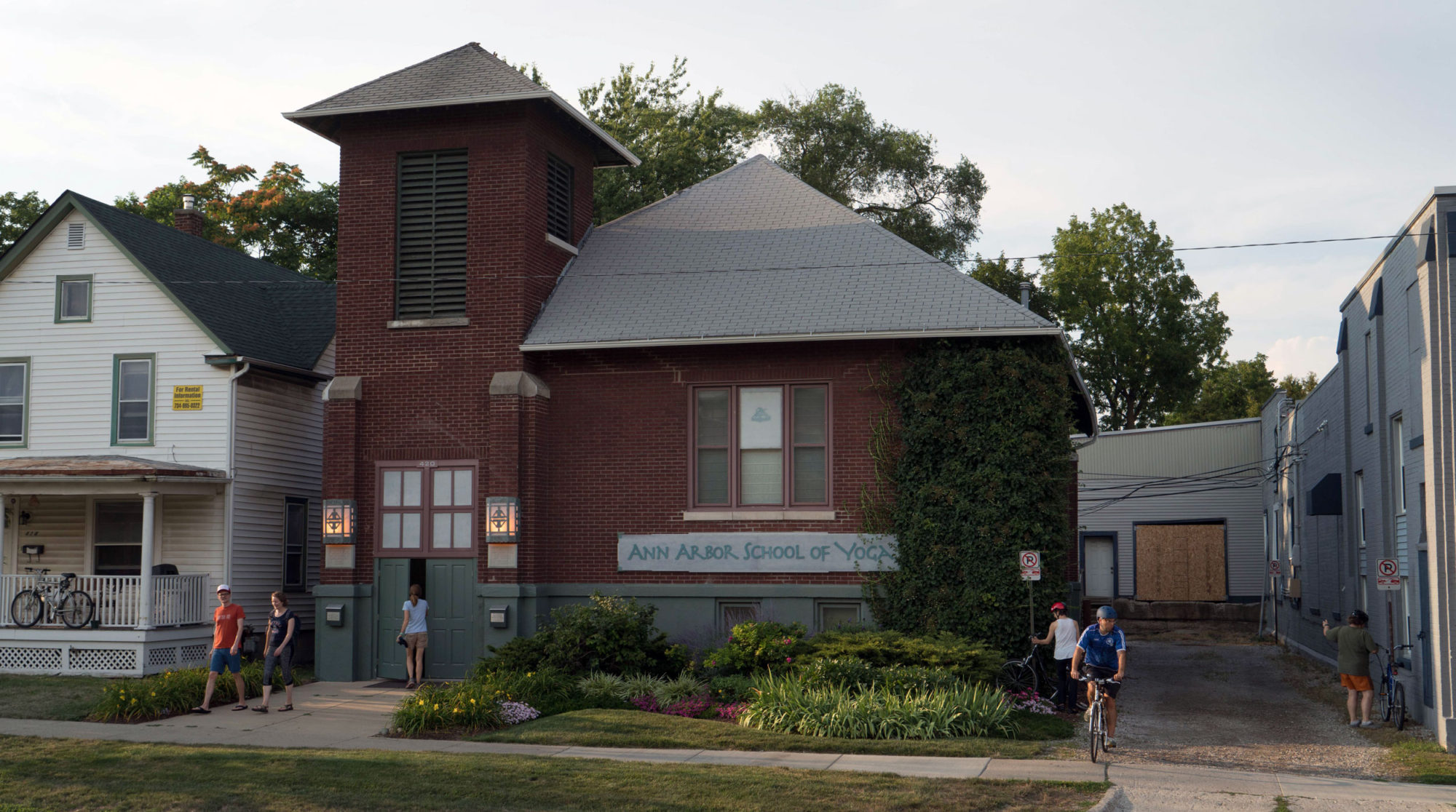
In 1998 she moved to a commercial building on 4th Avenue in downtown Ann Arbor, where she had a room of 1,400 square feet. She taught there until she decided the business had outgrown the space. Blakeney found a 4,500-square-foot vacant building at 420 W. Huron St., formerly the men’s homeless shelter.

Blakeney said she and the landlord, Ann Arbor developer Ed Shaffran, worked to transform the building into a school. A library, laundry room and restrooms were added, and the old oak floors and high ceilings were retained. The business opened in April 2006.

Although business had increased since the 1970s, Blakeney said, in the past couple of years it has stabilized. “There are many yoga studios opening, many more than five years ago, with not that many new people in the area.” She has a weekly enrollment of 270 people in the 18 classes offered this fall.

She said classes at the AASY differ from other exercise classes where the teacher is in front practicing along with the class. “Iyengar yoga classes teach people to understand the poses when in class,” Blakeney said. “They are taught the how and why… so that these can be practiced well outside of class.”

The center offers 10-week-long courses at $130 for Ann Arbor School of Yoga (AASY) members and $160 for nonmembers. The center also provides an occasional free trial class to the public. “It gives me a chance to explain to people what we do before they pay the $130 or $160 so they can make an educated choice if they want to take the class.”

Blakeney works with the nonprofit group AASY Action, which gives free classes to people staying at the Delounis Center Homeless Shelter. For AASY Action, a separate entity of AASY, she works with five other teachers. AASY Action, Blakeney said, is talking with some local agencies in hopes of serving other members of the community such as troubled youth, victims of domestic violence, and youths with learning disabilities.

She also offers special and out-of-town workshops, Teaching Training Intensive Weekends, and plans to take a group to Mexico in February for an annual workshop. She will return to Pune, India, in December to learn under the Iyengar family. “It is important for me to remain a student and learn,” Blakeney said.

BACKGROUND
Education: BA, Religious Studies, University of Michigan
Advanced Level Teaching Certificate granted by B.K.S. Iyengar, and studied annually in Pune, India, at the Iyengar Institute since 1983
Family: Son, 26
Residence: Ann Arbor
Experience: YNAUS Board, Chair of the Certification Committee
Curriculum Co-chair of 4 National Conventions, among other Committee service
Past the Board President of the IYAMW
Conference Chair for “From the Heartland Regional Conference”, in Chicago, Sept. 2011

INSIGHTS
Guiding principle: Best to work from personal experience, and try to learn, and then improve
Best way to keep competitive edge: Do the best that I can, based on my knowledge and experience
Mentor: B.K.S lyengar himself, his daughter and his son are my main teachers, and the institute in India is my mentorship
How do you motivate people: Share my enthusiasm
Goal yet to be achieved: Continue doing what I’m doing and have people benefit from it
Greatest passions: Continue to be intrigued with Iyengar yoga

TREASURES
Favorite cause: Art
Favorite book: The latest one was “The Time Traveler’s Wife”, I like fiction
Favorite movie: “My Brilliant Career”
Favorite restaurant: Zanzibar
Favorite vacation spot: Anywhere along the Great Lakes
Favorite way to spend free time: Reading
Vehicle: 1997 Audi A4

JUDGMENT CALLS
Best business decision: To start my own classes, rather than work at other programs in town
Worst business decision: Recently ordered way too many T-shirts, (for AASY)
Biggest missed opportunity: Don’t have one
Words that best describes you: Optimistic, but I’m also pragmatic
Advice you’d give yourself 10 years ago: Start saving more for retirement, since I’m self-employed

CONFESSIONS
What keeps you up at night: Nothing, really
Pet peeve: Don’t really have one
What did you eat for breakfast: A bagel with feta cheese and tomato, plus a cappuccino
Guilty pleasure: I can’t think of any, I don’t feel guilty about pleasure; maybe coffee
Person most interested in meeting: George Harrison
First choice for a new career: I won’t mind managing a nonprofit arts organization

A YOGA CLASS WITH IYENGAR

by Jane Myers (Ann Arbor News, Friday May 21, 1976)

They came from Beaverton, Oregon. Elm Grove, Illinois. Hendersonville, North Carolina. Chicago. Indianapolis. Washington, D.C.

Men and women from small towns and big cities across the U.S. came to Ann Arbor last week for the privilege of standing on their heads in the basement of the VFW Hall on East Liberty. Could they not, you might wonder, have stood on their respective heads back home in Beaverton and Hendersonville?

Of course they could have. But here it was better. Here, while they were twisting and turning, and stretching their bodies, they could be told by a trim, gray-haired, 58-year old man from Poona, India, that they weren’t trying hard enough, that they were wasting his time, and that they were all “masters of confusion.”

B. K. S. Iyengar is a teacher of yoga. But not just any teacher of yoga. His number of years of experience as a yoga teacher, – 40 – put him in a class by himself.
So does the notability [of some] of his followers. He has given yoga demonstrations for Queen Elizabeth II and her family. For Pope Paul. One of his most devoted students is violinist Yehudi Menuhin, who calls Iyengar “the best violin teacher I ever had.

Iyengar has made three visits to the U.S. in the past four years, all of them under the sponsorship of the Ann Arbor ‘Y’. How a yoga teacher from Poona, India, happens to be associated with the Ann Arbor ‘Y’ is not really too complicated a story. Mary Palmer, who is wife of William B. Palmer, a U-M professor of economics, began taking yoga lessons at the ‘Y’ in the late 60s to see if the exercises would help reduce pain in her knee joints.

They did, and Mary has been a devoted student and teacher of yoga ever since. When she and her husband were on sabbatical leave in India in the winter of 1969, she traveled to Poona to meet Mr. Iyengar and take lessons at his school there. Out of that experience, a close friendship developed between the Palmers and Iyengar. Mary convinced the ‘Y’ to sponsor his first visit to Ann Arbor in April, 1973, when he gave a lecture demonstration at the Power Center.

His visit this year included a one-week workshop for teachers of yoga, and another week of classes for both students and teachers. (The classes were conducted in the basement of the VFW Hall, where all ‘Y’ classes are held.) After his Ann Arbor stay, he flew to San Francisco for more classes and demonstrations, after which he planned to head for London for more of the same.

Participating in a class under Iyengar’s direction is not for the uncourageous. In fact, it looks downright scary. As he himself explains it, “I go like a tiger”.

Yoga, you see, is not just a body thing. It is a mind thing as well. If you try to talk to Iyengar about the ‘mind’ and the ‘body’ as separate entities, he simply looks you straight in the eye and asks, “How can you separate them? Where does the body stop? Where does the mind begin?” Iyengar is very convincing. The mind and body, of course, cannot be separated.

The trick, as Iyengar explains it, is to keep the body, mind, and soul “harmoniously functioning.” The problem is the following: there is a “human weakness” that stands in the way of this harmoniousness. What is the human weakness?

When you hear Iyengar describe it, you quiver at the horrible thought of ever catching it… he makes it sound like a dread disease that you certainly wouldn’t wish on your best friend, or your worst enemy either.

It’s called “inflated brain” otherwise known as “intoxicated intelligence” or “inflated intelligence”. Nobody leaves one of Iyengar’s classes with “inflated brain”.

You people don’t want to try… you’re not following me… why should I waste my energy here?… you should have been in the beginner’s class, I don’t know how you choose… look at him, he thinks he is doing it, he thinks he is Superman… you are all masters of confusion! Follow?

Nobody winces noticeably. When he tells them that “the head and the tailbone should not be shaken,” they try valiantly not to shake the head and tailbone. When he yells out that the “skin of the left back leg should become sharp,” they try to sharpen the skin of the left back leg.

And when he tells them to “feel the inner ankle and outer ankle parallel, from left to right,” and “to move the outer skin of the right hip up and the inner skin of the right hip down,” they try, they really try to move that skin up and down.

Move the skin?
If B. K. S. Iyengar says it’s possible, it’s possible. And he proves it by doing it. If he seems a bit merciless, it’s because he means to. “An inflated intelligence is like an abscess,” he says with conviction.

When he shows a young woman, a beginning student, how to put her hands together behind her back in a position she thought she was not yet advanced enough to attempt, he draws oohs and aahs of amazement from his observers. “How did you do it?,” they ask. “I put her brain in her pocket,” he says with dramatic simplicity.

The atmosphere in an Iyengar class verges on the reverential. It’s all respectful silence, tiptoeing, whispers. And now and then, a low chorus of groans when he gives permission to end a difficult position.

What is it all about?
The practice of yoga makes the mind free from the shackles of the body,” Iyengar explains. “What is the use of intelligence in an unhealthy body?” “You can release your mind to think of a higher life. You can open the gate of your own soul.” “Through yoga you can know what the self is.” At 58, Iyengar has no plans to sit in the shade in Poona, and sip tea.

The more I work, the more I feel the energy pouring in,” he says with a smile. “I want to practice yoga until my last consciousness.

Iyengar on Backward Extensions:

“Backbends are are like a third eye.”

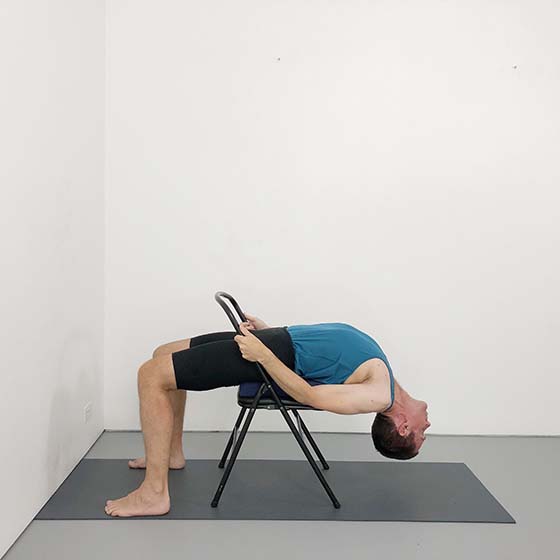
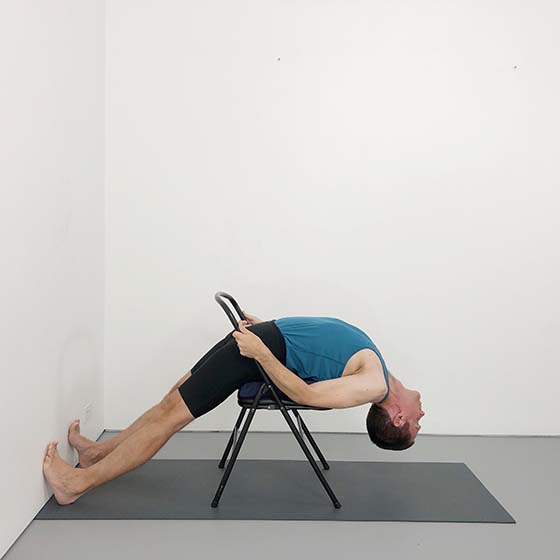
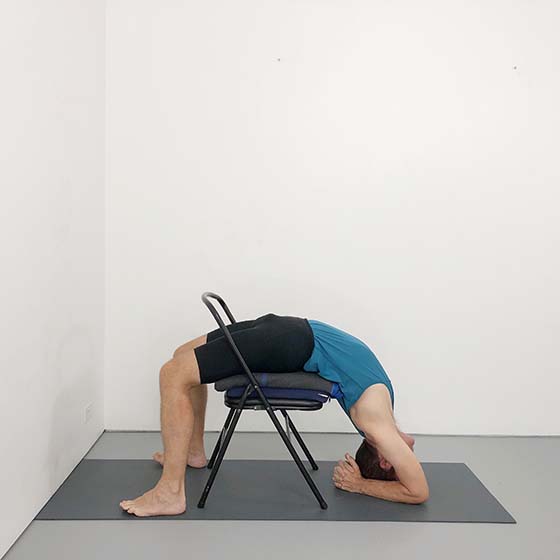
Backbends [backward extensions] are not taught at the early stages in the practice of the this art, but only when the body is trained, tuned and toned to such an extent that it accepts these poses.

Backbends are to be felt more than expressed. The other postures can be expressed and then felt. Like in meditation each person has to feel backbends. Backbends are not poses meant for expressionism. Backbends are meant to understand the back parts of our bodies. The front body can be seen with the eyes, but the back body can only be felt. That’s why I say these are the most advanced postures, where the mind begins to look at the back. Otherwise it is felt on the peripheral level.

For a yogi, the backbending āsanas are meant to invert the mind, to look in and back, to feel the actual back portion of the body. It is my feeling that one who knows, and looks into the back can look into God. Without the accurate spine movement, one can’t exist dynamically. Backbends demand a certain standard both in the body and the mind. Backbends are like a third eye. The third eye means strength and power within to face the unseen light when it falls on you or me.

Inversions work on certain parts of the body; standing poses work on certain parts of the body, and so the twists and balances. But the understanding of penetration of the mind on the spinal nerves and spinal muscles are not touched by the above poses except in backbends.

Practitioners should try these only after they’ve mastered the standing poses, twists and inversions. The question of balancings are unimportant for backbends, but the others have to come. They are the base for backbends.

Tadāsana is the base for standing poses. Jānu śīrṣāsana is the base for forward bends. In inverted poses, Sālamba sarvāṅgāsana I is the base. In balancings, Bakāsana is the base. In backbends, Ūrdhva dhanurāsana is the base. One creates tremendous depth and vastness in the chest through the backbends that the emotional centre accommodates [absorbs and withstands] all types of pressures and strains. There is no chance for a person who does backbends to get emotionally depressed or distressed.

The beauty of backbends is that the person remains intellectually stable – not strong. Backbends give stability to the body and bring maturity in the intelligence in order to develop ripeness in the brain and ripeness in the emotions. When one does a lot of backbends, the blood is circulated with such speed and force that one feels hot in the body. As that body becomes warmer than normal, soothing or cooling poses have to be taught afterwards. Soothing and cooling poses like Adhomukha śvānāsana, Adhomukha vīrāsana, bending downwards, and lateral Uttānāsana, bring the body temperature back to normal.  This is the natural ‘pill’ in yoga, to come back to a natural state.

I also say with backbends, you have to be cautiously bold. Not carelessly bold. You have to descend to the dictation of the spine. You cannot command from the brain to do the poses. As you play with a child, guarding the child from injuries, similarly you have to play in backbends, guarding your spine. Keep the mind, the intelligence and will power in such a state that they may not trespass and disturb the body. When one does backbends, one has to think and rethink. One has to start from the beginning.

Healthy adjustments are very essential and important: Positioning of the cells, positioning of the spinal vertebrae, positioning of the joints, how to squeeze, how to stretch, are all to be digested. In other poses the sternum is touched from the outside, while in backbends one touches from inside. This helps us to educate the mind both ways. In Śīrṣāsana, or forward bends or balancings, the mind acts as extrovert. In backbendings, mind goes within. With both, one hits the inner mind within and without using the body as a means.

In forward bends, one uses the outer mind while in backbends the outer mind is silenced and the inner mind is made to work. In backbends, one touches the body physically, mentally, intellectually, consciously and spiritually everywhere. That’s the beauty of backbends. Emotionally we can never be disturbed, for the emotional centre becomes an extrovert. When you do Viparīta daṇḍāsana, your head looks backwards, but your conscious mind stretches everywhere. Study by observing how the mind gets regulated. You not only know the freedom in the spine, but also the freedom in the spirit.
B.K.S. Iyengar

Build Resilience

by Adding Variety to Your Yogāsana Practice

Carrie Owerko shows us how repetition and novelty are both important in daily practice – Sep. 27, 2017.

At 55 years young, I am realizing how important it is to cultivate resilience in my yoga practice and teaching. If we are too hard on ourselves, it becomes more and more difficult to do new, challenging, or unfamiliar things. But if we are able to watch our body, mind, and behavior during times of change (which is basically all the time, since we are always changing) and be compassionate with what we observe, we build the courage necessary to face change (and take risks) with friendliness, openness, and curiosity.

Over the last decade I witnessed my elderly parents become more and more isolated, with very limited exposure to new or novel experiences. This became a problem when life circumstances required a really big change. My Mom, whom I knew to be an adventurous and open-minded person, became more and more fearful. She disengaged from the things she loved. Her world shrank. There were many reasons for her fear and her resistance to change.

She became depressed, which was completely understandable, especially after the death of my Dad. Grief can be devastating. She had also lost her sight several years earlier, and this visual impairment made any type of change disorienting and difficult. She has also endured a few unfortunate falls (one that caused significant injury), and yet she is—in her own way—one of the most resilient people I know.

Her story is one of the many reasons why I am more and more interested in what makes us capable of embracing change, even difficult change, with a sense of possibility and potential for growth. We still feel fear, fall down, and experience our own resistance. How we act in the face of fear, get up after falling down, and take part in the process of change is important. We work on this in yoga.

Practice helps us learn how to stay engaged, continue to grow, and even find joy in the challenges that change presents (in fact, a recent study finds that yoga and meditation may enhance stress resilience and well-being). Practice helps us see that we are not static, fixed, unchanging entities. We are actually dynamic, ever-changing processes. The repetition inherent in daily practice is extremely important, as is the addition of variation and novelty, which I focus on in my upcoming Iyengar 201 course.

It can be invigorating and empowering to get out of our comfort zone. It is exciting to learn new things. It can be awkward at times, but it’s so worthwhile, especially if we are compassionate with ourselves in the process. This compassion can be like a kind of grace, because we give ourselves permission to be, to change, and to grow. We grow into the type of person who can bounce back after setbacks, get up after falling down, and stay present in the often unpredictable flow of life. We grow into more resilient beings.

Build Resilience with Sālamba sarvāṅgāsana (and Family)

Sālamba sarvāṅgāsana (Supported All-limb balance), and related poses, including Viparīta karaṇi (Inverted Action), bolster both courage and contentment. They can be deeply nourishing for the nervous system. As you become more familiar with Sālamba sarvāṅgāsana, you will be able to explore some of its many variations. The variations are helpful because we are practicing staying calm and present to change as it presents itself in the pose. By letting go of the idea that the pose has to be done one way, we begin to understand the pose more deeply, and ourselves more deeply in the process.

Try this simple variation of Viparīta karaṇi. It is fairly accessible for almost all levels of practice, and helps us explore our capacity to balance and relax at the same time.

How to: Place two to three blankets on a sticky mat near a wall. Turn the blankets so they are long enough to support your entire torso from your shoulders to your buttocks. Fold the sticky mat over the blankets like a wrap for a sandwich filling (the blankets are the filling). Place your shoulders on this ‘wrap’ and the soles of your feet on the wall with your legs bent. Keep your head on the floor. As you exhale, lift your pelvis up. Then place a yoga block under your sacrum. Tilt the block so the end that is closer to the wall is a little higher. This way, your lower back will feel a sense of traction and elongation. Then straighten your legs and rest your heels on the wall. If you feel stable, bring your feet off the wall as you take your legs to a vertical position. And if that feels stable, try spreading your legs wide apart. Observe how you are floating or balancing up on this block. Relax as much as possible without becoming inattentive. If your attention starts to drift, you might lose your balance. After a few minutes, bring your legs together and rest your feet back on the wall for a few more minutes. Then remove the block, come down, and slide your back onto the floor.

https://www.yogajournal.com/yoga-101/iyengar-201-build-resilience-by-adding-variety-to-your-yoga-practice

In Her Father’s Light

by COLLEEN MORTON

August 28, 2007

(12.07.1944 – 12.16.2018)


Geeta Iyengar doesn’t tire easily. On the final day of the Iyengar Yoga Odyssey, a five-day conference in Pasadena, California, Geeta had invited some teachers to her hotel room for Indian food. “I was too tired to go,” laughed senior teacher Patricia Walden, who noted that the invitation symbolizes the way of the indefatigable daughter of B.K.S. Iyengar: “When Geeta is in Pune, she is serving all the time—her family, the institute, and her students.” It is precisely this kind of generosity and energy that propelled Geeta Iyengar across the United States in April and May on a month-long teaching tour.

Though most American yogis outside of the Iyengar community know B.K.S. Iyengar, fewer are familiar with Geeta Iyengar. Many within the Iyengar community, however, have studied repeatedly over the years with Geeta Iyengar in Pune, India, at the Ramamani Memorial Yoga Institute where she and her brother Prashant teach the majority of classes. Many have read and recommended her groundbreaking book Yoga: A Gem for Women (Timeless Books, 1995). Many love and respect Geeta Iyengar, who is 57 this year, as an authoritative, compelling teacher in her own right. This was in evidence at the convention, where senior American Iyengar teachers took a decidedly supportive, reverential role, demonstrating postures for Iyengar and assisting the students in her daily prāṇāyāma and āsana classes. Some teachers were brought to tears as they publicly thanked Iyengar, after a question and answer session, for her generosity and wisdom.

Iyengar has not had an easy life. At the age of 9 she was diagnosed with a severe kidney disease. It was either do yoga or wait for death according to her father, since the family did not have sufficient funds for medicine. In 1973 Iyengar’s mother, Ramamani (for whom the institute is named), died suddenly. Now, as the presiding matriarch of the Iyengar household, Geeta cooks all of the meals and is responsible for much of the administrative work at the Institute. “She answers every letter she gets,” said an Iyengar teacher who attended the 80th birthday celebration for B.K.S. Iyengar in Pune in 1998.

At the celebration, when some of the participants present tried to turn the attention toward their beloved Geeta, who had also recently had a birthday, Geeta left the room, protesting that the proceedings were not about her and that she was unworthy of the honor. So I wonder what it must have felt like for Geeta Iyengar to arrive in Pasadena on opening night to a room full of chattering yogis who fell into silent veneration when she entered.

Geeta Iyengar has both her father’s famous stern bearing and respect for discipline and her mother’s compassion—of which she spoke fondly on Mother’s Day, on a rare personal note. Iyengar also has a sweet, quiet sense of humor. Several times during the convention, she joked playfully with the students about their laziness, the mind tricks that they willingly go along with to avoid facing their fears and limitations. And at other times, Iyengar was unrelentingly stern, no-nonsense, even impatient—as teachers of great devotion are when their students fail them for lack of commitment or effort. People say we are too strong or strict,” said Iyengar as we worked with the placement of the hands in Downward-Facing Dog. “But if you reach through the palms, I will not shout, ‘What is it that makes you not pay attention there?'” Each instruction Iyengar gives belies her conviction that we owe it to ourselves to give yoga our supreme, honest effort. Behind many of her instructions, there is the poetry of a tender heart: “Small mind: short, closed palms. Your hands should open to give.”

Iyengar’s hands are wide open. She is not interested in coddling the ego—her own or anyone else’s. She does not underestimate her understanding of the vast subject of yoga. “I know what I am doing,” she says, but adds, “and I know what Guruji (B.K.S Iyengar) has done.” It is the work of her guru that she wants to clarify in the minds of Americans—often too eager for answers, impervious to authority, or distracted in our bodies to get it. Her mission is clear: to stand, as she once put it, in her father’s light and to illumine the way for the rest of us.

Yoga Journal: You commented on the interest in yoga in the United States, “Let it not be a wildfire.” Can you explain this?
Geeta Iyengar: The rising interest in yoga and the enthusiasm are always welcome. For me a healthy yoga addiction is better than other addictions. The fire of yoga must remain burning without smoke in the spiritual heart throughout the practice, the sādhana. The interest of the practitioner, sādhaka, needs to be affirmative and dynamic. However, this interest should not be a wildfire burning down the forest; the interest in yoga should not be disoriented and disarrayed.

Often the seeker goes to different teachers and different schools of yoga without having the proper aim or background. Instead of getting a solid footing on the path and its subject matter, he acquires knowledge in bits and pieces. The body, mind, and intelligence remain muddled. Going to a new teacher before allowing oneself to practice and digest the methods learned from another teacher leads one toward more confusion than clarity. Learning first with one teacher and getting well-established in practice makes one able to discriminate with maturity.

Often pains, problems, discomforts, doubts, misunderstandings, and misconceptions arise because of lack of understanding. This further leads toward lack of inner penetration into oneself. Learning yoga cannot be like eating junk food. One has to stick to the method in order to absorb and assimilate the sādhana precisely and properly. Remember the adage, “The rolling stone gathers no moss.” It is the same with the roving yogic sādhaka.

YJ: You have pointed out that all of the students’ questions about yoga have been oriented toward disease. What are the implications of this, in your view?
GI: Yoga has become popular as a healing method since it has curative and preventative value. But its scope is wider than this. The healing and therapeutic value is a kind of positive side effect of sādhana, a by-product. From this healing process, the urge to go further, to go close to the unknown, may start sooner or later.

The interest and the vision of the sādhaka should not be limited only to therapy. Certainly one has to practice having in mind the disease one suffers from. The practice should not be antagonistic to the healing process. One has to know how to deal with one’s own body and mind so that problems are solved and diseases are overcome. One cannot neglect demands for health from the body and mind.
But at the same time one should not divert one’s attention from the basic yogic approach and the goal: to be closer to the core of being. To let the intelligence touch the inner body also. One has to learn to look inside oneself to find one’s emotional and mental state as well as one’s intellectual capacity. One has to learn to see the problems of mind, intelligence, I-consciousness, and egoism, which often need to be corrected to stay on the path of self-awareness anywhere and everywhere. One cannot remain eternally stuck at the physical pains and problems and physical well-being only.

While correcting the posture of the body in āsana or the breathing method in prāṇāyāma, it is not merely the muscles, bones, or breath that we correct. We touch our consciousness in order to know its moods and modes. The involvement of consciousness in āsana is articulated in such a way that the flow of consciousness remains sober and pure.

YJ: You are an Ayurvedic doctor. How much understanding of Ayurvedic principles is essential for yoga students?
GI: Well, any knowledge of healing sciences will be supportive in the practice of yoga, whether it is Ayurveda, modern medical science, or homeopathy. However, apart from the physical body, Ayurveda recognizes the moral, mental, psychological, and intellectual aspects of human beings. Therefore, if along with human anatomy, physiology, and neurology, one understands one’s constitutional structure—the three guas [qualities/attributes]: sattva, rajas, and tamas; and the three  doṣas [humors]: vāta, pitta, and kapha—one can have a clear picture or X-ray of one’s body and mind.

Still this is objective knowledge about oneself. With this background of objective knowledge, yoga helps to transform that objective knowledge to subjective experiential knowledge of oneself. For instance, Guruji, my father, did not have a chance to study Āyurveda, but his own sādhana, his thorough practice, total involvement, deep penetration, and complete dedication in yoga helped him to know the body and the mind in depth. In fact, his way of practice, teaching, and treatment is based on his own experience. He used his physical and mental body as a laboratory, yet his line of treatment became universal.
It is only after studying Āyurveda that I realized how close Guruji‘s experiences are to Āyurveda, as far as the treatment is concerned. I too studied Āyurveda after gaining sufficient understanding about yogic science. One should first concentrate on yoga since that is the main subject. But understanding the basics of the fundamental constitution of the human body-mind according to Āyurveda will be of great help in knowing oneself.

YJ: You have been encouraging students to come to an understanding of the poses through their own experience in their bodies. What should a student do when his or her own internal experience disagrees with what the teacher is teaching?
GI: I did not say that students should understand the āsana through their bodies. The body is the instrument. One has to have a thorough knowledge of the āsana. But while doing the āsana or being in āsana, one has to learn to experience one’s body—outer and inner. In order to penetrate consciousness, one’s awareness and intelligence need to penetrate the body as well as the mind so that both cooperate to awaken the inner consciousness.

And this is the yogic sādhana in a real sense. Now when I was asking the students to look into their āsanas and feel their bodies—the body’s positioning, its response—in fact it was to help them learn the process of experiencing the placement of the mind and intelligence. This placement is the art of feeling oneself inside out and outside in.

When a teacher is teaching, it is true that the student has to obey in order to learn. But it does not mean that the student should not use his discrimination. When the internal experience of the student disagrees with the teacher’s teaching, the student has to analyze and work more, put more effort into understanding what the teacher is imparting. The student has to rub his intelligence a bit more strongly so that experiential knowledge of the teacher shines forth.

While teaching, this is what I ask the students to do. They have to learn to look within, feel themselves, sensitize themselves. It is not merely an outer performance. It is a method of grasping. It is an art of penetration. To teach the physical procedure of āsana is simple, but to teach the mental process in the very āsana is a meaningful and in-depth approach.

YJ: American readers will be interested to know what it was like for you being the daughter of such a brilliant teacher and a teacher yourself of your father’s techniques. You say he treated you “not as his daughter but as a pupil” in Yoga: A Gem for Women. Would you elaborate?
GI: Somebody asked me a while back how I felt being under the shadow of my father and I said instantly, “I am not under his shadow but under the light.”
When I teach my father’s techniques, he is no more my father but my guru. I follow my guru as any other disciple follows his guru. But it is certainly not a blind faith. Guruji‘s brilliance in this path has proved the rightness and reality of the subject. His sādhana and experience have become not only a guideline but a beacon light for us. When I teach his techniques, I am sure that it is a proven path. While practicing myself, I have seen its value and result. In teaching, I have seen the results on the students.

When I was undergoing training with Guruji, he did not show his affection as a blind love toward his daughter. Yoga demands discipline. Guruji is affectionate and compassionate, but he would not compromise the discipline. He teaches how we as pupils of yoga need to discipline ourselves for our own benefit.

YJ: You spoke about how your mother was compassionate but stern when she was raising you. How would you define compassion in a teacher? How can a teacher teach with the right balance of compassion and discipline?
GI: Compassion and discipline are not two separate things. They are two sides of the same coin. Discipline without compassion may prove brutal and fatal, and compassion without discipline may prove ineffectual or destructive. A teacher needs the right balance.

While teaching, the teacher has to discipline the disciple. But his discipline cannot be a kind of hard and rigid rule because at the end the discipline is meant for the good of the pupil. The teacher should not burden the pupil with discipline. Rather the teacher wants the pupil to go on a right and righteous path. However, this change does not occur instantly. The compassion of the teacher lubricates the stiffness and strictness of the discipline so that the student follows the discipline smoothly.

Colleen Morton is Internet Content Director at Yoga Journal.