By Dona Holleman
(Click here for Part 2)
The human being is very complex. The obvious part that is visible to the eye is the physical body. This body, however, is a composite of many parts. [However, most of them] are not so visible to the eye.
Beginning with the skull, the most conspicuous part, in which the brain and its various parts (neocortex, cerebellum, amygdale etc.) sit.
Next is the heart, the motor of the physical body, and generally associated with the emotions.
Less understood is the lower part of the body, the so-called core, meaning ‘centre’, where the internal organs and intestines reside. The intestines, or ‘factory’ of the immune system, defend the body against diseases and viruses. But these are also an important reservoir of emotions and intuitions.
The physical body is, so to speak, the tip of the iceberg. Some of it is visible above ‘sea level’. While the bigger part, unknown to many, is ‘underwater’. The body is made of physical material, such as flesh, bone, nerves, etc., which we can [mostly] see, touch, examine, experience, but which is only inert material*. In Western languages there are no special words to differentiate the parts, therefore I will use Sanskrit words**, which are very clear.
What we eat and drink are the bricks that construct the physical body. In Sanskrit this body is called the annamaya kośa, or the body made of Anna (food). To move the annamaya kośa [physical body] we need the brain. The brain is also material, emitting electric waves, and it is these that move the physical body. Everything that the annamaya kośa does begins with commands in the brain.
The brain programs all the movements of the annamaya kośa, and all the other processes of the physical body. This centre of organization in Sanskrit is called manomaya kośa. Within this word is the word ‘man’, or ‘hu-man’. The centre is the organ that distinguishes us from the animals, who have it but in a more rudimentary form, less developed. This centre is that which makes us ‘human’.
There is however one thing that even the Western doctors do not know, but which the Oriental [practitioners] and the yogis have always known. That the manomaya kośa CANNOT act directly on the annamaya kośa. There is NO connection between these two.
That which many people know, without knowing that they ‘know’ it, is that between the brain and the physical body, between the manomaya kośan and the annamaya kosha, THERE IS ANOTHER BODY. Acupuncture, shiatsu, t’ai ji, shàolín, and many other disciplines, do not act on the physical body, but on another subtle, electric body. This electric body (think of the meridians in acupuncture or nadis in yoga) is called prāṇāmaya kośa in the yogic tradition, a subtle or etheric body, made of prāṇa, or ch’i. [One can infer from the name] according to yoga, this [sheath] is made of prāṇa.
Many books have been written on what exactly prāṇa is, but if we keep to the tradition, both occidental and oriental, we can visualize the many figures of ‘saints’ surrounded by a halo. Personally I would say that prāṇa is not air, nor oxygen, or energy, but the basic material of the universe, which is LIGHT, photons.
Prāṇāmaya kośa is made of photons. In yogic tradition the practice of breathing, called prāṇāyāma, is a very important part of the practice. When doing prāṇāyāma, we not only inhale air [which contains oxygen], but we inhale LIGHT. Therefore this guided breathing fills the prāṇāmaya kośa with light, strengthening it and making it shine. This is the shining that you see around saints, but it is also the very same which we see when someone is ‘happy’. We say that this person is ‘radiant’. In the winter, when there is little light [some] feel more depressed, dull, but in the summer when there is plenty of sunlight [many] feel uplifted, full of energy.
The prāṇāmaya kośa is the ‘blue-print’ of the annamaya kośa, and is similar to the annamaya kośa, or rather, the annamaya kośa is similar to the prāṇāmaya kośa, having been ‘created’ by it. Any blockage or problem in the prāṇāmaya kośa manifests itself sooner or later in the annamaya kośa. In the same way that when the annamaya kośa becomes ill, [this originates] in the prāṇāmaya kośa. [Thus] healing of the annamaya kośa must start in the prāṇāmaya kośa.
In Japanese that energy, that light, which is the subtle body, is called ki (ch’i or qi in Chinese), and the body made of ki, or prāṇa, the prāṇāmaya kośa, is that body that acts between the brain, between the manomaya kośa, and the annamaya kośa. The annamaya kośa cannot execute the commands of the manomaya kośa by itself. [Know that] t’ai ji, shàolín, and [many] other oriental disciplines serve to strengthen and control the prāṇāmaya kośa.
The manomaya kośa, which composes a command for a certain movement, sends this command to the prāṇāmaya kośa, which in turn ‘collects’ energy, ki, ch’i, prāṇa, to execute the command and translate it into a movement of the annamaya kośa. When it has gathered sufficient ki, ch’i, or prāṇa it can move the annamaya kośa. This process is called INTENT. It is this command, this intent, that is sent out by the prāṇāmaya kośa which then moves the annamaya kośa.
This process goes on all day, but 99 % of it is on an unconscious level. Each movement that we make follows this procedure. So what is the difference between the daily movements and the yogic core movements? The annamaya kośa, the physical body, has a centre, which is between the upper part of the body (arms, head and chest) and the lower part (legs). This centre is called the core in western language. Remember, that the word core means centre. The core covers the central part of the physical body between the pelvic diaphragm and the thoracic diaphragm.
The bones that contain the core
· Lumbar vertebrae (5)
· False ribs (3)
· Floating ribs (2)
· Bones of the pelvis (ilium, ischium and pubis).
For later reference, the word ‘pelvis’ in Latin means ‘basin’.
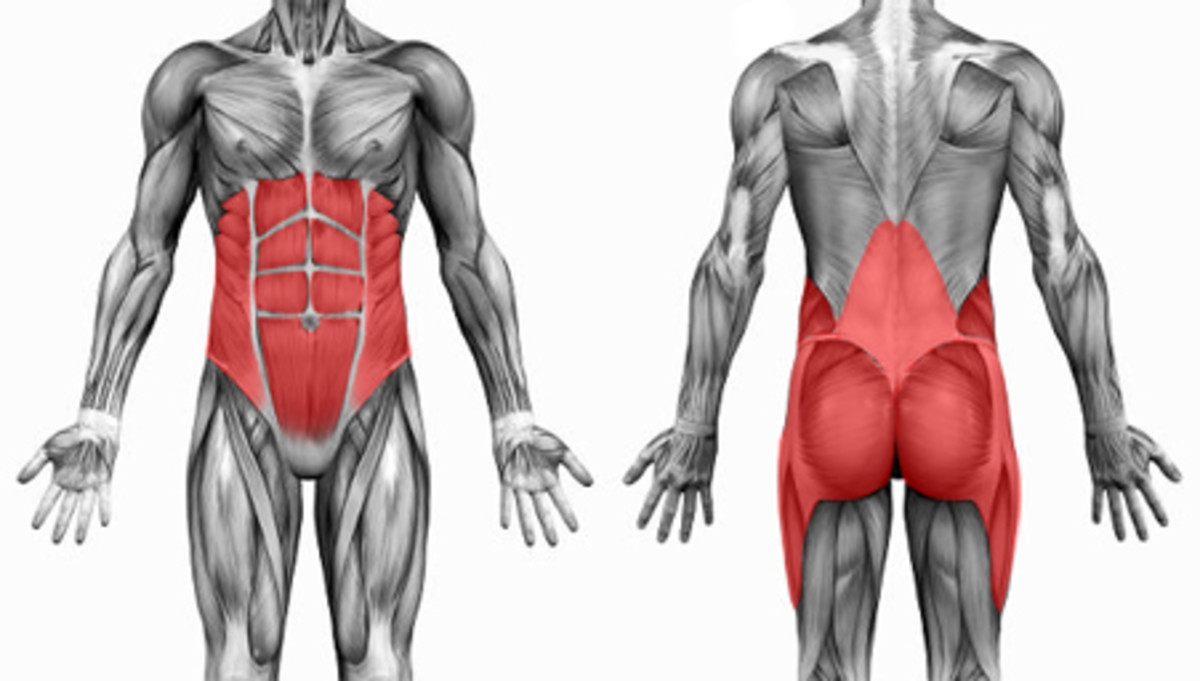
The muscles of the core
Posterior muscles:
· Erector spinae
· Quadratus lomborum
· Psoas major
· Psoas minor
· Iliacus
· Gluteus medius and minimus
Lateral muscles:
· Gluteus minimus
Anterior/lateral muscles:
· Rectus abdominis
· External oblique
· Internal oblique
· Transversus abdominis
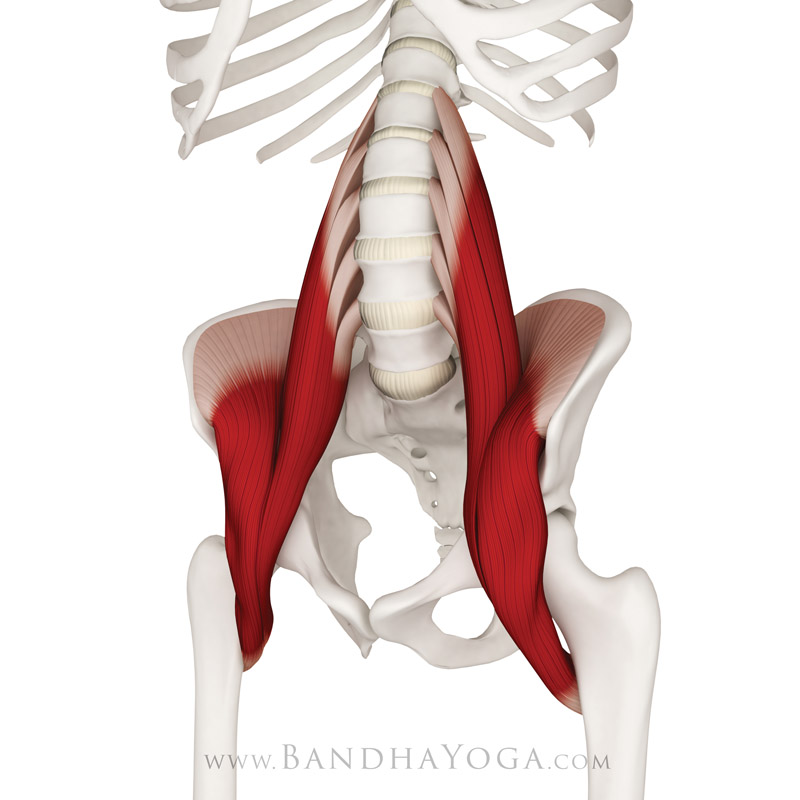
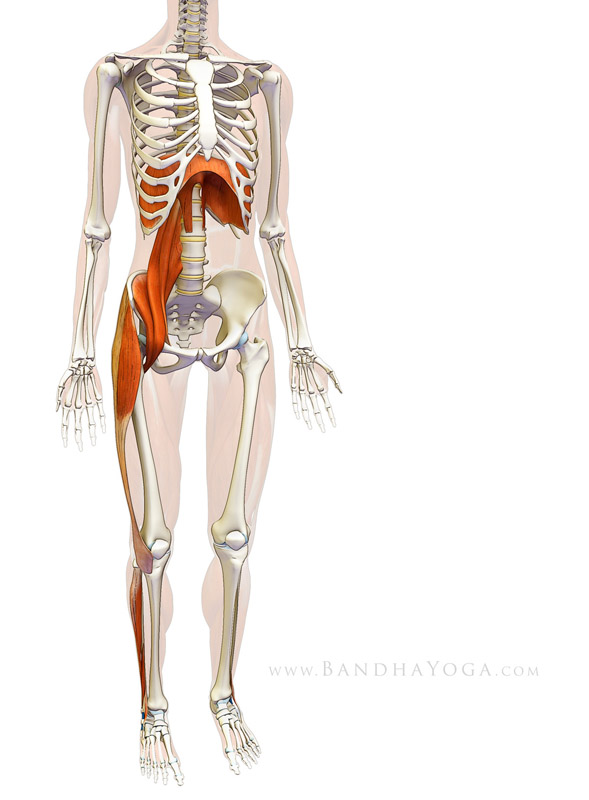
But the most important [of all], which few people know about or how to use it, is the psoas (see above). The psoas is the only muscle in the body that connects the inner thigh (the small trochanter) directly to the lumbar spine, and has a very important role in correct posture, and in the activity of the core. [Because] it stabilizes the pelvis and the inner organs.
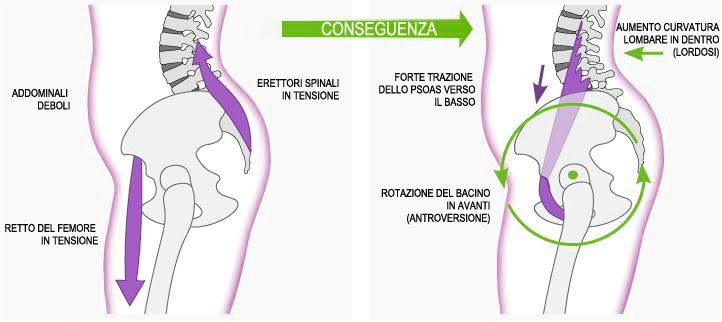
Rectus femoris in flexion –––> Anterior pelvic rotation
Wrong (above):
The psoas is loose, does not have tone, and the weight of the inner organs pulls the lumbar spine forward, so that the pelvis collapses/rotates forward (anteversion). Think of a pregnant woman with the lumbar collapsed forward because of the weight of the baby. [When the spinal erectors are under tension, there is an increased lumbar curvature (lordosis).]
Correct (below):
When the psoas works correctly, has good tone, and sustains the inner organs, it keeps the pelvis in a vertical position, even in slight retroversion. I have called this slight retroversion the scoop. Remember that the word pelvis means basin, and thus is [holding the organs] correctly, without ‘spilling forward, over, or out.’ [When the abdominal muscle (‘abs’) are under tension, there is a reduced lumbar curvature.]
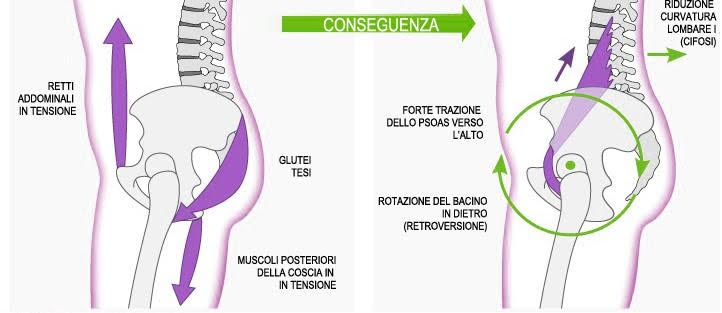
Hamstrings in flexion –––> Posterior pelvic rotation
The core is the central part of the annamaya kośa. It is purely physical. Within the core, the physical part, however, is the subtle center, the centre of the prāṇāmaya kośa, which in various languages, is called hara, dāntián, kanda. This subtle centre is below the navel, halfway [between] the navel and the pubic bone, and halfway between the two iliac crests. This is the centre of the prāṇāmaya kośa, and is considered the centre of life and vitality in many traditions.
Since we all now know the word hara (Japanese for the lower dāntián), I will use [it henceforth]. Hara is the centre of the prāṇāmaya kośa, and is situated in the centre of the core, which is the subtle centre of the annamaya kośa. The hara is from where the energy radiates in the entire subtle and physical body. All the movements of the physical body start here, [which happen to be] those which are furthest away from the centre (arms, shoulders, legs, etc.).
A word here about the core and hara being the centre of life and emotions (the intestines and the emotions). It is interesting to [know] that the most common modern ‘disease’ is obesity, especially in the central part of the body (the core), the belly-fat, thighs and buttocks.
Our modern life has never been so stressful and hectic, with millions of things to do every day, and millions of problems to solve. But our annamaya kośa and the amygdala, which is the centre of the three f’s, fight, flight, or freeze, has not been able to keep up with [the ever faster paced] of modern life, technology, and other stress factors.
As this stress is practically uninterrupted, the brain repeatedly produces cortisol, the so-called stress hormone, as the body and brain feel continuously ‘threatened’ by daily life (think of cortisol as nature’s built-in alarm system. It’s your body’s main stress hormone). As a result the body tries to ‘protect’ its most vulnerable part (as far as emotions, the core or hara is concerned) and builds a ‘cushion’ around it to protect it against the perceived threat, stress: thus the famous ‘big belly’, obesity.
Jon Gabriel, in his book Visualization for Weight Loss, explains in a simple way how this whole process functions. [He also explains] how to reverse it by learning certain techniques of visualization, and meditation. These ‘convince’ the body that there is no life threatening situation going on, and therefore lower the production of cortisol.
The Japanese have a kind of ‘walking meditation’ called Shinrin-yoku (professor Qing Li of the Nippon Medical School of Tokyo is the main researcher in this field). In the book Art and Science of Forest-Bathing he describes the ‘technique of forest walking’, which is a slow walking through a wooded area, paying total attention to everything you see (!). [This] has the same aim as taking a ‘holiday’ from modern life by immersing oneself in nature in a meditative way, leaving computers, and cell phones at home.
For the same reason yoga should be done very slowly in order not to set in motion this ‘defense’ mechanism by unnecessary stressing. I have noticed however, that many people after doing years of yoga ‘increase’ their body fat, which, as I said, may be triggered by the fact that they do yoga, or other exercises, in a hurried and stressful way, setting off the body’s alarm system.
How to activate the core:
To activate the core you have to contract the glutei and the tensor fasciae latae muscles of the thighs and ‘suck’ the abdomen inside, starting from the pelvic diaphragm and pubic bone up till the sternum (xiphoid process). At the same time the lumbar spine and the sacrum are slightly pushed forward vertically and the pelvis placed in a slightly retroversion mode. (see Correct image above)
As you know, I named this movement the scoop (like the [action] of the spoon with which you take the soup out of the soup bowl, or the ice-cream out of the ice cream carton). The scoop is part of a type of breathing which I call mūla bandha breathing. With this movement the breathing changes and moves from the anterior ribs, where most people breathe erroneously, to the back ribs, where in fact the lungs are, and as a consequence the back ribs widen towards the sides of the chest.
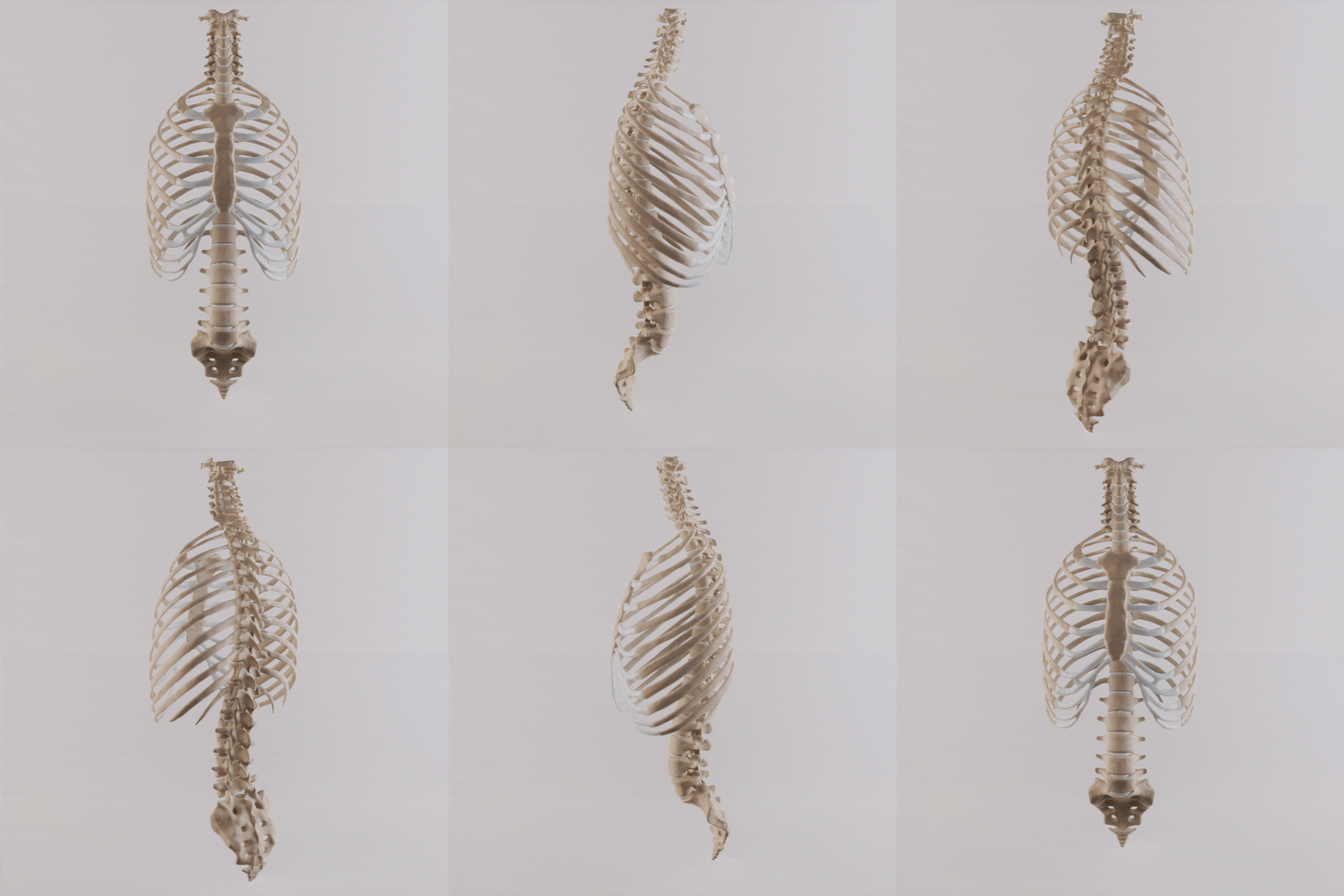
(Note: The true ribs (1-7) are attached to the sternum, and therefore cannot widen. The false ribs (8, 9, & 10) are not attached to the sternum, but to each other with cartilage. The floating ribs (11 & 12) attach only to the vertebrae. Therefore the main widening is done in the false and floating ribs).
At the same time the place where the breathing enters the throat, which for most people is in the upper throat, is lowered and the air enters through the lower throat (the part of the throat used for yawning and ‘heaving a sigh of relief’).
The total effect is that the movement of the breath starts in the lower abdomen, goes backwards towards the kidneys and from there moves upwards, following the curve of the spinal column and ending up behind the manubrium, which is the upper part of the sternum. As a consequence, this action lifts the first part of jālandhara bandha.
This is the movement of the mūla bandha breathing, from down upwards. Obviously, however, the air itself does enter in the lower throat [filling] the lungs [from bottom to top].
Attention:
The lower part of the sternum, the xiphoid process, does NOT come forward, like many people [allow] erroneously. Placing it in this way, the sternum is [further] inclined, but the sternum MUST remain [seemingly] vertical with the manubrium in a line above the xiphoid process. The whole movement takes place on the back side of the chest (where the lungs are). Imagine that you have a large belt between the chest and the pelvis. Then this belt should always have the same width in the front as in the back, so that the frontal ribs [do] not move upward [and forward], away from the iliac crests.
It is important to emphasize that this whole movement of the breathing is only possible with peripheral eyes. With concentric eyes this movement is not possible. With peripheral eyes the air enters automatically in the lower abdomen, which results in mūla bandha breathing. While with concentric eyes the air enters automatically in the upper throat, resulting in the classical Ujjāyī breathing of the old texts.
In ‘HARA AND THE CORE- Part Two’ I will discuss concentric and peripheral eyes, and total attention, PLUS isometric and isotonic exercises.
* In Hinduism, the term “Inert body” denotes the physical form devoid of consciousness, awareness, and vitality. It embodies change and decay, contrasting with the true self’s essence of Absolute Knowledge.
Inert body, as described in Vaishnavism, Purana, and Vedanta, signifies a lifeless, unconscious physical form lacking vitality and awareness. It represents death and the gross, changing aspects of existence, distinguished from the true self, which remains unaffected by physical decay. The concept emphasizes the inert body’s inability to perform mental actions or possess consciousness, aligning it with the notions of mortality and the transient nature of physical existence, in contrast to the state of Absolute Knowledge.
** There are five kośas, or sheaths, from gross to fine:
- Annamaya kośa, ‘food’ sheath (Anna), physical body
- Prāṇāmaya kośa, ‘energy’ sheath (Prāṇa), life force
- Manomaya kośa ‘mind’ sheath (Manas), mind + five senses
- Vijñānamaya kośa, ‘discernment’ sheath (Vijñāna), intellect
- Anandamaya kośa, ‘bliss’ sheath (Ananda), spiritual
 Rafael Durán