“A yogi has the senses under control and is able to withdraw or externalize them at will just as a tortoise is able to extend or withdraw its limbs.” ~Bhagavad Gita (2.58)
Are you a Yogi, Bhogi or Rogi – but hopefully not a Drohi? These may sound like a nursery rhyme or something out of a Dr. Seuss book, however, they are words every aspiring yogi should be familiar with. Language is the gateway to understanding the teachings of any culture or philosophy. To assimilate the teachings of Yoga, some grasp of key Sanskrit words is essential otherwise many concepts can get lost in translation, or are only superficially assimilated.
Take the much misunderstood word Yogi, which has over the last few years had a meteoric assimilation in the English lexicon. I even heard it thrown around on Fox News recently. I would like to popularize three new words in the English language: Rogi, Bhogi and Drohi.
Most children in India have heard some version of this proverb from their elders: One who eats once a day is a Yogi (divine wo/man). One who eats twice is a Bhogi (pleasure seeker). One who eats three times is a Rogi (plagued by ill-health). One who eats four times is a Drohi (destructive, menace to society).
On the simplest level this ancient proverb suggests different levels of appetites and points us in the direction of consuming less food and simplifying our diet, which goes a long way in creating purity of mind and body. However, over consumption of food is not the only thing we need to curtail to deepen our connection with the divine and become a Yogi. In our health and body oriented culture we often overlook that while consuming healthy food is important even more important is the quality of our inner consumption.
We all have large appetites fueled by an innate hunger to gratify our senses and validate our unique identity. Just as our taste buds can make us indulge in food, our eyes can feast on appealing visions, our ears become obsessed by certain types of sounds, and our touch craves unique sensations. Our muscles can gorge on exercise and even our minds can overindulge in captivating ideas, thoughts, and words. Furthermore, we often devour unhealthy emotions such as resentment, revenge, jealousy, guilt, and fear. We regularly overwhelm ourselves with other people’s harsh words and attitudes. Finally, all of us are guilty of guzzling down social media and the endless stimulation and distractions of the modern world.
While, our body and mind thrive on a balanced approach to fulfilling our innate yearnings, they are destroyed when we overindulge them, regardless of the object or cause of our enchantment (yes, even yoga can become an addiction). Excess of any type, and lack of time to withdraw our senses inwards (such as deep rest, sleep, and meditation) produces inordinate amount of stress on the body and mind. Scientific research also shows the result of stress and overconsumption on our hippocampus, which is smaller in depressed people because stress can suppress the production of new nerve cells needed for its regeneration.
Ironically, even obsession and excessive focus on bodily health can lead to ill health. While a healthy body is very helpful for our spiritual search, as it is one less distraction, it is by no means essential. It might surprise you to know that some of the greatest Yogis of our time were born with difficult health karma. Ramana Maharishi, one of the greatest Hindu saints of the last century died of cancer. It is said that the Buddha was always ill, and had to travel with his doctor. Or look at Physicist Stephen Hawking, one of the greatest scientific minds of our times, who has been paralyzed for the last 50 years.
A Yogi curtails her/his appetite and practices moderation in sensory gratification, no matter how enchanting or appealing the experience in front of her/him. S/he eats just enough to live and does not let her/his cravings overwhelm her/him.
We become Rogis when we chase a hunger, goal, person, emotion, experience, or desire without restrain, and exert ourselves beyond capacity. This overblown focus usually is a result of some deep seated psychological blocks that we are unaware of, which urge us forward and seem to have a life of their own. Our compulsions create self destructive behaviors that obliterate our peace of mind and fuel further cravings. Rogi in Sanskrit is another word for the ailing, sick, and invalid, as these compulsions and impulses raise our stress hormones, destroy our peace of mind, and the health of our body. We are Rogi’s when we identify solely with the body.
Bhogis are passionate, goal oriented people with strong opinions and often strong ambitions. They have a great hunger for success, recognition and enjoying life’s pleasures. Their happiness is outcome driven and as such they are constantly looking for satisfaction and validation through something outside of themselves. Most of us are bhogis and there is nothing particularly wrong with that. However, yoga teaches us that fulfillment of external/worldly desires is not the ultimate goal. If our happiness is based on waiting for a desire or goal to be fulfilled or getting “what we want” we are in a hopeless situation because that can never be realized. Desires and goals are always changing, growing, shifting. According to Shawn Achor, the author of “Scientific Proof that Happiness is a Choice,” every time we hit a success, our brain moves the goalpost of where success is”.
A Yogi is someone who has come to the realization that the excesses of the Rogi and the outcome driven happiness of the Bhogi are both ultimately fruitless. S/he is one who is striving for freedom from the unpredictable clutches of outer circumstances, and turns instead towards his inner sanctuary for joy that can always be accessed regardless of circumstances.
A Yogi does not have to be someone who does Yoga or renounces life and sits on a mountain top and meditates. Rather s/he is someone who performs her/his karma and obligations with the highest state of excellence. In practical terms, a Yogi is someone who meets challenges, not from the narrow perception of the personality (body/mind) but the expansiveness of spirit.
S/he sees life as a learning experience and proceeds with calmness, stability and equanimity.
Lastly, Drohis are traitors whose hunger is so deadly and toxic that s/he not only will destroy her/his life, but end up tormenting others around her/him as well.
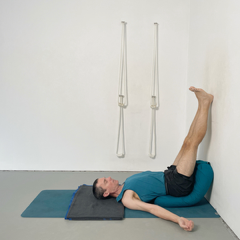
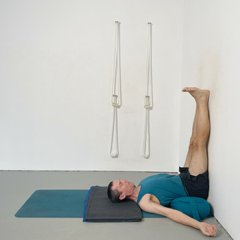
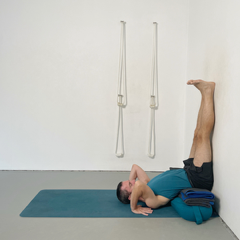
Viparīta karaṇi [inverted action], commonly known as Supported Legs-Up-the-Wall Pose, is a deeply calming restorative inversion. Practiced regularly, it can relieve fatigue, calm the nervous system, reduce swelling in the legs, and support healthy circulation. In this Viparīta karaṇi tutorial, we’ll guide you through three key variations of Viparīta karaṇi—ranging from beginner-friendly to advanced—with a free instructional video and detailed images to support each stage of the pose.
Whether you’re a new student with tight hamstrings or an experienced practitioner aspiring to practice the forward roll entry, this Viparīta karaṇi tutorial will help you develop confidence and technique in this classic Iyengar Method posture.
1. Viparīta karaṇi for Beginners: Angled Bolster Setup
The first variation is ideal for newer students or anyone with tight hamstrings. Instead of placing the bolster parallel to the wall, it’s angled upward with a portion tucked up the wall to help elevate the pelvis and reduce strain in the legs.
Key setup points: Bolster angled with roughly one-third tucked up the wall A flat blanket cushions the head Legs rest at approximately a 60-degree angle
Step-by-Step Instructions:
Press hands into the floor to lift the pelvis onto the bolster
Walk the feet and hips closer to the wall in stages
Only straighten the legs once the pelvis is securely supported
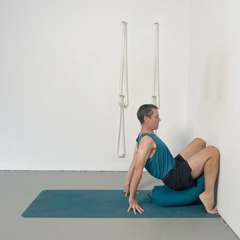
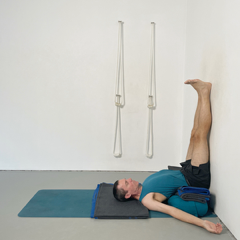
2. Intermediate Variation: Classical Setup with Side Entry
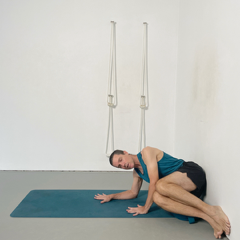
This version brings the hips directly into contact with the wall for a more traditional alignment. The bolster is now placed parallel to the wall, with a small gap left to allow the tailbone to drop slightly.
Setup details: Bolster parallel to the wall with a few centimeters of space Blanket under the head remains in place
Entry technique:
Sit sideways on the bolster
Hug knees and use the hands and forearms to rotate onto the back
Carefully swivel the legs up the wall while keeping both sitting bones in contact with the wall
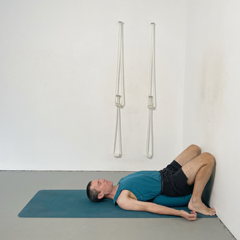
3. Advanced Variation: Forward Roll Entry for Experienced Students
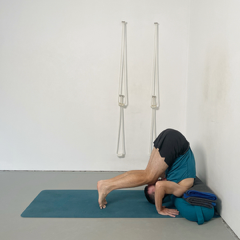
For those comfortable with inversions and looking to deepen their practice, this variation teaches how to forward roll into Viparīta karaṇi. This action allows for a higher lift under the pelvis, using additional blankets for support.
Setup: Bolster positioned further from the wall with two neatly folded blankets stacked on top Optional block at the wall to gauge distance
Technique overview:
Position hands forward of the head and place crown of head on the mat
Press hands firmly, tuck toes under, and lift knees
Walk in until shoulders contact the bolster, then use controlled pressure to bring the pelvis to the wall
Slide into position, ensuring even blanket distribution and correct spinal alignment
Key Benefits of Viparīta karaṇi • Calms the nervous system • Promotes a parasympathetic response, helping reduce anxiety and stress • Supports circulation: Elevates the legs to help reduce swelling and fatigue • Improves breath awareness: Gentle elevation of the chest and abdomen enhances natural respiratory rhythm • Restores energy: Reverses the effects of gravity and long periods of standing or sitting • Safe inversion alternative: Offers many of the benefits of shoulderstand with less strain
FAQs How long should I stay in Viparīta karaṇi? Anywhere from 5–15 minutes is typical. Longer holds allow for deeper relaxation, especially in restorative practices.
Can I do this pose if I have neck issues? Yes, but stick with the beginner or intermediate version. The forward roll should only be attempted once you’re confident and have no contraindications.
What props do I need? A yoga bolster, at least three blankets, and a block. You can modify with cushions or firm pillows if needed.
Is this pose safe during menstruation? Although Viparīta karaṇi is a rejuvenating restorative pose, it is still considered an inversion. Other poses such as Setubandha sarvāṅgāsana may be better choices during menstruation.
Final Thoughts on Viparīta karaṇi Viparīta karaṇi offers a restorative pathway into the benefits of inversions. Whether you’re just starting or looking to refine your technique, the step-by-step guidance in this tutorial and accompanying class will help you practice with clarity, alignment, and confidence.
Restraints Abound Most drivers are required to stay on the right side on two-way roads, yet others have to do so on the left. While on these roads we need to observe speed limits, turn lanes, detours, etc. Similarly, our cupboards separate our dishes and kitchenware. Some civil privileges such as voting require a minimum age, just as does retirement. The trades and professionals have parameters that need to be heeded. Recuperation sometimes comes with an extensive list of restrictions. Almost all begin education at a required age, and in this country are expected to graduate HS, at a minimum. Fewer still continue on, and achieve their terminal degrees in another 2-8 years.
A select few pursue self-development, while imposing additional restrictions. In this regard, we seek the advice of those who’ve already traveled this path. Bellur Kṛṣṇamachar Sundararaja Iyengar was such a guide for close to 1,000 certified Iyengar Method instructors in the US, with only a half-dozen of these residing in KS. Even after death, Mr. Iyengar continues to point the way via numerous writings. His pursuit was noteworthy. At 16, beginning āsana studies with his brother-in-law, the renown Śri Tirumalai Kṛṣṇamacharya, in Mysore. When 18, young Sundararaja was assigned to instruct in Pune, where he continued in his inquiry ’til the age of 95.
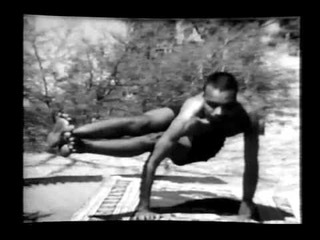
BKS himself followed his teacher’s example, resisting the traditional path, and eventually becoming a householder. There is film of Sundararaja when twenty practicing the vinyāsa of his lineage. This third part, (āsana) of Patañjali’s aṣṭāṅgayoga (eight limbs of yoga) would often consume about 10 hrs each of these early days.
Patañjali’s Yoga Sūtras In his pursuit, BKS eventually develop what his students endearingly came to call the Iyengar method of yoga. In time he wrote Light on the Yoga Sūtras ofPatañjali, and later Core of the Yoga Sūtras. “As a mortal soul, it is a bit of an embarrassment for me with my limited intelligence to write on the immortal work of Patañjali on the subject of yoga.”
“Patañjali fills each sūtra with his experiential intelligence, stretching it like a thread (sūtra), and weaving it into a garland of pearls of wisdom to flavour and savour by those who love and live in yoga, as wise-[beings] in their lives. Each sūtra conveys the practice as well as the philosophy behind the practice, as a practical philosophy for aspirants and seekers (sādhakas) to follow in life.”
Patañjali begins his four-chapter (I-IV) sūtra compilation thusly, I.1, atha yogānuśāsanam, Now the teachings of yoga [are presented]. He then summarises in I.2, yogaś citta-vṛtti-nirodhaḥ, Yoga is the stilling of the changing states of mind.
“Yoga is defined as restraint of fluctuations in the consciousness. It is the art of studying the behaviour of consciousness, which has three functions: cognition, conation or volition, and motion. Yoga shows ways of understanding the functionings of the mind, and helps to quieten their movements, leading one towards the undisturbed state of silence which dwells in the very seat of consciousness. Yoga is thus the art and science of mental discipline through which the mind becomes cultured and matured.”
“As the [changing states of the mind] must be restrained through the discipline of yoga, yoga is defined as citta vṛtti nirodhaḥ. A perfectly subdued and pure citta is divine, and at one with the soul.”
“Patañjali’s opening words are on the need for a disciplined code of conduct to educate us towards spiritual poise and peace under all circumstances. He defines yoga as the restraint of citta, which means consciousness. The term citta should not be understood to mean only the mind. Citta has three components: mind (manas), intelligence (buddhi), and ego (ahaṁkāra), which combine into one composite whole. The term ‘self’ represents a person as an individual entity. Its identity is separate from mind, intelligence, and ego depending upon the development of the individual.”
“Before describing the principles of yoga, Patañjali speaks of consciousness and the restraint of its movements.”
“Why did Patañjali begin the Yoga Sūtras with a discussion [in the first chapter] of so advanced a subject as the subtle aspect of consciousness? We may surmise that intellectual standards and spiritual knowledge were then of a higher and more refined level than they are now, and that the inner quest was more accessible to his contemporaries than it is to us.”
“The verb cit means to perceive, to notice, to know, to understand, to long for, to desire, and to remind. As a noun, cit means thought, emotion, intellect, feeling, disposition, vision, heart, soul, Brahman. Cinta means disturbed or anxious thoughts, and cintana means deliberate thinking. Both are facets of citta.”
“Abhyāsa (practice) is the art of learning that which has to be learned through the cultivation of disciplined action. This involves long, zealous, calm, and persevering effort. Vairāgya (detachment or renunciation) is the art of avoiding that which should be avoided. Both require a positive and virtuous approach.”
“Tapas is a burning desire for ascetic, devoted sādhanā (practice/quest), through yama, niyama, āsana, and prāṇāyāma, [the first four of Patañjali’s eight limbed system]. This cleanses the body and senses (karmendriya and jñānendriya), and frees one from afflictions (klesa nivṛtti).“
“Steady and Comfortable” Although the Iyengar method revolves about the core of yogāsana, little is said about these in the Yoga Sūtras (195 sūtras according to Vyāsa and Kṛṣṇnamacharya, and 196 according to others, including BKS Iyengar). First mentioned in II.29, yama-niyamāsana-prāṇāyāma-pratyāhāra-dhāraṇā-dhyāna-samādhayo ‘ṣṭav ańgāni, The eight limbs are abstentions, observances, posture, breath control, disengagement of the senses, concentration, meditation, and absorption.
Then on II.46, sthira-sukham āsanam, Posture should be steady and comfortable. Followed by II.47, prayatna-śaithilyānanta-samāpattibhyām, [such posture should be attained] by the relaxation of effort led by absorption in the infinite.
Continuing in II.48, tato dvandvānabhighātaḥ, From this, one is not afflicted by the dualities of opposites. Finally in II.49, tasmin sati śvāsa-praśvāsayor gati-vicchedaḥ prāṇāyāmaḥ, When that [āsana] is accomplished, prāṇāyāmaḥ, breath control, [follows]. This consists of the regulation of the incoming and outgoing breaths.
“Today, the inner quest and the spiritual heights are difficult to attain through following Patañjali’s earlier expositions. We turn, therefore, to [the second] chapter, in which he introduces kriyāyoga, the yoga of action. Kriyāyoga gives us the practical disciplines needed to scale the spiritual heights. My own feeling is that the four padas (chapters) of the Yoga Sūtras describe different disciplines of the practice, the qualities and aspects of which vary according to the development of intelligence and refinement of consciousness of each sādhaka (seeker/aspirant).”
“Sādhana is a discipline undertaken in the pursuit of a goal. Abhyāsa is repeated practice performed with observation and reflection. Kriyā, or action, also implies perfect execution with study and investigation. Therefore, sādhana, abhyāsa, and kriyā all mean one and the same thing.
“Āsana [is] the positioning of the body as a whole with the involvement of the mind and soul. Āsana has two facets, pose and repose. Pose is the artistic assumption of a position. ‘Reposing in the pose’ means finding the perfection of a pose and maintaining it, reflecting in it with penetration of the intelligence and with dedication. When the seeker is closer to the soul, the āsanas come with instantaneous extension, repose, and poise. In the beginning, effort is required to master the āsanas. Effort involves hours, days, months, and several lifetimes of work.”
“When effortful effort in an āsana becomes effortless effort, one has mastered that āsana. In this way, each āsana has to become effortless. While performing the āsanas, one has to relax the cells of the brain, activate the cells of the vital organs, and of the structural and skeletal body. Then intelligence and consciousness may spread to each and every cell. The conjunction of effort, concentration, and balance in āsana forces us to live intensely in the present moment, a rare experience in modern life. This actuality, or being in the present, has both a strengthening and a cleansing effect: physically in the rejection of disease, mentally by ridding our mind of stagnated thoughts or prejudices; and, on a very high level where perception and action become one, by teaching us instantaneous correct action; that is to say, action which does not produce reaction. On that level we may also expunge the residual effects of past actions.”
All Encompassing Restraint It is this all encompassing effort in the Iyengar method which involves not only the other first four limbs (yama, niyama, āsana, and prāṇāyāma) while in yogāsana, but also the three that follow (pratyāhāra, dhāraṇā, and dhyāna).
“…whatever āsana is performed, it should be done with a feeling of firmness, steadiness and endurance in the body; goodwill in the intelligence of the head, and awareness and delight in the intelligence of the heart. This is how each āsana should be understood, practised, and experienced. Performance of the āsana should be nourishing and illuminative. Some have taken this sūtra [II.47] to mean that any comfortable posture is suitable. If that were so, these would be āsanas of pleasure (bhogāsanas), not yogāsanas. This sūtra [II.47] defines the perfected āsana.”
“From the very first sūtra Patañjali demands the highest quality of attention to perfection. This discipline and attention must be applied to the practice of each āsana, to penetrate to its very depths in the remotest parts of the body. Even the meditational āsana has to be cultivated by the fibres, cells, joints, and muscles, in cooperation with the mind. If āsanas are not performed in this way they become stale and the performer becomes diseased (a rogi) rather than a yogi.”
“Nor does āsana refer exclusively to the sitting poses used for meditation. Some divide āsanas into those which cultivate the body and those which are used in meditation. But in any āsana the body has to be toned and the mind tuned so that one can stay longer with a firm body and a serene mind.”
“Āsanas should be performed without creating aggressiveness (ahiṃsā) in the muscle spindles or the skin cells. Space must be created between muscle and skin so that the skin receives the actions of the muscles, joints, and ligaments. The skin then sends messages to the brain, mind, and intelligence which judge the appropriateness of those actions.”
“In this way, the principles of yama and niyama are involved and action and reflection harmonise. In addition the practice of a variety of āsanas clears the nervous system, causes the energy to flow in the system without obstruction and ensures an even distribution of that energy during prāṇāyāma.”
“Usually the mind is closer to the body and to the organs of action and perception than to the soul. As āsanas are refined they automatically become meditative as the intelligence is made to penetrate towards the core of being. Each āsana has five functions to perform. These are conative, cognitive, mental, intellectual, and spiritual.”
“Conative action is the exertion of the organs of action. Cognitive action is the perception of the results of that action. When the two are fused together, the discriminative faculty of the mind acts to guide the organs of action and perception to perform the āsanas more correctly; the rhythmic flow of energy, and awareness is experienced evenly and without interruption both centripetally, and centrifugally, throughout the channels of the body. A pure state of joy is felt in the cells and the mind. The body, mind, and soul are one. This is the manifestation of dhāraṇā, and dhyāna, in the practice of an āsana.”
“Patañjali’s explanation of dhāraṇā [concentration] and dhyāna [meditation] in the sūtras beautifully describes the correct performance of an āsana. He [writes], ‘the focusing of attention on a chosen point or area within the body as well as outside is concentration (dhāraṇā).’ Maintaining this intensity of awareness leads from one-pointed attention to non-specific attentiveness. When the attentive awareness between the consciousness of the practitioner and his [/her] practice is unbroken, this is dhyāna.”
In II.48, “Patañjali says that the pairs of opposites do not exist in the correct performance of an āsana clearly [implying] the involvement of dhāraṇā and dhyāna.”
“As praṇava (sacred syllable Ōṁ) has three letters ā, u, ṁ, which stand for generation, continuation, and culmination in words or actions, āsana too has three movements. The first is going into position – akāra (the first letter of the praṇava). The second is establishing and staying in the āsana – ukāra (the second letter of the praṇava). The third is coming out of the position – makāra (the third letter of the praṇava). In this way, an āsana mentally expresses the praṇava mantra of āuṁ, without uttering it. If a practitioner with a clear intention retains the significance of āuṁ and practices the āsanas, observing the three syllables of āuṁ, [s/]he becomes involved silently in the awareness of āuṁ.”*
“This way of practice diffuses the flame of the seer so that it radiates throughout the body. The sādhakas then experience stability in the physical, physiological, psychological, mental, and intellectual bodies. In short, the seer abides and feels each and every cell with unbiased attention.”*
* Core of the Yoga Sūtras, by BKS Iyengar ** all other quotations from Yoga Sūtras of Patañjali, by BKS Iyengar *** Sūtra translations from The Yoga Sūtras of Patañjali, by Prof. Edwin Bryant
A 2024 Mayo Clinic study found that the ability to maintain balance standing on one leg indicates how well a person is aging more than strength or gait. Not only does it let us in on someone’s neuromuscular health, but it can also be a signal of other ailments.
“We utilize [balance] diagnostically to rule in or rule out other diseases,” says Paraminder Padgett, a neurological clinical specialist and physical therapy clinical supervisor at Dartmouth Hitchcock Medical Center. “We know inactivity can lead to poor balance, but problems in the brain can also lead to poor balance. One of our jobs is to help tease that out.”
That’s because a wide range of chronic conditions—diabetes, arthritis, multiple sclerosis, Parkinson’s, Alzheimer’s—can quietly erode your balance over time. Some affect nerves and proprioception, while others disrupt cognitive function and decision-making, all of which affect stability.
So while standing on one leg with your eyes closed might seem like a silly test, it’s actually a surprisingly comprehensive check-in. Balance is a complex, full-body symphony involving your eyes, ears, joints, muscles, and brain. Yet after age 40, these systems slowly decline due to the sedentary lifestyle many Americans ease into.
The result? A gradual loss of stability that can have serious consequences down the line: falls, fractures, and a shrinking world as people avoid movement they no longer trust. In 2021 alone, accidental falls caused 38,000 deaths among Americans over age 65. But here’s the hopeful part: it doesn’t have to be that way.
WHAT BALANCE DEPENDS ON—AND WHAT STARTS TO FADE
Good balance depends on the integration of our vision, somatosensory system (responsible for the sensory information of touch from our muscles, joints, skin, and fascia), and vestibular system within our ears. When any of these systems start to slip, your sense of equilibrium can go with it.
“Just like we have wrinkles on the outside of your body, you have wrinkles on the inside,” Padgett says. “If you use it right, the systems in the brain will continue to adapt to that degradation.”
In other words, use it or lose it. However, Skaggs says we don’t necessarily need to expect these systems to dwindle as we reach the magic age of 40. “These concepts of variation are misinterpreted relative to folks just not taking care of their health,” he says. While some physical decline is natural—like changes in muscle mass, joint mobility, or sensory precision—what we think of as “normal aging” is often a reflection of long-term neglect.
“When someone is trying to get out of a chair and starts to notice that they can’t do that without using their hands, then that internal model will cause them to keep using their hands,” Skaggs says. “It will become their new way of getting out of the chair, leading to more weakness and less ability to use their legs to get out of their chair.” These accommodations and precautions within these movements expedite their loss.
HOW TO PROTECT—AND EVEN RESTORE—YOUR BALANCE
The good news is that balance isn’t a fixed trait. It can be trained, rebuilt, and maintained at any age—if you keep your body moving and your brain engaged.
“We are designed for our trunk balancing efforts. Your core should be dominating as a point of stability, for standing on one leg, for getting up and off the toilet or reaching down to get something in your kitchen,” Skaggs says. “When it’s not, your upper back, your hamstrings, your pectoral muscles start jumping in to help you do these simple things.” That starts becoming the pattern, and your proximal stability systems wane.
For many, your 50s is when movement starts to decline. “I hear a lot of ‘Well, I worked all my life. I retired. It’s okay to sit in my recliner and watch TV all that.’ Or, ‘I do crossword puzzles. I’m keeping my mind active,’” Padgett says. It’s not enough. Movement is essential.
She works on what they call “dual tasking”—patients doing a physical activity and cognitive challenge simultaneously – to nurture their balance. For example, she says walking and naming fruits, starting with the letter A, and getting through the alphabet.
Variety in movements is also necessary as we age, especially for the vestibular system. “The ear canals are oriented in a way to help your brain know where your head is in space, to know what upright is and if you are upright,” Padgett explains. She points to yoga and offers downward dog and other poses where your head is down. “Your brain has to deal with and assimilate that information to know which way is upright.”
Activities that involve unpredictability or play—like juggling, hiking, or tossing a frisbee—are particularly useful. “You’re introducing complexity, and the more complex you get, the more you need to react,” Padgett says. “You’re working on your reactive balance.”
Even going barefoot can help. “The sensory information that comes through when you’re barefoot is a lot more pronounced and beneficial. Your foot mobility is going to be more engaged when you’re barefoot.” Small changes can wake up underused systems, whether you’re standing on a foam pad, walking on an unpaved path, or simply closing your eyes during a balance drill.
Most importantly, find movement you enjoy. “I certainly do not enjoy all the exercise that I do, but I always feel good when I’m done. I know that it’s good for me and allows me to do the things that I want to do, mostly pain free,” she says.
Research supports what these experts see daily: systemic balance training improves physical function and may also boost memory and spatial awareness. “The most important thing to do is to move and to move as much as possible,” Padgett says. “So, you have to find something that’s enjoyable for you.”
Rae Witte is a New York-based writer. In addition to writing, Witte has newsletters for freelance journalists for transparency and for insights on working with freelancer journalists for publicists about the process from pitch to publish, does media training, puts on panels for small businesses, and curates FINDS NY, a vintage and secondhand home goods shop.
B.K.S. Iyengar (1918-2014) is arguably one of the most well-known and influential yoga teachers within modern postural yoga. Named as one of the hundred most influential people in the world by Time magazine in 2004 Iyengar’s impact reached far beyond the yoga studio.
Spanning a life of almost 100 hundred years he went from sickly child to international Guru who wrote one of the best-selling yoga books of all time and pioneered a precise approach to yoga that used props to help the physical, mental, and intellectual body to align.
“Occasionally throughout history, there have been individuals whose achievements leave a positive mark across the entire world. B.K.S. Iyengar was such a person.” Iyengaryogalondon.co.uk
In this article we’ll look at:
The life behind the teacher
Philosophical influences on the Iyengar Method of Yoga
B.K.S. Iyengar – The Child “The approach of a young child to yoga is very different from that of an adult.” – B.K.S. Iyengar
Bellur Krishnamacarya Sunderaja Iyengar was one of 13 born into a poor brahmin family in Karnataka, India. His beginnings were rife with illness and during his childhood, he suffered from typhoid, malaria, and tuberculosis all of which impacted his education and well-being.
B.K.S. Iyengar – The Student “Yoga works on each individual for his or her growth and betterment, physically, mentally, emotionally, and spiritually.” – B.K.S. Iyengar Iyengar began yoga studies under the tutelage of his brother-in-law Śrī Tirumalai Krishnamacharya in Mysore at the age of 15. Krishnamacharya had little faith in Iyengar’s prospects as a yogi due to his physical health, but it was through yoga that Iyengar found a mode of healing and well-being.
As a teacher, Krishnamacharya was renowned for his fierce and uncompromising manner* towards his students, and it is said to have offered very little direct tutorage to Iyengar. Along with Krishnamacharya’s other students, K. Pattabhi Jois, Indra Devi, and T.K.V. Desikacha, Iyengar became one of the most influential yoga teachers of the 20th century.
B.K.S. Iyengar – The Teacher “It is relatively easy to be a teacher of an academic subject, but to be a teacher in an art is very difficult, and to be a yoga teacher is the hardest of all, because yoga teachers have to be their own critics and correct their own practice.” – B.K.S. Iyengar
At just 18 Iyengar was sent to Pune to teach yoga. Resisting the traditional path of other yogis, Iyengar did not choose to become a sannyasi [a renunciate, or someone who has given up life as a householder] which subsequently allowed him to marry and become a father.
“In life, we have a lot of responsibilities. It is not meant for renunciation. We live in this society and it is our duty to give back to our society. Renunciation comes to me when I am 96. Renunciation means giving up the enjoyment of worldly happiness. But I am full of inner happiness.” – B.K.S. Iyengar
It was Iyengar’s relationship, both as a student and friend, with internationally renowned violinist Yehudi Menuhin in the 1950s that propelled him to success in the West. Menuhin said, “I consider B.K.S. Iyengar to be my first real violin teacher. He is the first to teach me how to use my body”.
Iyengar began teaching at the London Education Authority in the 1960s on the basis that the teachings be predominantly physical omitting the philosophical and spiritual aspects of yoga. This paved the way for the first Iyengar Institute in the West.
“Iyengar’s biomedical dialect made postural yoga appealing to a wide array of modern urban individuals.” Andrea Jain in Selling Yoga
Iyengar was a charismatic teacher and despite being notorious for his temper*, he was also known by his students for his sense of humor and compassion. Notably, his radical approach to teaching was founded on the notion that yoga was for everyone regardless of race, gender, or class.
After the death of his wife, Iyengar established the Ramamani Iyengar Memorial Yoga Institute in Pune in 1975 where he taught with his children Geeta and Prashant. Iyengar spent the rest of his life at the RIMYI and continued to teach well into his 90s.
Iyengar Method – The Training “Yoga is my way of life.” – B.K.S. Iyengar
There are thousands of trained Iyengar Method teachers throughout the world, all of whom have undertaken the rigorous program of teacher training. At least eight years of study are required before entering the two-year introductory certificate program. Senior Iyengar Method teachers must undertake mandatory in-depth training to progress in their teaching.
Iyengar Method – The Philosophy “Yoga does not just change the way we see things, it transforms the person who sees.” – B.K.S. Iyengar
B.K.S. Iyengar refers to the practice of yoga as “meditation in action”. His approach to the philosophical concepts of yoga was heavily underpinned by the classical yoga of Patañjali. In the Yoga Sūtras of Patañjali, we find the eight limbs of yoga which is a systematic approach to living a purposeful life and path to samādhi.
The eight limbs of yoga, also known as Aṣṭāṅga yoga (not to be confused with K. Pattabhi Jois’s Aṣṭāṅga vinyasa), provide a holistic guide to life with attention to ethical conduct, discipline, self-inquiry, and spirituality. The first four stages are concerned with refining aspects of daily life before diving deeper into the subtleties of meditation and consciousness.
Let’s take a look at the philosophical inquiry behind Iyengar’s method in more detail.
1 | Yamas – Often referred to as ethical standards, or restraints, the five Yamas set out a code of behaviors to live by. Consider these the do not’s:
Ahiṃsā – non-violence (lit., non-harming)
Satya – truthfulness (not lying)
Asteya – non-stealing
Brahmacharya – self-restraint, (not distracted)
Aparigraha – non-avarice, non-hording, or non-possessiveness
2 | Niyamas– A compliment to the Yamas are five Niyamas considered the ‘inner observances’, and help us to act appropriately. [Regard] these as the do’s:
Śauca – cleanliness, purity (external and internal)
Saṇtoṣa – contentment
Tapas – self-discipline, spiritual austerity, and persistent meditation
Svādyāya – study of the sacred scriptures (for one’s liberation)
3 | Āsana – The physical postures, and the dominant form of yoga associated with modern practice.
4 | Prāṇāyāma – The practice of focusing on the breath. Eventually a means to activate prāṇa, or energy, prāṇāyāma is thus the control of the breath or breathing exercises. [It must first begin with studying one’s breath.]
5 | Pratyāhāra – Often referred to as detachment from the external (such as cravings or drama), pratyāhāra is the withdrawal of the senses and a tool for turning towards the internal.
6 | Dhāraṇā – Concentration, or focus on a single mental object, is the practice of dhāraṇā.
7 | Dhyāna – Meditation is the focus of this limb. Dhyāna differs from concentration as it is a wider state of awareness, and not reliant on a fixed mental point.
8 | Samādhi – A state of being that is at one with all that is around us, with the universe. A kind of enlightenment, or bliss, is used to describe the state of samādhi. [Another is a ‘settled’ of the mind.]
Iyengar Method – The practice “Iyengar prescribed a thoroughly individualistic system of postural yoga that was a rigorous and disciplined form of body maintenance” Andrea Jain in SellingYoga
The Iyengar Method is one of the first world-wide ‘brands’ of yoga and was initially successful because of its focus on physical methods with little focus on the wider teachings of yoga. This accessible approach to what was previously an esoteric practice used physical exercise to draw people in.
There are three important components of the Iyengar Method which provide a good insight into the style: alignment, sequencing, and the use of props.
ALIGNMENT “The body cannot be separated from the mind, nor can the mind be separated from the soul” – B.K.S. Iyengar
The precise approach to the performance of postures in the Iyengar Method is detailed and specific. Postures are held for a longer duration than in many other styles allowing time to work with alignment, breath, corrections, and adjustments while in the shapes.
There is an emphasis on learning and progression through the alignment principles on account of the demanding attention and awareness required. ‘Good alignment’ means that the whole physiological and mental system is balanced.
SEQUENCING “In India, āsana was never considered to be a merely physical practice as it is in the west.” – B.K.S. Iyengar
Iyengar’s is a methodical approach to sequencing postures and aims to prepare the body for opening in a safe way. Unlike many other styles, the Iyengar Method does not require warming sequences such as sun salutations (sūryanamaskāra). It often features poses being held for longer periods, sometimes up to 10 minutes, which are said to help to build strength, flexibility, as well as, focus. Classes generally end with a ‘re-invigorating’, or ‘re-energizing’ posture (śavāsana) to cultivate vitality.
PROPS “But even in India, nowadays many people are beginning to think in this way because they have picked it up from the people in the West whose ideas are reflected back to the East.” – B.K.S. Iyengar
Considered a pioneer in the use of ‘props’, (Iyengar developed the use of belts, blocks, straps, walls, sandbags, chairs, stools, ropes, bolsters, sticky mats, and more), in order to provide support and help those with limitations, lack of experience, or injuries. The use of props compliments the alignment principles, and helps students to perform each pose safely.
Iyengar Method – Proposed Benefits “Your body exists in the past and your mind exists in the future. In yoga, they come together in the present.” – B.K.S. Iyengar
Like other styles of yoga, the Iyengar Method is a good approach to improving health holistically. More specifically it claims to:
B.K.S. Iyengar’s Writing “My subject is yoga – the path which cultures the body and senses, refines the mind, civilizes the intelligence, and takes rest in the soul which is the core of our being.” – B.K.S. Iyengar
Light on Yoga is arguably one of the most widely known books on yoga, and includes over 600 photographs of 200 āsana accompanied by instructions on how to do the poses and gain their benefits. It has been translated into 23 languages since being published in 1966, and has been referred to as “the bible of modern yoga”. [Originally, this book was intended for those without a certified Iyengar Method instructor (CIYT).]
Key Takeaways Iyengar’s is a methodical approach to the practice of yoga and its success rides on the teachings of the man who pioneered a brand of yoga for householders that was both challenging and therapeutic.
“Yoga is a light, which once lit, will never dim. The better your practice, the brighter the flame.” – B.K.S Iyengar
[* A student originally teaches as s/he was taught]
The therapeutic benefits of Haṭha-yoga arise from whole body energetic balancing combined with distinct biomechanical adjustments. We gave an example of this in our last blog post, where we looked at the disorder known as adult acquired flatfoot deformity, its biomechanical basis and how to utilize yoga to maintain healthy foot arches. In this post we focus on the plantar fascia of the foot and examine the most common cause of heel pain—plantar fasciitis—to see what happens when things go wrong. Finally, we consider how yoga can be used to bring things back into balance and even to prevent this condition. First, let’s look at fascia in general.
A fascia is a fibrous structure that is formed from sheets of connective tissue. The deep fascia covers and invests muscles, tendons, ligaments and blood vessels throughout the body. An important example of a deep fascia is the thoracolumbar fascia. All yoga practitioners should be familiar with this structure and its myofascial connections, as it forms a critical support system for the lumbar spine and sacroiliac joint. Other types of fascia include the superficial fascia of the subcutaneous tissue (under the skin), and the visceral and parietal fascia, which surround organs such as the heart and lungs. Figure 1 illustrates the deep fascial elements of skeletal muscles. Click here to see this in the context of stretching and Hanumanasana (front splits).
Figure 1: The deep fascia covering and investing skeletal muscle.
The plantar fascia or plantar aponeurosis (you can use either term) originates from the medial tubercle of the calcaneus (heel bone) and continues forward to attach to the proximal phalanx of each of the toes (via the plantar plates). Extending (dorsiflexing) the toes tightens the plantar fascia, thus elevating the foot arch. During this process, the metatarsal heads act as pulleys to form a “windlass” that tightens the plantar aponeurosis. The plantar fascia has elastic qualities in that its fibers are somewhat wavy in the relaxed position. These fibers straighten in response to forces applied (like the heel-off phase of gait). Thus, the plantar fascia can store energy like a spring. Figure 2 illustrates this concept.
Figure 2: The windlass mechanism of the plantar aponeurosis (fascia).
The plantar aponeurosis also forms a myofascial connection with the muscles of the calf (gastrocnemius and soleus) via the Achilles’ tendon and, by extension, the hamstrings (and potentially other muscles of the posterior kinetic chain). Forces that stretch the plantar fascia are distributed along these muscles. Conversely, tightness in these muscles can adversely affect the function of the plantar fascia and thus the arch of the foot. Figure 3 illustrates these myofascial connections in adhomukha śvānāsana. (downward facing dog).
Figure 3: The myofascial connections to the plantar fascia in adhomukha śvānāsana.
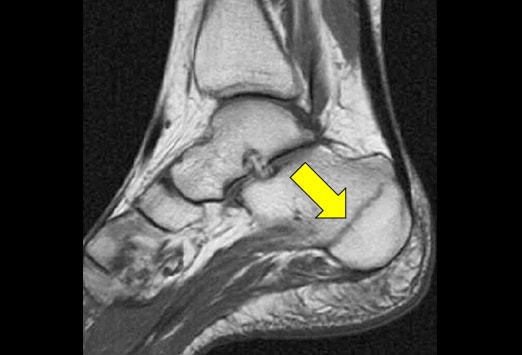
Plantar fasciitis is an overuse injury related to repetitive overstretching of the plantar aponeurosis. In this condition the forces of gait are concentrated where the plantar fascia attaches to the calcaneus, instead of being distributed over the fascia and the muscles at the back of the legs. This results in microtrauma to the plantar aponeurosis near its origin, causing inflammation and heel pain. Risk factors for developing plantar fasciitis include tight calf muscles and hamstrings, endurance-type weight bearing activity (such as running) and a high body mass index. Figure 4 illustrates plantar fasciitis. Click here to see a reference MRI image of this condition.
Figure 4: Plantar fasciitis (note the inflammation at the origin of the plantar aponeurosis).
Note that there are other conditions that can cause heel pain. An example of such a condition is a stress fracture of the calcaneus, which is also seen in runners. This problem is treated differently from plantar fasciitis. Accordingly, if you have heel pain be sure to consult a health care practitioner who is appropriately trained and qualified to diagnose and manage such conditions. Use your knowledge of pathological conditions to deepen your understanding of the body and to work with yoga as an adjunct in prevention and treatment.
Since one of the most important aspects of managing this condition is stretching of the plantar fascia, heel cords (gastrocnemius/soleus complex) and hamstrings, yoga offers an ancient preventative solution. For example, adhomukha śvānāsana stretches both the hamstrings and heel cords. Click here to see how to use reciprocal inhibition to release the gastrocnemius and soleus muscles and allow the heels to lower to the floor in adhomukha śvānāsana.
Figure 5: Stretching the plantar aponeurosis (fascia) in chaturaṅga daṇḍāsana.
Chaturaṅga daṇḍāsana (four limbed staff) stretches the plantar fascia itself. Use this image to aid in visualization of this process while in the pose. One of our previous posts gives some tips on how to ease into Chaturaṅga daṇḍāsana and another describes a key muscular co-contraction in this pose.
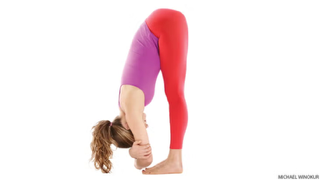
Uttanāsana (standing forward extension) illustrates a stretch of the posterior kinetic chain, linking to the feet (figure 6). Click here for a tip on integrating the hip abductors to access sacral nutation to refine Uttanasana. Thus, we can see that the Sun Salutations (Surya Namaskar) offer an ancient self-contained method for working with the plantar fascia and its myofascial connections to maintain a healthy foot arch. For many more tips and cues like this, check out the Yoga Mat Companion book series and The Key Muscles and Key Poses of Yoga.
Figure 6: The posterior kinetic chain and its connection to the feet in Uttanāsana.
We conclude with a step-wise technique on using biomechanics and physiology to lengthen the heel cords in jānu śīrṣāsana (seated forward extension):
Step one: Bend the knee about 15 degrees to release the gastrocnemius muscle at its origin on the posterior femur.
Step two: Use the hands to gently draw the ankle into dorsiflexion and stabilize it in this position by engaging the biceps to flex the elbows. The cue I use for this is to “draw the top of the foot towards the front of the shin (dorsiflexion).”
Figure 7: Steps to release and then lengthen the calf muscles in Janu sirsasana.
Step three: Hold the foot in place and gradually engage the quadriceps to straighten the knee. Ease into this position. Maintaining the ankle in some dorsiflexion with the arms and extending the knee distributes the stretch throughout the calf muscles (the gastrocnemius and soleus) as illustrated here.
Figure 8: The myofascial connection between the plantar fascia, heel cord and calf muscles.
You can add a facilitated stretch to the calf by gently pressing the ball of the foot into the hands for 8-10 seconds and then taking up the slack by further dorsiflexing the ankle. This activates the Golgi tendon organ at the muscle tendon junction, resulting in relaxation of the contractile elements. We describe a similar technique to lengthen the hamstrings, as well as the physiological basis for facilitated stretching in our blog post on how to lengthen the hamstrings in jānu śīrṣāsana.
Chris Macivor is the graphic designer Originally posted here
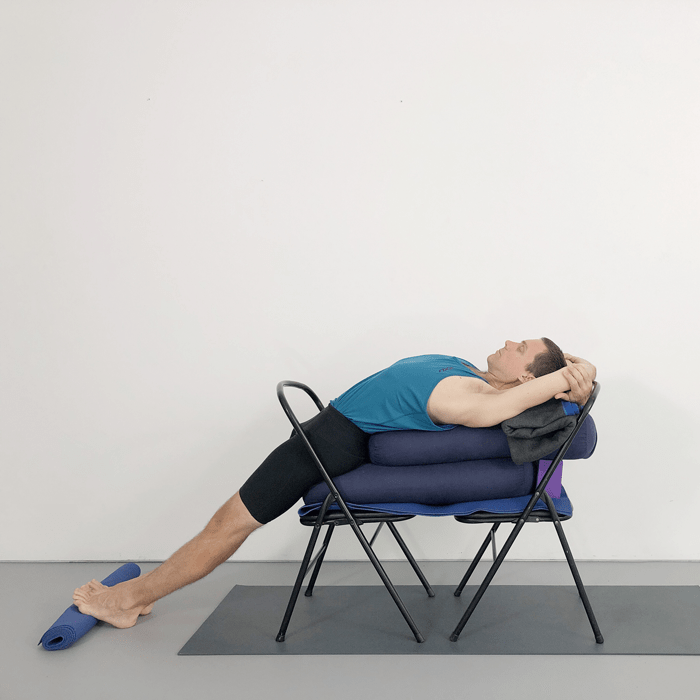
Salamba Purvottanāsana is a great example of an Iyengar method restorative pose that can help rejuvenate energy levels. Much of what is today known as restorative yoga has evolved from the teachings of the contemporary Indian yoga master B.K.S. Iyengar. His innovative usage of props allows the practitioner to remain in supported positions for longer periods of time, in yoga poses that might otherwise involve effort and fatigue.
The supported version of Purvottanāsana described in this post is well suited to times of tiredness or illness, and has many potential therapeutic applications. It is a great pose to include in a home yoga practice at times when energy needs to be preserved. Whilst in the pose the chest is held in an open but supported position. The degree of chest opening is similar to what might be achieved with more dynamic backbends, but can be sustained for a considerably longer duration of time. A practitioner would ideally stay in this pose and soak up it’s benefits for at least five or ten minutes. Remaining in the pose for an extended period of time has a calming effect on the nervous system. It can help to combat stress and counteract lethargy from mental and physical exertion.
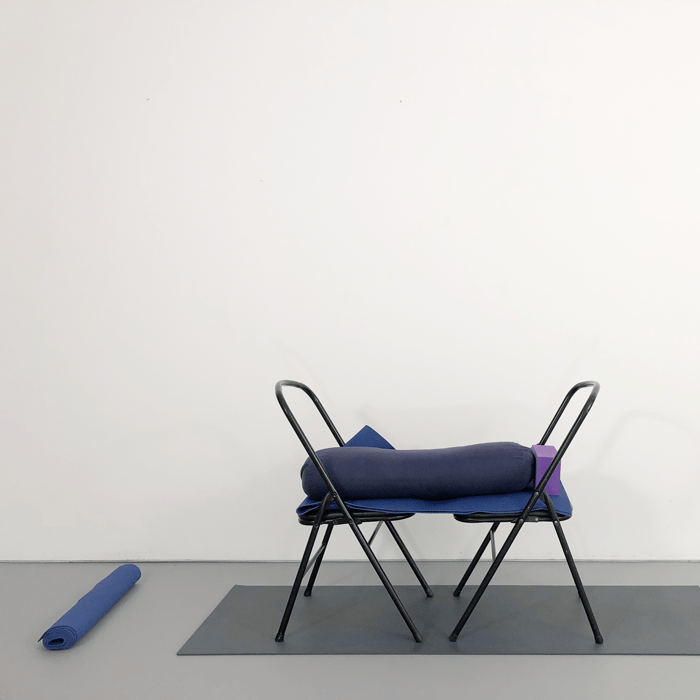
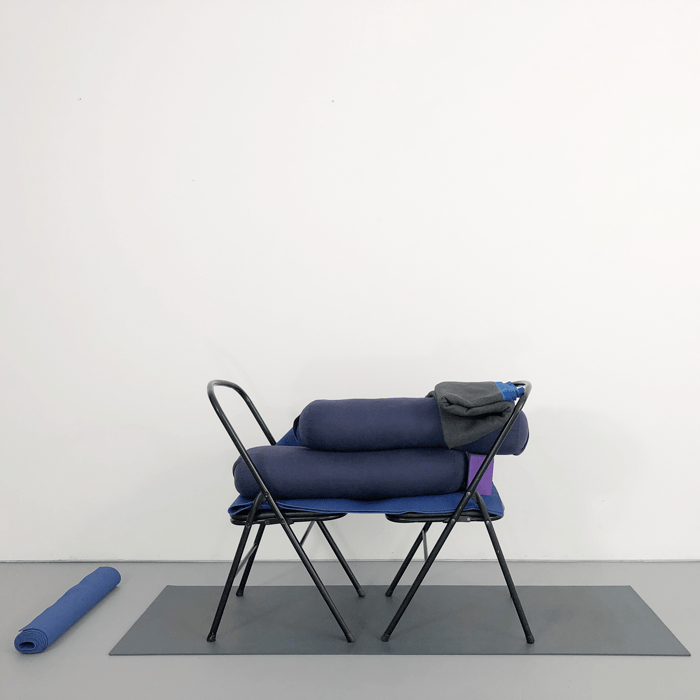
Set up your chairs and other props
Position two chairs closely together so that the fronts are facing.
Fold a yoga mat in half, and drape the mat over the seat of both chairs. This will help to link the chairs together and prevent them from sliding apart.
Place a bolster on the seat of the chairs.
Ensure that the end of the bolster is level to the edge of the first chair that you will be sitting on.
The other end of the bolster will not quite reach the edge of the other seat. Place a block on its side edge in the section of the seat that overlaps the end of the bolster. This block will help to support the next bolster layer and will prevent your head and shoulders from sinking downwards.
Build a bit more height
Now place a second bolster on top of the first.
Ensure that the top bolster overlaps the bottom bolster by around 20cm or 8 inches. The exposed section of the bottom bolster is where you will eventually sit.
The other end of the top bolster will be supported by the block.
Place a three-fold blanket at the end of the top bolster. Your head will eventually rest onto this blanket.
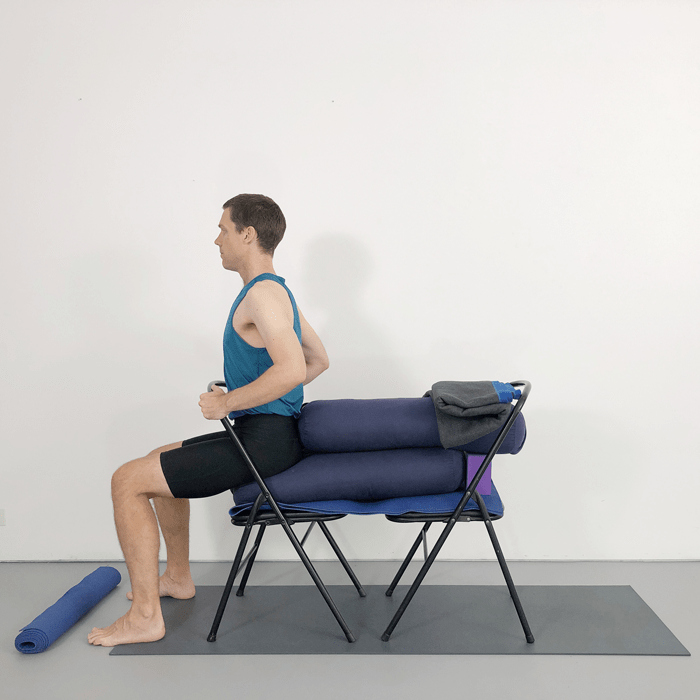
Position yourself
Before lying back over the chairs, prepare a support for the balls of your feet. A rolled yoga mat is ideal for this purpose, but other nearby objects will do in a pinch. Anticipate how far this foot support will need to be away from the chair, and place it in position.
To position yourself on the support, begin by sitting on the top bolster with your legs straddling either side of the support. Bring one leg through the inside of the chair frame and then slide forwards so that you are sitting on the bottom bolster.
Keep your knees bent and have your feet flat to the floor, as you lie back over the top bolster.
Position head on the three-fold blanket so that the tops of your shoulders are level to the edge of the blanket.
Tuck buttocks towards your knees.
Now straighten the legs.
Turn inner thighs down, calves outwards, and press your big toe bases down and into the rolled mat.
Allow arms to release down by your sides.
Relax…
In addition to having arms hanging down by your sides, another option is to fold and bring them overhead to rest on the support.
Fold your arms in such a way that, gently clasp each elbow with the fingers .
This light grip is sufficient to stabilise your elbows at a shoulder width distance. You can then consciously allow shoulders to release in a downward and outward direction.
As you remain in the pose observe how your breath starts to become soft and smooth.
As chest is lifted up by the supports, allow your abdomen to relax and release in a downward direction.
Ensure that your jaw muscles, tongue and eyes are free from tension.
Conclusion
Salamba Purvottanāsana is a rejuvenating pose that is commonly used in the Iyengar method. It can have specific therapeutic applications in a yogāsana class context, but is also a great pose to include in one’s home practice. It is an ideal pose to practice during times of fatigue or low energy. Remaining in this pose for around ten minutes will maximize its potential benefits.
Focusing on regulating your breath can help calm your mind
September 6, 2022/Cleveland Clinic healthessentials
The late Buddhist monk Thích Nhất Hạnh once wrote, “Breathing in, I calm body and mind. Breathing out, I smile. Dwelling in the present moment, I know this is the only moment.”
How incredibly peaceful does that sound? Breathing techniques like 4-7-8 breathing can help you tap into your inner calm, benefitting everything from your stressed-out nervous system to how well you sleep at night.
Integrative medicine specialist Melissa Young, MD, explains how to do this soothing style of breathing and what health benefits it can provide.
What is 4-7-8 breathing? The 4-7-8 breathing technique is a style of intentional breathwork that can calm your mind and body. Though popularized in 2015 by integrative medicine specialist Andrew Weil, MD, it has ancient roots in the yogic practice of prāṇāyāma, or focusing on the breath.
The gist of it goes like this:
Inhale through your nose for four counts.
Hold your breath for seven counts [regard it as a pause, rather than as a ‘holding’].
Exhale through your mouth for eight counts [exhale through the nose, as directed by Mr. Iyengar in Light on Prāṇāyāma].
But there’s a little bit more to it if you want to ensure that you’re tapping into all of its health benefits.
The benefits of 4-7-8 breathing “Yoga breathing techniques calm the body down and bring it into a more relaxed state,” Dr. Young explains. “This kind of breathing can help us focus our mind and our body away from worries and repetitive thoughts.”
She goes deeper into what this breathing technique can do for you.
Calm your mind The repetitive nature of 4-7-8 breathing provides a calming distraction to your racing mind. “The counting sequence is a way to focus your mind on something other than your worries,” Dr. Young says.
Reduce stress and anxiety Your sympathetic nervous system is responsible for your body’s “fight-or-flight” response. When you’re stressed, this system goes into overdrive, which makes you feel amped-up — like a fast-beating heart, shallow breathing and other telltale signs of stress, like sweaty hands and an upset stomach.
Your parasympathetic nervous system is responsible for relaxing your sympathetic nervous system and helping you calm down. “Breathing techniques like 4-7-8 breathing can play a huge role in activating your parasympathetic nervous system and helping you to shift back toward tranquility,” Dr. Young says.
Help you sleep Forget counting sheep and skip right to counting your breath. Calming your mind and reducing your anxiety can go a long way toward a good night’s sleep, and 4-7-8 breathing is associated with both. It’s also been shown to decrease heart rate and blood pressure, which put your body in the right state for sleep.
Train your body to better respond to stress They say you can’t teach an old dog new tricks, but with practice and repetition, you can teach your nervous system to do some pretty cool things.
“It takes some time for the nervous system to respond to this type of breathwork,” Dr. Young says. “The more we do it, the more we allow our bodies to go into that parasympathetic mode.”
If you regularly practice 4-7-8 breathing (especially during times when you’re not particularly stressed), your body will actually learn to incorporate it into your go-to stress response.
How to do 4-7-8 breathing You can do this practice in any position, though Dr. Weil recommends sitting up with your back straight. If you’re using 4-7-8 breathing to help you fall asleep, though, you can even do it while lying in bed.
Here’s how to do it:
Position your tongue. Throughout this breathing technique, your tongue should stay toward the roof of the mouth, with the tip of your tongue touching the back of your two front teeth [no, keep your tongue passive
as directed by Mr. Iyengar in Light on Prāṇāyāma]*.
Breathe out deeply. “With any breathing technique, it’s ideal to start with an exhale,” Dr. Young says. Let your breath out through your lips, making a whooshing sound [no, breathe through the nose as directed by Mr. Iyengar in Light on Prāṇāyāma]*. Now you’re ready to begin counting .
Inhale and count to four. Breathe in through your nose while mentally counting up to four. Don’t go too slowly or too quickly; pick a pace that works for you.
Hold and count to seven. Without straining or stressing, gently hold your breath while counting to seven in your mind [regard it as a pause, not a ‘holding’].
Exhale and count to eight. Breathe out slowly for eight counts, with your lips slightly pursed around your tongue. “You should hear that whooshing sound,” Dr. Young says. Congrats! You’ve now completed one cycle of 4-7-8 breathing [exhale through the nose, as directed by Mr. Iyengar in Light on Prāṇāyāma].
Repeat the process. Do steps three through five again for three more cycles: Inhale through your nose for four counts; hold your breath for seven counts [Regard it as a pause, not as a ‘holding’]; exhale through your mouth for eight counts [exhale through the nose, as directed by Mr. Iyengar in Light on Prāṇāyāma].
Dr. Young warns that when you’re first starting out learning 4-7-8 breathing, you may experience a little bit of lightheadedness or shortness of breath. But this is just a function of learning to breathe more slowly.
“So, many of us just aren’t used to focusing on our breathing,” she says. With a little bit of practice, your body will soon adjust.
Tips for 4-7-8 breathing Although 4-7-8 breathing is a fairly simple, straightforward technique, it’s a powerful one that can pay off big for your mind, body and spirit. Dr. Young shares some additional insight into making it work for you.
Fine-tune your practice In the beginning, don’t put pressure on yourself to go at a snail’s pace. No one expects you to master your breath on the first try (or even the second or the third or the 20th), so allow yourself to go at whatever pace feels right for your skill level.
As you become more skilled at 4-7-8 breathing, you’ll be able to slow things down for deeper relaxation benefits. “The counting and the ratio of your breath will stay the same, but you can readjust the pace to your comfort,” Dr. Young notes.
Do it twice a day Practice makes progress! The more you do 4-7-8 breathing, the better at it you’ll become, and the more your body will begin to incorporate it into your stress response. Dr. Young suggests doing three cycles of this breathing technique twice a day. “You’re going to see results really quickly,” she says.
Make it a habit Identify two recurring moments during your day that you can designate for practicing 4-7-8 breathing. Whether you do it when you wake up, after you get off work or right before you get in bed, setting a time for it can help you to stick with it and adopt it as an ongoing practice.
“Getting into a habit at certain times of the day makes it easier to stay with it,” Dr. Young says. “It doesn’t matter when you do it; it just matters that you actually practice it.”
To hear more on this topic, listen to the Health Essentials Podcast episode, Breathwork for Beginners. New episodes of the Health Essentials Podcast publish every Wednesday.
* Mr. Iyengar writes in Light on Prāṇāyāma, #32 of Cautions and Hints: “Saliva flows at the beginning of prāṇāyāma. Swallow after breathing out, but before breathing in, and never while holding the breath. Do not stiffen or press the tongue against the teeth and palate, but keep it and the throat passive.”
** Mr. Iyengar writes in Light on Prāṇāyāma, #5 of Cautions and Hints: “Breathing in prāṇāyāma should always be through the nose, except where otherwise stated as in Ch. 24.” However, this chapter describes inhaling through on open mouth for Śītalī and Śītakārī prāṇāyāmawith the tongue curled. Exhalation remains through the nose.
If you’re having difficulty with forward bends, don’t assume it’s your hamstrings. Inflexible rotator muscles may be to blame.
Judith Hanson Lasater Yoga Journal Aug 28, 2007
There is an old Sufi story about philosopher-fool Nasrudin, who was looking for his house keys under a street light. A couple of friends happened by and joined in the search. Finally, in exasperation, one of the friends asked Nasrudin where he thought he had lost the keys. Nasrudin pointed to a spot some distance away where it was extremely dark. But why are we looking here then? he was asked. He replied: Because it is so much easier to see under the light.
This story reveals a common human tendency: to look where we want to instead of digging deeper to reveal the root of a problem. This is true of some yoga students who are trying to move deeper into their forward bends.
You attend class regularly, sometimes for years, practice at home, and make progress in most poses—except for forward bending. You seem to have hamstrings of steel! No matter how often or how long you practice, there doesn’t seem to be any change. One day while teaching, I realized that I was like Nasrudin. I was looking in the wrong place to find a solution for some students who, no matter how often or how long they practiced, did not experience any change in forward bending poses. I realized that, like the hamstrings, a group of muscles in the hip area—the external rotators—can interfere with the ability to bend forward.
While each of these muscles is a separate structure, they function as one, working to externally rotate the femur (thighbone), stabilize the pelvis during walking, and help stabilize the pelvis and the femur together when you are standing on one leg. When you bend forward, all of the muscles on the back side of your body must lengthen, including the rotators.
An especially important rotator is the piriformis, which attaches to the sacrum and to the femur; the sciatic nerve passes directly under this muscle. A tight piriformis can do more than just limit your forward bends.
Folding Through Troubling Tight Rotator When a tight piriformis presses down on the sciatic nerve, it can lead to ‘piriformis syndrome,’ which creates a radiating pain in the buttocks, down the back of the thigh, into the leg and foot.
And if this rotator is especially tight, it can pull on the sacrum, affecting the functioning of the sacroiliac joint (the joint between the sacrum and the pelvis). When the sacroiliac joint is dysfunctional, the lumbar (lower) spine can also be adversely affected.
So if your forward bends are limited, or if you’re experiencing ‘piriformis syndrome,’ it’s a good idea to continue to work on the hamstrings, but also include a few rotator stretches in your regular asana routine.
A note of caution: If the leg pain is great and/or persists, it is advisable to seek the treatment of a qualified health professional.
Walk the Walk for Flexibility Walking has a phase called the swing phase in which you are, in effect, standing on one leg: One leg is the support leg and the other is swinging forward but has not yet touched down. Because gravity tends to pull down on the pelvis, we need the action of the rotators on the standing leg side to hold the head of the femur and the pelvis together in a stable position. Rotators tend to get tight when this action is exaggerated, like when you run or dance.
In order to understand this concept, try an experiment. Place your fingertips on the front of your pelvis, slightly to the side of the bony prominence called the ASIS (anterior superior iliac spine). Walk across the room and notice how these bony landmarks are held virtually level in relationship to the floor—this is because the rotators are holding the pelvis stable while you’re walking.
Now, keeping the hands as they are, raise the right leg in front of you as if you are about to take a step. Allow the left hip to sway to the left. The pelvis is now tipped downward on the right as the right rotators are relaxed. Place the right foot on the floor and try this experiment on the other side.
Dancers and Prancers Beware Dancers and runners usually have tight rotators because they demand increased stability from these muscles. Dancers, for example, need stable rotators when standing on one leg and lifting the other leg up in an arabesque. They might be quite flexible in other ways, but often have tight rotators.
For runners, the increased momentum associated with the forward movement of the legs places greater demands on the rotators to hold the pelvis level.
Try this: Stand up and place the feet a foot or so apart with the feet turned out as in second position in ballet. In order to turn the feet out when standing, you contract your external rotators to rotate the femur. If you hold them in this externally rotated position as if they are tight, you will see how that interferes with forward bending. Hold the buttocks firm by squeezing them together; try to bend forward. Even if you are supple, this will be difficult. If, on the other hand, you turn the thighs inward, stretching as opposed to contracting the rotators, this will facilitate forward bending.
Now turn the toes and thighs inward as much as possible. Imagine that you are pressing outward with the heels but actually keep the feet still as you bend. It will be much easier to bend forward with the legs and feet in this position. This is because the external rotators are being stretched and thus are interfering less with the forward movement of the pelvis over the thigh bones.
Practice Makes Perfect in These Five Rotator Stretches The five rotator stretches presented below are in order of increasing difficulty. The benefits they bring to other poses, such as uttānāsana (Standing Forward Bend), as well as to ease of walking, make them worth doing frequently. Because these poses can be deep stretches even for experienced students, attempt them when you are already warmed up by your regular yoga practice or some other physical activity. And remember: Recent research in muscle physiology has found that stretches need to be held for at least one minute in order to be effective. You may feel some of these stretches more on one side than the other. In fact, the longer you practice yoga, the more aware you will be of the differences between your right and left side. You may want to stretch the tighter side longer.
After each stretch, walk around the room to relax the rotators. You may discover that walking is easier as the rotators loosen. Try practicing a forward bend to see how it has changed. You may also notice that your Padmāsana (Lotus Pose) improves. Hopefully such observations will encourage you to make these poses part of your regular asana practice.
5 Rotator Stretches:
1. Reclining Twist
Lie on your back and bend the knees so that the feet rest on the floor. Inhale. As you exhale, bring the knees slowly to the chest one by one so that the lower back remains firmly on the floor. Squeeze your knees together and drop them to the left, keeping your shoulders on the floor. The legs should be approximately at a 90 degree angle to the body, but experiment to find the position that maximizes the stretch in your outer hips (especially the right one). As you stay in the pose, imagine that the belly is rotating in the opposite direction from the legs. Repeat on the other side.
2. Reclining Twist With Raised Knee
Lie on your back with your knees bent and your feet on the floor. Cross your right ankle over your left knee. Inhale. As you exhale, drop the legs to the left, bringing your right foot to the floor and keeping your shoulders on the floor. To increase the stretch, gently push your right knee away from you with your left hand. This should intensify the stretch in the outer right hip. If you don’t feel this stretch, experiment with the placement of your right foot; you may need to bring it closer to the hip or move it farther toward the knee on the floor. Repeat on the left side.
3. Standing Pigeon Pose
Place a blanket along the end of a stable, waist-high table. Lift your left lower leg onto the table with the knee bent; the shin and thigh should form a 90 degree angle. Keep the shin parallel with the far end of the table. Ideally, both your foot and knee should be resting on the table. If you find this too difficult, try a shorter table. You should feel the stretch in the outer hip and buttock of the left leg. If you are not feeling much of a stretch, bend forward as you exhale, making sure you don’t move your standing leg and knee. It is important that the forward bend comes from the hip joints. If you move from the hip joints, you should not feel a strong stretch in your back. If you bend from the spine, you will stress the lower back-and won’t stretch the rotators. You can further augment the stretch of this position by moving the supporting leg away from the table or moving the foot on the table away from your body. Repeat with the right leg on the table.
4. Modified Pigeon Pose
Start in Downward-Facing Dog (adhomukha śvānāsana). Step the right foot forward between the hands so that you are in a lunge position. Rest the left knee on the floor. Move your right foot so that it is exactly in the middle of your hands. Make sure that the right shin is perpendicular to the ground. As you exhale, let the right knee drop out to the right side. You will need to move your right arm out of the way. Place it where you need it for balance and then move your left leg and torso backward so that you actually open up the angle of the right knee; you will move your body slightly backward as you do this. It is important to keep the right foot slightly flexed so that you are putting weight on the outside rim of your foot and not your ankle.
Some students will be able to bring the left thigh and right buttock all the way to the floor, as in the splits. Use bolsters or blankets for support if you can’t reach the floor. As you allow the body to drop down, keep the middle of the pubic bone exactly in line with the right heel.
Most students, when they feel the deep stretch in the right rotators in this pose, will shift the pelvis to the right. It is better to keep the body a little higher and toward the left than to shift the pelvis off to the right side. After several breaths, repeat this pose on the left side.
5. Twisting Lunge
Start in Downward-Facing Dog. Step the left foot forward between the hands so that you are in a lunge position. Rest the right knee on the floor. Make sure that the left shin is exactly vertical. Place the right forearm down on the floor and place the right palm over the instep of the left foot.
Gradually let your body weight down onto your forearm. With your left upper arm on the outside of your left thigh and your left hand on your shin, hug your left leg toward your heart so that the chest drops down and you turn your breastbone toward the inside of the left leg. (Your hips will not be square in this position.) Keep the left shin vertical and the left foot flat on the floor. Repeat on the other side.
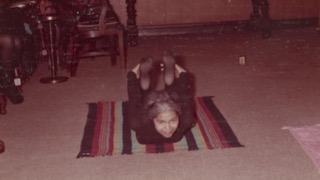
If you look closely, you can see a twinkle in her eye.
The Library of Congress image, taken in Detroit in March 1973, shows the late civil rights leader Rosa Parks engaged in the holistic practice of yogāsana, lying on her stomach and pulling her feet toward her head while looking up toward the camera.
The move, called bow pose or dhanurāsana, is associated with fearlessness and grace, and involves reaching back with your hands to grab your ankles, then extending your chest and thighs upward, opening to the world.
The image serves as evidence that Parks, who was born in 1913 and lived to 92, was a true yogi.
“The fact that she did yogāsana does not at all contradict the other things that I know about her,” said Brenna Greer, associate professor of history at Wellesley College who has studied the life of Parks.
“She was often taking care of herself,” Greer said, which contributed to her strength.
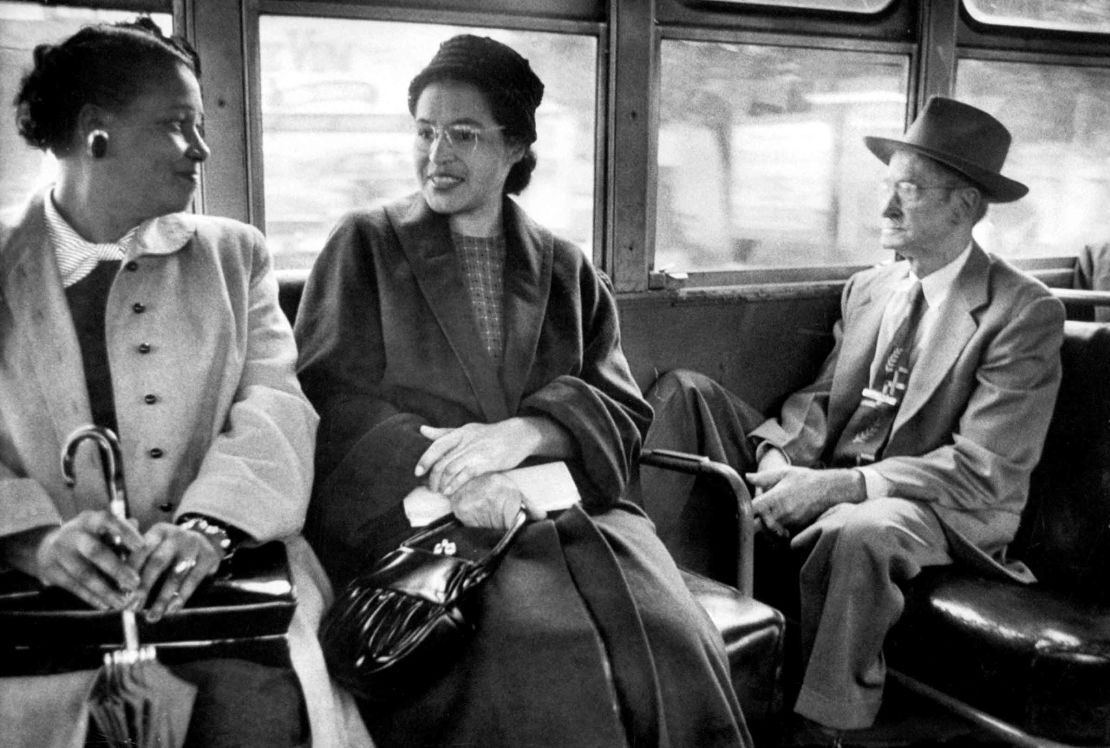
The twinkle in Parks’ eye makes it sobering to remember that almost two decades before the date of that photo, in December 1955, she was arrested at age 42 in Montgomery, Alabama, for refusing to give up her seat on a city bus to a white passenger.
The way Parks took a stand for civil rights reflects many of the principles behind yoga that connect the body and the mind, such as satya, a practice of truthfulness intended to guide people to think, speak and act with integrity, said Stuart Sarbacker, professor of comparative religion and Indian philosophy at Oregon State University, who has studied the history of yoga.
“Yoga can be defined as mind-body discipline, and it’s rooted in the idea that when you discipline your mind and body, they become very powerful, and then that becomes the basis for having a more skillful and more impactful agency in the world,” Sarbacker said.
“Part of my thinking about Rosa Parks is that this was a very impassioned person who wasn’t tired. She was really fed up. That’swhat she was,” he said. “But she was very disciplined in her approach.”
Parks famously has said that she did not refuse to give up her seat on the Montgomery bus because she was physically weak or had tired feet.
“The only tired I was, was tired of giving in,” she once said.
Before her arrest, Parks was active in the Montgomery branch of the NAACP, even becoming its secretary, and in the summer of 1955 she attended a series of workshops on desegregation, including discussions on the use of nonviolent resistance to oppose segregation.
“There’s a real strength behind what she stands for,” Greer said. “More so than most, we have a really limited and, I think, inaccurate image and understanding of this person whose history can be so informative and valuable to us — if we allow ourselves to have it.”
He made a ‘big splash’ with his spiritual vision of yoga as a “universal practice that was India’s gift to the world,” Sarbacker said.
In the early 20th century, yoga grew in popularity specifically among women. British social activist Annie Besant wrote the book “An Introduction to Yoga” as a collection of four lectures she gave on the practice in 1907.
“Between the 1920s and 1950s, the physical aspect of yoga was brought to the fore, being marketed toward women as a way to achieve health and beauty,” Sarbacker said.
It was around this time thatParks was likely introduced to yoga.
Parks was born in Tuskegee, Alabama, and “she talks about how her mother really impressed on them the importance of health and being outside and stretching,” Greer said, adding that the civil rights activist had chronic tonsillitis as a child that often waylaid her.
Parks practiced daily stretching and exercise routines, which her mother taught her, according to historian Stephanie Evans.
“Her first exposure to daily exercise actually came from her mother, who was a teacher in Alabama,” said Evans, a professor of Black women’s studiesat Georgia State University, national director of the Association of Black Women Historians and author of the book “Black Women’s Yoga History: Memoirs of Inner Peace,” in an email.
“When the school near their home closed, Rosa and her brother Sylvester still benefited from the diverse lessons their mother offered, and she was their teacher until Rosa was eleven.”
By the time Parks was an adult, yoga had grown in popularity among movie stars and artists. Around this time, a yoga teacher named Indra Devi helped make the practice popular among celebrities, Sarbacker said.
“In the ’50s, she taught Hollywood celebrities, really bringing yoga into the cultural mainstream of the United States. And I think that too helped really popularize yoga,” he said. “We still see echoes of this in terms of the relationship between yoga and celebrity culture.”
By the late 1950s, several stars in Black Hollywood — including singer and actress Eartha Kitt and singer and actor Herb Jeffries — practiced yoga.
Parks was not only taking yoga by this time, but she was also teaching the practice, Evans said.
Parks moved to Detroit in 1957, and her niece Sheila McCauley Keys and nephew Asheber Macharia have recounted in writings how their aunt accompanied them to yoga classes and cultivated her own private practice.
Then in 1964, Parks became a deaconess in the African Methodist Episcopal Church. It was a time when there was a link between the Civil Rights Movement, Black churches and Mahatma Gandhi’s philosophy of satyagraha or “the seizing on to the truth,” Sarbacker said, referring to the concept of resistance that has ties to the yoga philosophy of satya. Gandhi’s approach directly influenced the Rev. Martin Luther King Jr., one of the most prominent leaders of the Civil Rights Movement.
“The efforts of the Civil Rights Movementdidn’t happen by accident,” Sarbacker said. “It was driven by people who cared deeply about the causes that they were invested in and went to lengths to train their bodies and their minds to be up to the task of effecting change in the world.”
‘Mindful and purposeful’
Yoga remained a prominent part of Parks’ life and activism. She died in 2005 in Detroit.
“Parks was mindful and purposeful in her public presentation of peace work. For example, the legacy of yoga continued in the Rosa and Raymond Parks Institute (for Self-Development), which was established in 1987 in Detroit,” Evans said in her email.
“Their signature programs, developed by Mrs. Parks and her longtime friend Elaine Steele, included civil rights history education, advocacy training, and building life skills,” she said. “Exercise is woven into the fabric of the five-week course for youth, and participants are exposed to yoga, as well as karate and other activities.”
There are also many lessons on self-care, communal care and stress management — especially for the Black community — woven into the history of Parks and her yoga practice, Evans said.
Parks’ example of mind-body health not only supports self-care but alsothe importance of community care.
“The stress of people living in America is at an all-time high,” Evans said.
“Systemic solutions must be put in place in addition to a focus on personal healing. It is not enough for an individual to ‘work hard’ to overcome systems of oppression. Changing the system requires a collective effort to address how those systems were built and kept in place,” she said. “Practices like yoga give individuals and communities the focus and energy to work together and make necessary changes.”
While Greer is inspired by how Parks prioritized self-care and personal healing by practicing yoga, she said she worries about how the message of self-care may take away from the importance of having others contribute to a person’s care and well-being.
“I’m always conscious of how self-care absolves others from caring for us,” Greer said.
“I really appreciate this idea that mental wellness and physical health, for Black women in particular, is radical. For us to take charge of that, it’s radical, because others aren’t. We’re neglected in that way by society at large,” Greer said. “Nobody says to men, ‘Are you practicing self-care?’ So, at the same time that we are committing ourselves to it, and learning and making the time to take care of ourselves, we should not stop expecting it as just a right — and it’s something that we should be able to expect from others.”
Correction: An earlier version of this story had the wrong date for the Rosa Parks’ Library of Congress image. It was taken in March 1973.